

Stratbase Institute | June 9, 2026
The 10th anniversary of the landmark 2016 arbitral ruling, coupled with the entry into force of a new global treaty on marine biodiversity this year, has strengthened calls for states to uphold their responsibility to protect and preserve the marine environment, particularly in the South China Sea.
This according to policymakers, diplomats and maritime and legal experts who spoke at a forum on the implementation of the Biodiversity Beyond National Jurisdiction (BBNJ) Agreement, a landmark international treaty under the U.N. Convention on the Law of the Sea (UNCLOS) to protect, conserve and manage marine life in the international waters.
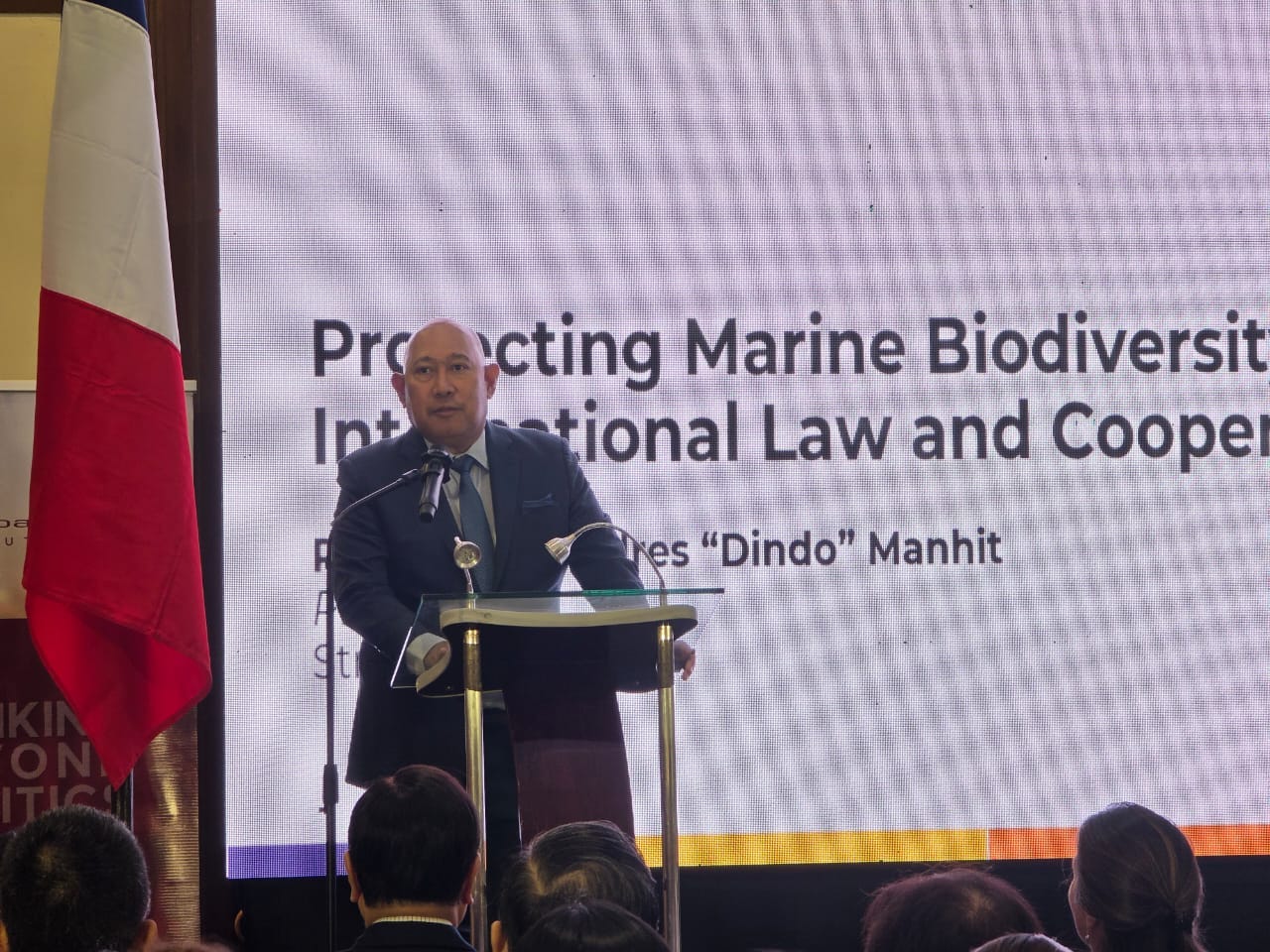
Organized by the Stratbase Institute and the Embassy of France in the Philippines, the forum discussed opportunities for regional cooperation as countries begin implementing the BBNJ Agreement, which entered into force this year.
For Stratbase Institute President Victor Andres “Dindo” Manhit, the enforcement of the BBNJ this year takes on more significance as the country also marked the 10th anniversary of its arbitral victory, which invalidated China’s sweeping claims over the West Philippine Sea.
He added that while the 2016 arbitral award was widely remembered for invalidating China’s expansive nine-dash line claim and affirming the Philippines’ maritime rights in the West Philippine Sea, it also established an important environmental precedent.
It may be recalled that the arbitral tribunal also found that China had violated its obligations under UNCLOS by failing to prevent harmful harvesting of endangered marine species and by causing severe environmental damage through its large-scale island-building activities.
These findings, Manhit said, “made clear that the destruction of coral reefs, the harvesting of endangered marine species, and the degradation of fragile ecosystems are clear violations of international law and are unacceptable under the rules-based international order.”
He added that the entry into force of the BBNJ Agreement this year, meanwhile, built on those principles by strengthening the international legal framework for the conservation and sustainable use of marine biodiversity in areas beyond national jurisdiction.
Ambassador of France to the Philippines Marie Fontanel echoed this sentiment, saying that the BBNJ’s entry into force sends a “broader signal… that when states unite around a shared conviction, international law can still move forward” even when trust in international law “is under constraint.”
“The Philippines understands better than anyone that this governance is an essential matter. France, for its part, is also a labourer, a partner, a co-responsible actor in the world’s second-largest exclusive economy zone, 90% of which lies here in the Indo-Pacific. We are not distant observers of what happens in these waters,” she said.
“We share with the Philippines the conviction that protecting these spaces is both an ecological imperative and a matter of justice for future generations,” she added.
BBNJ connection to the arbitral award
This is especially important for countries around the South China Sea as one-fourth of the waters are considered high seas, noted former senior associate justice Antonio Carpio.
Ironically, China has ratified the BBNJ agreement even as it argued that this ratification was without prejudice to its claims in the South China Sea, Carpio noted.
“For China, the High Seas Treaty does not apply to the High Seas of the South China Sea,” he said. “To prevent acquiescence from setting in, the Philippines must object timely to China’s declaration that China has jurisdiction over the high seas in the SCS...We have to protest one year from September 2025.”
“The Philippines must start it (the protest) because otherwise we will have implicitly acquiesced to it,” he added.
Taken together, Manhit said, the arbitral award and the BBNJ treaty provided a stronger foundation for rules-based ocean governance especially in one of the most biodiverse waters in the world.
But “the challenge before us is implementation. The Arbitral Award must continue to be defended, and the BBNJ Agreement must be translated into concrete action,” he said. “We believe that the Philippines cannot — and should not — stand alone. This is the value of having partners such as France.”
“As an Indo-Pacific resident power, France has been a steadfast partner of the Philippines in advancing a rules-based maritime order, protecting marine biodiversity, and promoting cooperation for the sustainable governance of our oceans,” he said.
The BBNJ enforcement is particularly significant for the Philippines, one of the world’s most biodiverse marine countries and a nation whose economic and food security are closely tied to the health of the oceans.
On September 2025, the Philippines became the 65th nation to ratify the BBNJ, which commits to protecting 30% of the world’s oceans by 2030. However, experts estimate that less than 1% of the high seas currently benefit from any form of protection.