


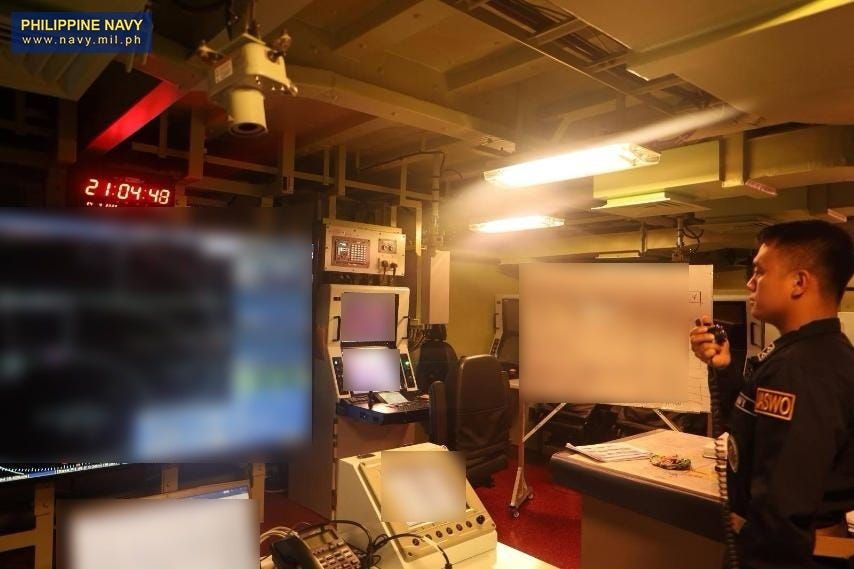
Photo from Philippine Navy.
Manuel Mogato | May 5, 2026
MANILA — The Philippine Navy learned how detect and track a subsurface “hostile” vessel during the 12-day multilateral maritime activity in the West Philippine Sea, enhancing its sea denial capability.
Two guided-missile frigates, BRP Miguel Malvar (FFG6) and BRP Antonio Luna (FFG15) were on patrol in the West Philippine Sea, together with a Japanese destroyer, JS Ikazuchi (DD-107), an Australian frigate, HAS Toowoomba (FFH-156), a Canadian frigate, HMCS Charlottetown (FFH-339), and an American Coast Guard cutter, USCGC Midgett (WMSL-757), discovered an imagery “enemy” submarine lurking on the seabed.
Navy Captain Marie Angelica Sisican, a Philippine Navy spokesperson, said the allied vessels instantly tracked and drove away the submarine after detecting its presence. (Also read: Philippines, allies practice how to repulse amphibious assault landing)
Sisican said the anti-submarine warfare activity was part of the Balikatan’s maritime component as the five allied countries trained on how detect and track “a subsurface contact under realistic conditions,”
“The activity reflects increasingly complex and operationally-relevant training designed to prepare naval forces for evolving maritime challenges while reinforcing cooperation and adherence to international law,” Sisican told journalists.
She said the Philippine Navy underscored its growing readiness to address complex maritime threats through integrated and coordinated operations within the maritime domain. (Also read: Learning to fight future wars in Balikatan drills)
“These developments reinforce the Navy’s commitment to strengthening maritime security, strengthening cooperation with partner nations, and safeguarding the country’s sovereignty and maritime interests while contributing to regional stability.” she added.
The situation in the West Philippine Sea has increasingly become complex as China deployed more armed vessels to assert its sovereignty claim on almost the entire South China Sea. (Also read: Philippines rejects China’s sovereignty claim on West Philippine Sea)
Brunei, Malaysia, the Philippines, Taiwan, and Vietnam also have conflicting claims on the strategic waterway where $3 trillion worth of seaborne goods pass every year.
China held its own naval drills around Bajo de Masinloc to match the allies’ 12-day multinational maritime event in the West Philippine Sea.
There were occasions when China shadowed and observed the five nations’ drills, which included the anti-submarine warfare (ASW) exercises, the centerpiece of the allies’ 11 vessels’ activities.
