


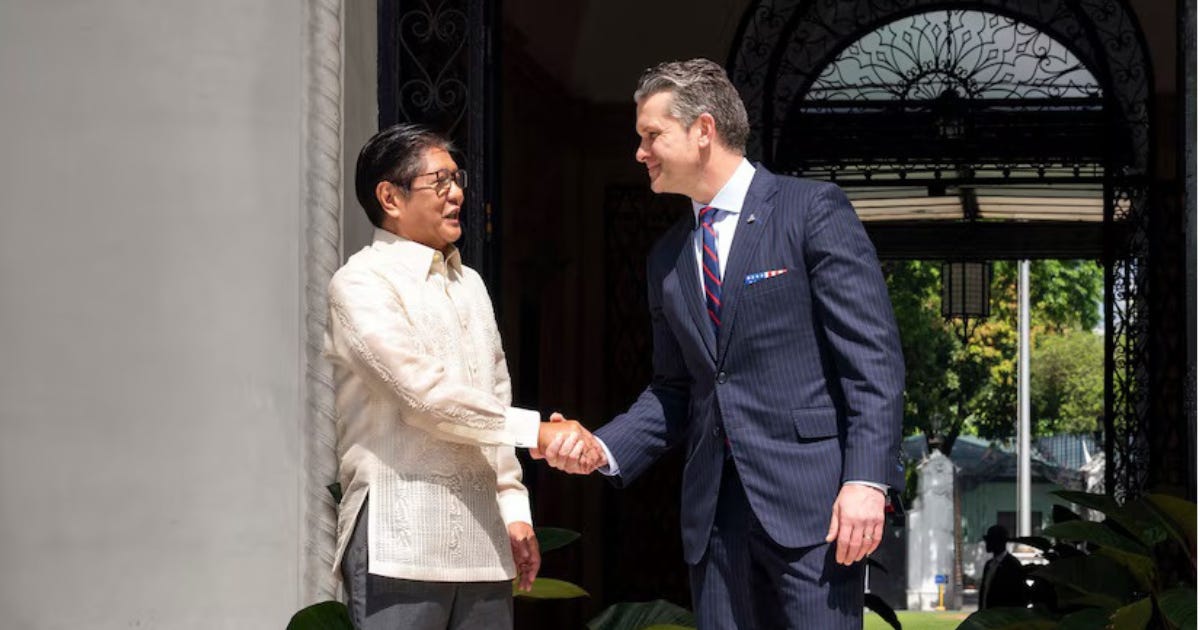
US Secretary of Defense Pete Hegseth met with Philippine President Ferdinand Marcos Jr. and Defense Secretary Gilberto Teodoro Jr. during his two-day visit in Manila to discuss how both nations can “accelerate the progress of US-Philippines. Photo from US Department of Defense.
Manuel Mogato | Published: April 2, 2025
MANILA — Washington’s top weapons salesman made a sales pitch to Manila’s political leaders as it embarked on a major arms build-up to deter Beijing’s growing influence in the region.
US Defense Secretary Pete Hegseth publicly reaffirmed Washington’s “ironclad” commitment under the 1951 Mutual Defense Treaty (MDT) and sided with the Philippines in case of China’s aggression.
Hegseth, who faced trouble at home for using an instant messaging app to coordinate military strikes in the Middle East, also repeated Washington’s usual position that it would make sure the Indo-Pacific region would remain free and open, and that ships and planes are free to navigate the seas and airspaces.
However, the transactional occupant of the White House had a hidden agenda during Hegseth’s first Indo-Pacific trip to Japan and the Philippines.
US President Donald Trump wanted every military dollar and cents it had spent to benefit the American economy.
The United States announced it would keep its $336 million foreign military sales (FMS) funding to the Philippines.
No cash would go to Manila. Instead, the funds would be plowed back into US defense contractors selling equipment and services to its former colony, generating jobs and creating business opportunities for American companies.
Washington was also looking for defense contracts in Manila, fully aware President Marcos had plans for a 1.1 trillion pesos arms build-up for the next 10 years.
For instance, Washington has a standing offer to sell a squadron of F-16 multi-role fighters for $2.4 billion. It also offered additional Black Hawk or Bell helicopters and has sold three C-130 Super Hercules transport planes.
It also offered High-Mobility Artillery Rocket Systems (HIMARS) and a plethora of tactical missiles for the Philippines’ Army, Navy, Air Force, and Marines.
The US would be competing against Israeli, South Koreans, and European defense suppliers, but would be exploiting its close bilateral relations to win contracts.
It could use several US State Department and Pentagon programs, like the Maritime Security Initiative and FMS to subsidize the defense contracts for the Philippines.
The Philippines will be a lucrative market, similar to Taiwan which has been upgrading its surface combatants and aircraft to prepare for China’s rumored invasion plan in 2027.
Hegseth could also push President Marcos to increase its defense spending to about 2 percent of its Gross Domestic Product (GDP) from the current 0.9 to 1.0 percent, allowing more funds to military build-up.
The Philippines is in the market for advanced multi-role fighters, frigates, corvettes, and off-shore patrol vessels, drones, conventional diesel-electric submarines, and missiles.
The US would push its allies and partners to share the burden of making the world secure and safe from countries, like Russia, China, Iran, and North Korea.
For instance, Washington wanted its North Atlantic Treaty Organization (NATO) allies in Europe and North America to depend less on the United States and assume more role in Europe’s defense.
It also wanted more capable Indo-Pacific allies, like Australia, India, Japan, and South Korea, to do the same.
The United States does not want to be the world’s policeman. It cannot put out fires in many parts of the world simultaneously.
Its hands are full in Eastern Europe, the Middle East, and the Indo-Pacific. Its military forces are thinly spread in the world, allowing its adversaries to improve their capabilities to challenge their global domination.
President Donald Trump has been negotiating with Russia to end the three-year conflict in Eastern Europe, which drained US resources.It worked closely with Israel to hit targets in Yemen and make the Red Sea safe for global trade.
Hegseth’s swing to Guam, Hawaii, Japan, and the Philippines demonstrated the Trump administration’s focus on China, which has emerged as its biggest rival and threat.
Washington is becoming more worried with Beijing’s growing global influence in Africa, Middle East, Oceania, South America, and the Indo-Pacific.
The United States wanted to keep its leadership role in the free world, but it needs help to strengthen its own economy.
Thus, Hegseth’s Indo-Pacific swing was like hitting two birds with a stone – reaffirming its security alliance and opening opportunities for business and investments.
There would be no more free lunches. Trump wants allies and partners to spend more for their defense and share the burden of making the world safe.