


Manuel Mogato | March 15, 2026
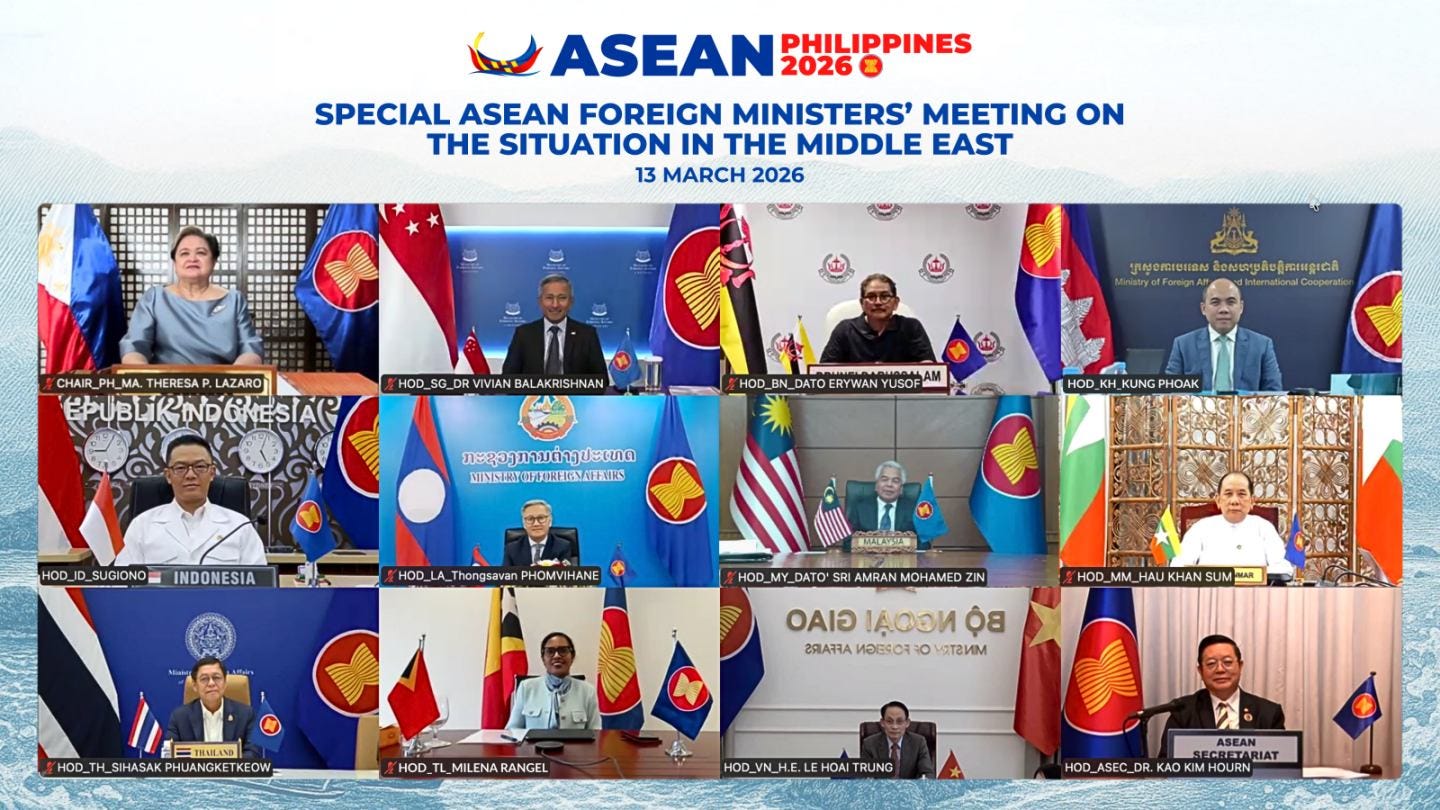
Manila — The Association of Southeast Asian Nations (ASEAN) called for a halt to all hostilities in the Middle East, expressing deep concern about the safety of civilians and critical infrastructure, as well as the global economic impact on oil supply and prices.
“The Ministers issued a unified call for the immediate cessation of hostilities, the exercise of maximum restraint by all parties, the protection of civilians and critical infrastructure, and an urgent return to diplomatic dialogue as the only path to durable peace and stability,” Foreign Affairs Secretary Maria Theresa Lazaro told journalists in a press statement.
Lazaro said she convened a virtual meeting of the 11 Southeast Asian foreign ministers to discuss the worsening situation in the Middle East following attacks launched by the United States and Israel on Iran. (Also read: US insists the destruction of Iran’s nuclear facilities)
The conflict has entered the third week with no end in sight, even after Tehran’s supreme leader, Ayatollah Al khamenei, was killed in an air strike as well as more than 30 other political and military leaders of the Islamic Republic of Iran. (Also read: Removing Ali Khamenei is done, but there is still a lot of work to do for the US and Israel)
“The foreign ministers held in-depth exchanges on the broader consequences of the crisis, with particular attention to its cascading effects on energy supply chains, commodity prices, macroeconomic stability, and the welfare of ASEAN nationals currently in conflict-affected areas,” Lazaro said in a press statement.
Also read: Think of the civilians, end the Middle East conflict
“The Ministers reaffirmed ASEAN’s collective obligation to extend emergency assistance and consular protection to nationals of Member States throughout this crisis,” she added.
There are more than 2 million Filipino workers in the Middle East. There are also Indonesians, Cambodians, Malaysians, Singaporeans, Thais, and Vietnamese in the region.
Apart from Southeast Asian workers and tourists who were caught in the conflict, ASEAN also discussed “short-term mitigation measures, including the sharing of best practices, coordinated policy responses to cushion economic shocks, and concrete steps to safeguard both ASEAN nationals abroad and regional energy supply chains.”
Among the measures agreed was to provide ASEAN states, dependent on oil products, with a supply under the 1996 ASEAN Petroleum Security Agreement.
At least four ASEAN states - Brunei, Indonesia, Malaysia, and Vietnam - produce more petroleum than their demand and consumption.
The Philippines imports about 98 percent of its petrol demand and consumption from the Middle East and less than 10 percent from other sources, including ASEAN states.
The Philippines has a stockpile of up to 60 days. It needed an alternative source of petroleum products, such as the US and Canada.
President Ferdinand Marcos said his government will find a new fuel source and implement measures to mitigate soaring fuel costs, which have a domino effect on consumer goods, transportation, and agriculture.
Marcos has ordered public offices to implement a compressed four-day workweek, distribute fuel subsidies, and seek Congress’s approval for temporary powers to reduce or suspend taxes on fuel products.