

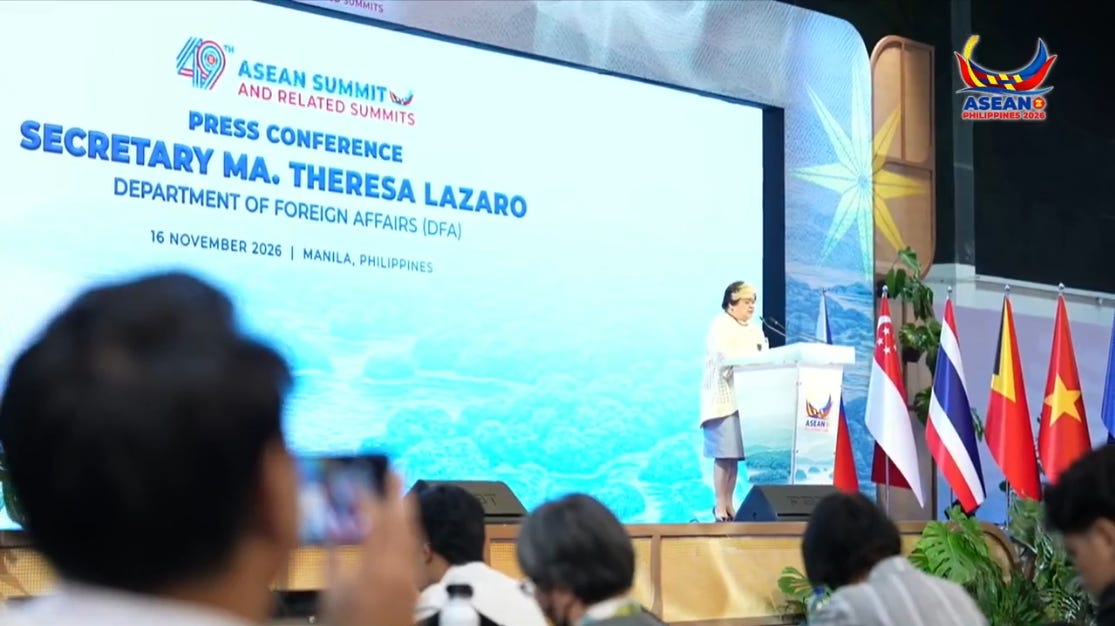
Foreign Affairs Secretary Ma. Theresa Lazaro at a press conference at the International Media Center in Pasay City, November 16. Official Handout.
Manuel Mogato | November 16, 2026
MANILA — ASEAN member-states and China on Monday shared best practices on how to deal with cross-border crimes that have proliferated across the region.
Speaking to journalists at the second day of ASEAN Summit, Foreign Affairs Secretary Lazaro said that each member state had already come up with suggestions on how to deal with the transnational crime issues, such scam hubs and human trafficking that has spread even outside Asia.
“[T]here are certain discussions on [transnational crime], even on a bilateral level, but I think they’re coming up with something on a region-wide level in ASEAN,” Lazaro told a news conference.
“There had already been some proposals and I think it will be taken up by the corresponding negotiators.”
Lazaro did not elaborate.
“There are a number of proposals already because this has been hurting also not only ASEAN member states but even Europe and the rest of the world,” she added.
An earlier ASEAN meeting on transnational crime, held in October, came out with an agreement among ministers to improve communication and collaboration to monitor and deter illegal activities, particularly with “micro” scam hubs.
At that meeting, China’s representative shared that they are equally alarmed with the new trends in transnational activities aimed to avoid detection from law enforcement authorities.
Just days prior, Philippine officials also reported that a drug shipment supposedly en route to Manila had been apprehended at an airport in Laos. (Also Read: Philippines investigates drug syndicate in Mindanao after 500 kilos drug haul in Laos)
Lazaro shared that transnational crime was among the highlighted priority areas in ASEAN’s bilateral meeting with China.
Among the topics discussed was the non-binding comprehensive strategic partnership (CSP), which has recently celebrated its fifth anniversary.
The meeting came out with four outcome documents, mostly focused on the CSP and energy cooperation.
Lazaro also said that Chinese Premier Li Qiang, who represented China at the Summit, had mentioned the South China Sea Code of Conduct (COC) at the meeting.
“One important statement of the Chinese Premier is when he said that he is committed towards an effective, substantive, and early conclusion of the Code of Conduct, which is consistent with the 1982 UNCLOS,” Lazaro said.
The COC, which should have been signed under the Philippine chairship, failed to reach completion.
“If we were given another five to six months, I think I said this yesterday, we could’ve finish it. But to say it will finish in 2027 — Now we give it to Singapore.”
“Despite the monthly negotiations that we shepherded, it was not enough time to really finish the COC. So I am sure that Singapore will be able to do that.”