

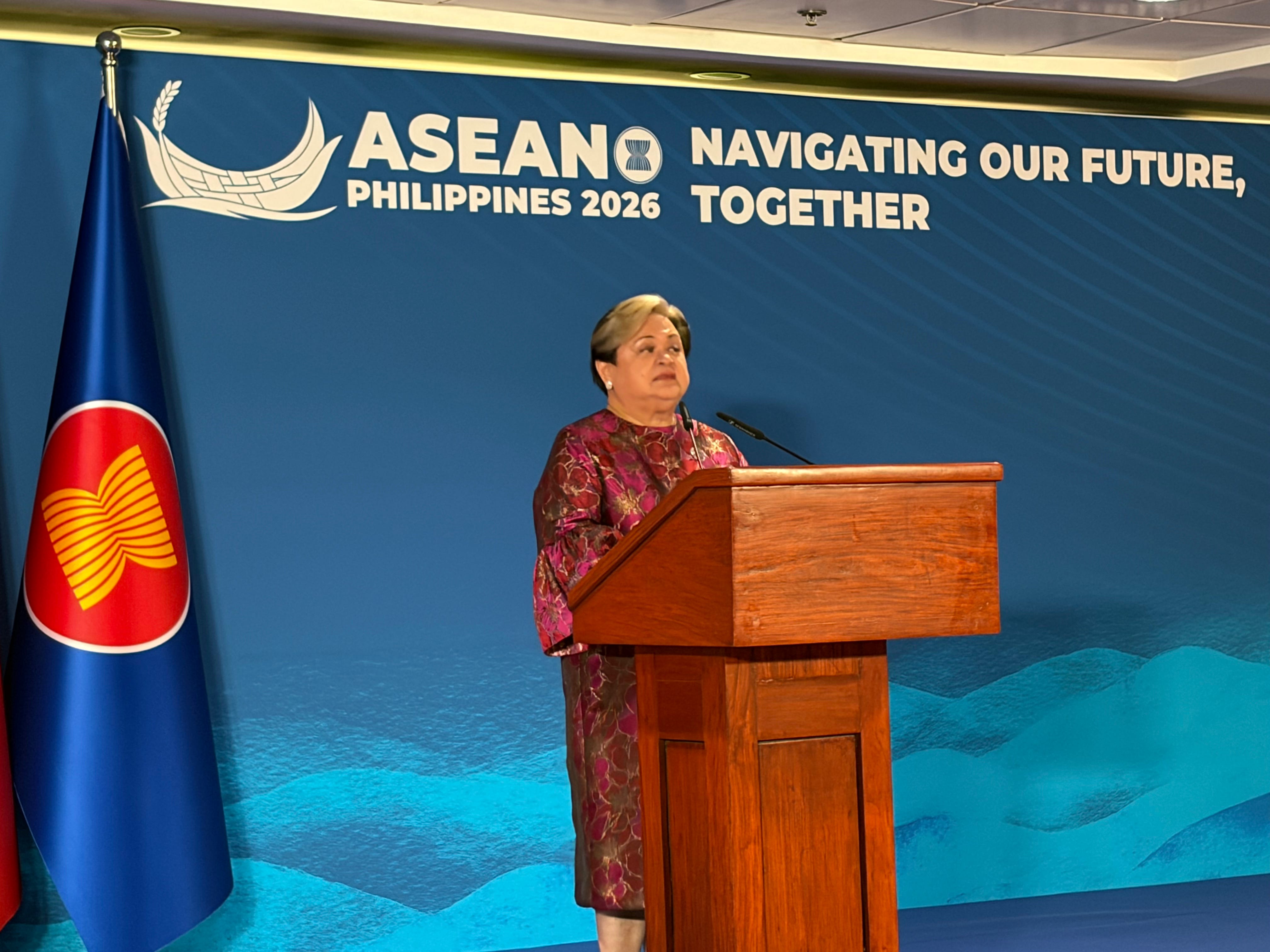
Foreign Affairs Secretary Ma. Theresa Lazaro speaking to reporters at the sidelines of the 59th ASEAN Foreign Minister’s Meeting. Photo by Anna Mogato.
Anna Mogato | July 21, 2026
MANILA – The Association of Southeast Asian Nations (ASEAN) renewed calls on the United States and Iran to “exercise utmost self-restraint and avoid any acts that may further aggravate the situation” in the Middle East.
Philippine Foreign Affairs secretary and ASEAN Chair, Ma. Theresa Lazaro, said that the statement was proposed by the Philippines during the plenary discussion of the 59th ASEAN Foreign Minister’s Meeting (AMM).
“There is, of course, serious concern on the developments of the Middle East. In fact, if you notice, this is just one, this is the only document that involves geopolitics in our discussions,” Lazaro said. (Also read: ASEAN calls for cessation of hostilities in the Middle East)
“But this is of such urgency that we have to release the document as soon as possible.”
In a statement released on Tuesday, July 21, ASEAN ministers expressed concern that the resumed conflict in the Middle East “severely undermine the ongoing efforts of key mediators and diminish the prospects for a peaceful resolution through dialogue and diplomacy.” (Also read: ASEAN: Finding relevance in a burning world)
ASEAN foreign ministers issued a statement as they gathered in Manila this week for annual ministerial meetings. The 10 Southeast Asian foreign ministers will also have an opportunity to discuss mutual bilateral issues, including security and economic matters with top envoys from Australia, China, Japan, Russia, CT South Korea, and the United States
In June, both parties were supposedly close to an agreement following talks in Switzerland, mediated by Pakistan and Qatar.
However, tensions resumed later that month after Iran launched a drone attack on a commercial cargo ship passing by the Strait of Hormuz.
The regional bloc in the statement also “called for the restoration of the safe, unimpeded, and continuous transit passage of vessels and aircraft in the Strait of Hormuz.”
About a fifth of global oil and natural gas shipments, or roughly 20 million barrels, pass through the Strait of Hormuz. (Also read: How long will Iran hold the world hostage in the Strait of Hormuz?)
The ministers expressed deep concern over the impact the conflict has on Southeast Asian nationals who live and work in the region. In the same document, the member states reaffirmed their shared commitment to aid ASEAN nationals.