


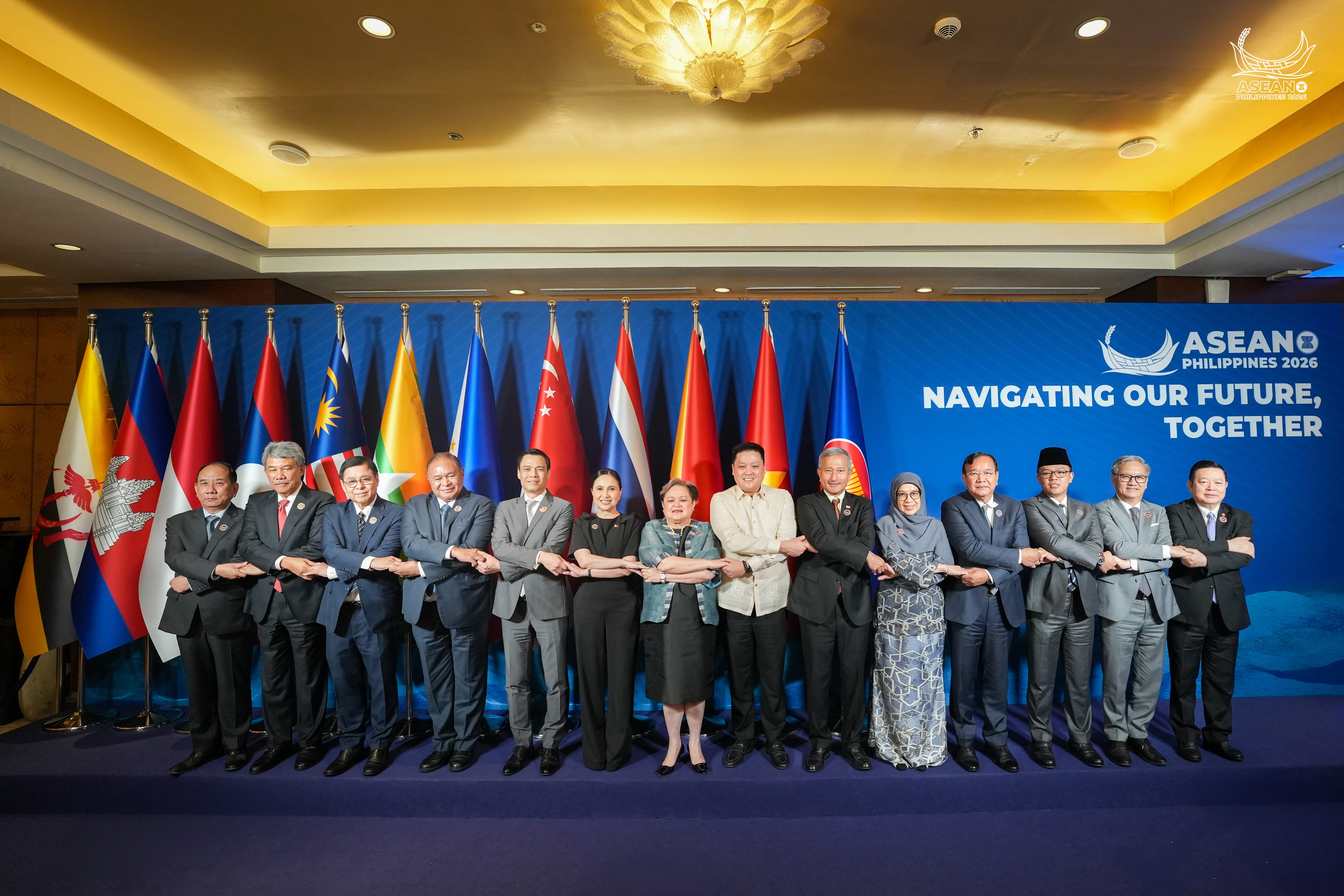
38th ASEAN Coordinating Council (ACC) Meeting. Official handout
Manuel Mogato | May 8, 2026
This week, 10 Southeast Asian leaders gathered in the central Philippines to discuss region-wide measures to mitigate the effects of the global oil shock brought about by more than two months of conflict in the Middle East.
Energy and food security are top priorities on the agenda of the Association of Southeast Asian Nations (ASEAN) Summit in Cebu, relegating other security issues in Eastern Europe and in their own backyard in the Indo-Pacific.
Fuel and fertilizer supply and prices are the most immediate concern.
Myanmar’s political situation, the South China Sea dispute, the Thai-Cambodian border, and the volatile situation in the divided Korea persisted as regional concerns.
The Middle East situation used to be a footnote at every ASEAN Summit, as only Muslim-dominated states expressed concern over the Palestinian issue and violence in other parts of the region, such as Iraq, Afghanistan, Syria, and Libya. (Also read: ASEAN calls for cessation of hostilities in the Middle East)
But the Israeli and American attacks on Tehran at the end of February changed the situation. Iran has held the world hostage by closing the Strait of Hormuz, choking about 20 percent of global oil supply.
As Southeast Asian states worry about a steady supply of oil, an Eastern European country that seeks to improve relations with ASEAN may become a victim of the Middle East conflict. (Also read: Viable alternative to Middle East oil)
Ukraine’s leader, Volodymyr Zelenskyy, had even traveled to Southeast Asia two years ago to drum up support for his country in its fight against the Russian aggression.
Ukraine has expressed interest in becoming an ASEAN dialogue partner, raising its profile in this part of the world and winning more support in the war against Russia. (Also read: The Strategic Intelligence Assessment on Ukraine Putin Underestimated (Part II))
During that time, ASEAN was concerned with the conflict in Ukraine due to its impact on energy and food supply.
Ukraine has destroyed or damaged Russian oil and gas infrastructures in the Black and Baltic Seas, affecting global supply and prices.
Both Ukraine and Russia are the world’s top wheat producers, and a major disruption in the grain production has created food shortages in some African and Middle Eastern countries.
In addition, Russia was also one of the world’s top sources of fertilizer products.
Kyiv was a rising star until the conflict in Tehran, which eclipsed the energy and food problems caused by the conflict in Eastern Europe.
However, the real issue was that Ukraine has nothing to offer ASEAN.
Russia was suddenly ASEAN’s darling because it offered an alternative source of energy resources. Manila was the first to sign supply contracts with Moscow, but other Southeast Asian states, such as Indonesia, Malaysia, Thailand, and Vietnam, have expressed interest in Russian crude supply.
Moreover, Ukraine’s trade and economic figures with ASEAN are not encouraging. The level of ASEAN-Ukraine trade isn’t even close to that of other European states, such as Norway, Switzerland, and Turkey.
Kyiv’s promise to raise trade figures from 1.8 billion in 2024 to $5 billion in 2026 is doubtful given Ukraine’s current economic conditions, with the war continuing.
Thus, Kyiv would not be able to contribute significantly to ASEAN’s growth.
Zelenskyy’s efforts to bring Ukraine closer to ASEAN appeared to be more of a propaganda stunt to strengthen Kyiv’s position in the international community and shame Moscow as well.
Zelenskyy’s real intentions could actually be to enlist ASEAN’s support to gain humanitarian aid and military backing.
In the case of the Philippines, Ukraine offered joint production of drones, which Kyiv has been using effectively in the conflict.
It could transform Manila into a production base for military drones in the Ukrainian conflict. It will take some time for the Philippines and Ukraine to sign a drone production agreement.
ASEAN should not take sides in Ukraine’s war with Russia. It should stick to its time-honored principle of non-interference and neutrality. (Also read: Dangerous recruitment
At the start of the ASEAN Summit in Cebu, the leaders called on the US, Israel, and Iran to end the conflict and exercise self-restraint to stop the death and destruction.
Perhaps ASEAN can do the same in Eastern Europe. The Ukraine and Russia conflict has to end now. Countless lives were lost, and a huge amount of public and private properties were destroyed.
It’s about time ASEAN takes a larger role in finding peace in Iran and Ukraine. ASEAN can find more relevance in helping end conflicts around the world.
