

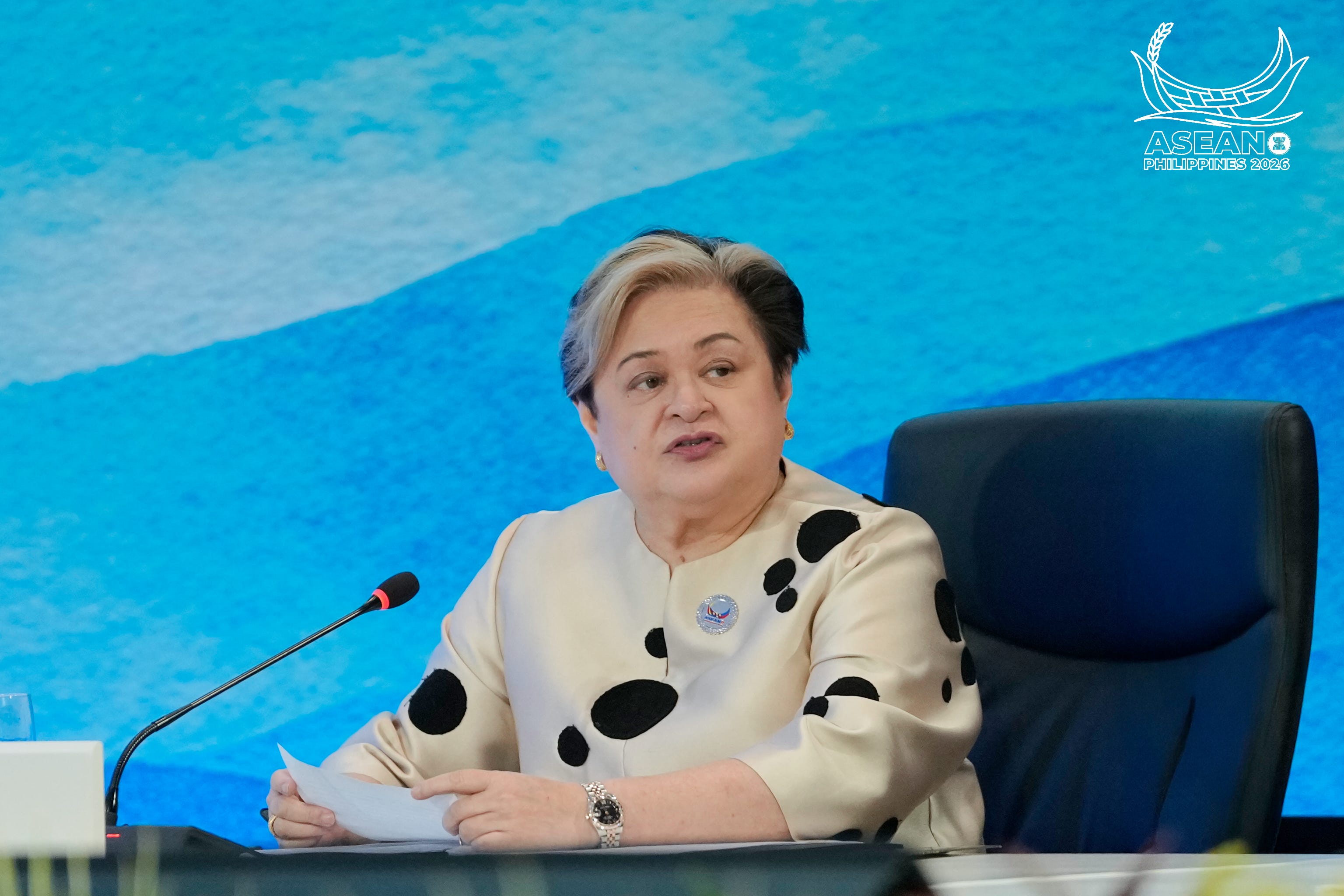
Philippine Foreign Affairs Secretary and current ASEAN Chair Ma. Theresa Lazaro during the ASEAN Plus Three Post-Ministerial Conference on Thursday, July 23. Official handout.
Anna Mogato | July 24, 2026
MANILA — The Association of Southeast Asian Nations (ASEAN) has made significant progress on two regional issues that cast doubt on the bloc’s relevance.
Foreign Affairs Secretary Maria Theresa Lazaro, who also chairs this year’s ministerial meetings, said ASEAN foreign leaders are nearing an agreement on a regional Code of Conduct, and finding a political solution on Myanmar’s problem.
Regarding Myanmar, Lazaro said she plans to visit the country in the fourth quarter to assess the progress of ASEAN’s five-point consensus mechanism to normalize the situation.
It will also be a humanitarian mission as she plans to visit detained leader Daw Aung San Suu Kyi and thousands of displaced people.
As the ASEAN special envoy to Myanmar, Lazaro also called on Myanmar’s generals to end violence and allow humanitarian aid to displaced communities. (Also read: Philippines calls on Myanmar to free political prisoners)
“But I think the impact here is really trying to reach out to the vulnerable communities in Myanmar, and of course, permits will be asked from the Junta government that now talks about their ability to really reach out to us,” Lazaro told journalists at the end of the 59th ministerial meeting in Manila.
Despite concerns that the ministers are being lax on their stance in Myanmar, Lazaro said that ASEAN leaders are still standing by the five-point peace plan.
“It’s still the five-point consensus that is still the foundational document that we are looking at during the discussions with the foreign minister of Myanmar; there have been a lot of questions on their compliance with the five-point consensus,” Lazaro said.
“It may not happen yet, but let’s see what compliance they can give; ASEAN is patient. ASEAN is still looking for whatever they can give.”
Likewise, Lazaro said ASEAN saw some positive movement in their talks with China regarding the Code of Conduct (COC) on the South China Sea.
The Philippines has repeatedly maintained its stance that the COC will be concluded within the year, before the ASEAN chairship is handed over to Singapore.
“If we see [it] from our point of view, it’s the progress being made,” she said. “The terms of reference are very important because, [back then it was] still the definition of, let’s say, self-restraint.”
The COC, which stems from the 2002 Declaration of Conduct of Parties in the South China Sea, has had multiple milestones under discussion.
Now, Lazaro said that there had been a growing consensus among parties, aided by the political will of other ASEAN member states and China, to conclude the talks.
“I think you know very well that we have monthly meetings. These negotiations have not been done this way since the start of January,” Lazaro added.
“There have been monthly meetings of the negotiators, and this is now part of the political will that we intend to finish this code of conduct by the end of the year.”
Lazaro had also met China’s Foreign Minister Wang Yi on the sidelines of the AMM to discuss the continued tensions on Ayungin Shoal and Bajo de Masinloc.
Lazaro clarified that Chinese Foreign Minister Wang Yi’s positions during their bilateral talks are not part of the discussions on the Code of Conduct, which is based on the 1982 landmark agreement, the United Nations Convention on the Law of the Sea (UNCLOS).
Among the outcomes of the 59th ASEAN Foreign Ministers Meeting are the joint communiqué, which detailed the ministers’ response to regional and global issues, the joint statement on the Middle East and the guidelines on engagement between ASEAN and high contracting parties relating to the Treaty of Amity and Cooperation (TAC).
On Friday, the ministers will hold a high-level conference with high contracting parties to the TAC, with four new acceding countries signing the peace pact: Poland, Romania, Sweden and Lithuania.