

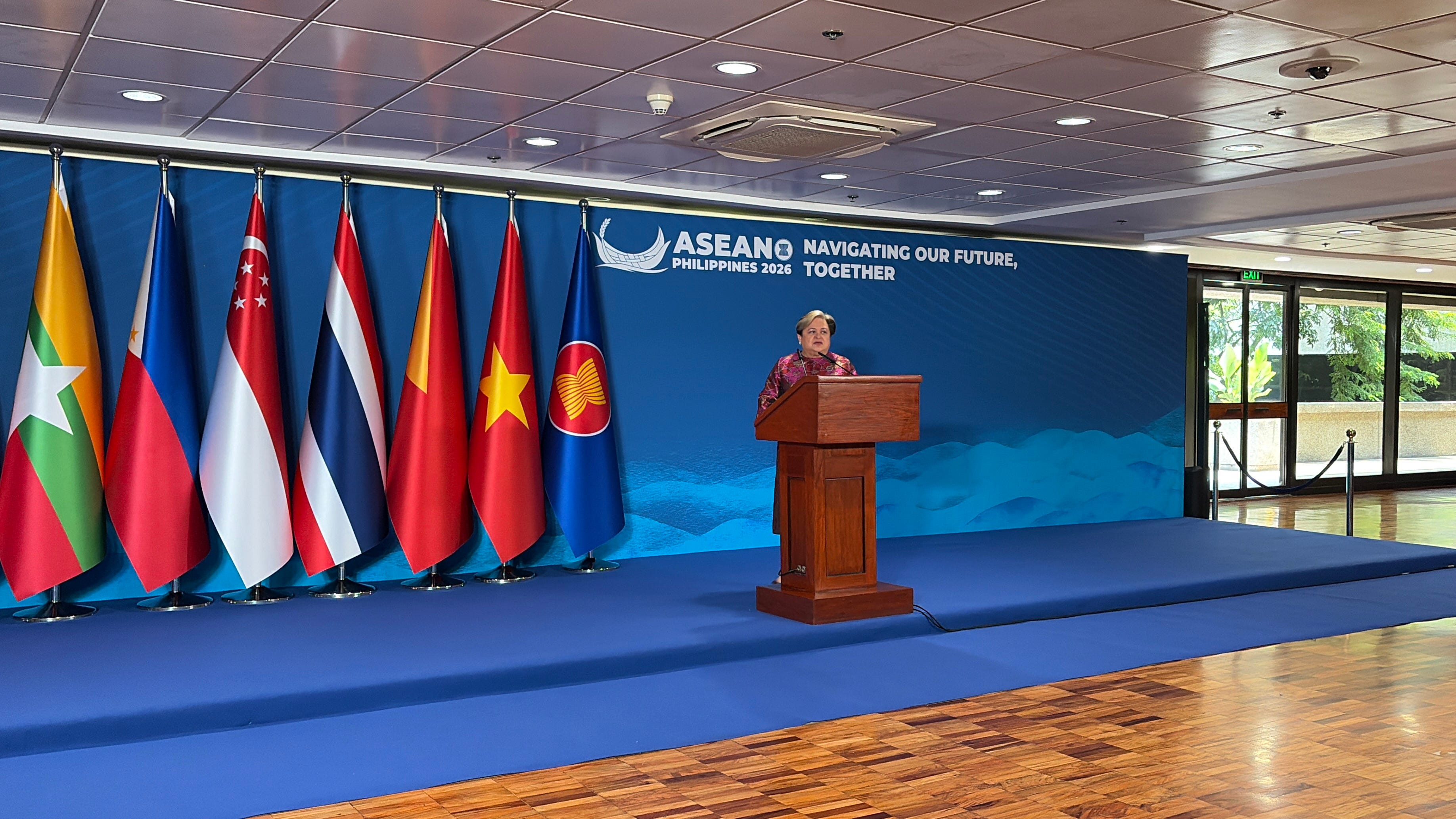
Foreign Affairs Secretary Ma. Theresa Lazaro during the brief press huddle on July 21. Photo by Anna Mogato.
Anna Mogato | July 21, 2026
MANILA – The Association of Southeast Asian Nations (ASEAN) is dead set on resolving the political crisis in Myanmar, setting a November deadline to resolve the question when Manila hosts an end-of-the-year ASEAN leaders summit.
Foreign Affairs Secretary Maria Theresa Lazaro briefed the Southeast Asian ministers on Tuesday on the outcomes of last week’s informal meeting with Myanmar’s representatives and stakeholders in Thailand.
She is also this year’s ASEAN chair and special envoy to Myanmar.
“The foreign ministers agree that for these proposals to come to fruition, we should require the continuous deliberation of our senior officials as to how this may be interpreted in the outcome documents,” Lazaro told reporters at the sidelines of the 59th ASEAN Foreign Ministers Meeting.
Myanmar plunged into a deep political crisis after the generals seized state control and threw the civilian leaders, led by Daw Aung San Suu Kyi, in jail and attacked various ethnic rebel forces. (Also read: Philippines calls on Myanmar to free political prisoners)
ASEAN proposed a five-point consensus mechanism to normalize the situation, hold elections, free political prisoners, and allow humanitarian assistance to displaced people. The generals have yet to comply with all the mechanisms.
Early this month, Thailand hosted an unprecedented meeting between ASEAN foreign ministers and their Myanmar counterparts, and later Lazaro met with representatives of ethnic armed organizations from Myanmar in an effort to resolve the crisis.
Lazaro said through her meetings with her counterparts, she is also optimistic about ASEAN’s commitment to assist Myanmar in achieving a lasting solution.
A non-paper document, or unsigned diplomatic document, was presented during the extended informal discussion on Myanmar earlier that day.
It will also be given to senior officials to clarify some points in assessing “demonstrable developments” happening in Myanmar, she told journalists.
“There were two documents that the foreign ministers have tasked the senior officials with. One is some kind of a benchmark — How do you assess the development [in Myanmar]? And therefore, that’s one. And second is the long-term permanent possibility of a special envoy,” Lazaro said.
“It has been agreed upon that having an annual special envoy, like in my case, is something that is not really that effective because, you know, you have to have the whole picture and it should be, it cannot be on an annual basis.”
Instead, Lazaro said ASEAN is also considering other proposals, such as Brunei’s suggestion to appoint a special envoy assisted by the ASEAN Secretariat.
Unlike the ASEAN Chairmanship, which changes hands every year, the Secretary-General who heads the Secretariat holds the position for five years.
“There’s also the issue of funding — who’s going to fund the travels of the special envoy. But again, we have tasked the senior officials to really give meat and discuss this carefully because this is an input to the leader’s meeting in November,” Lazaro added.