

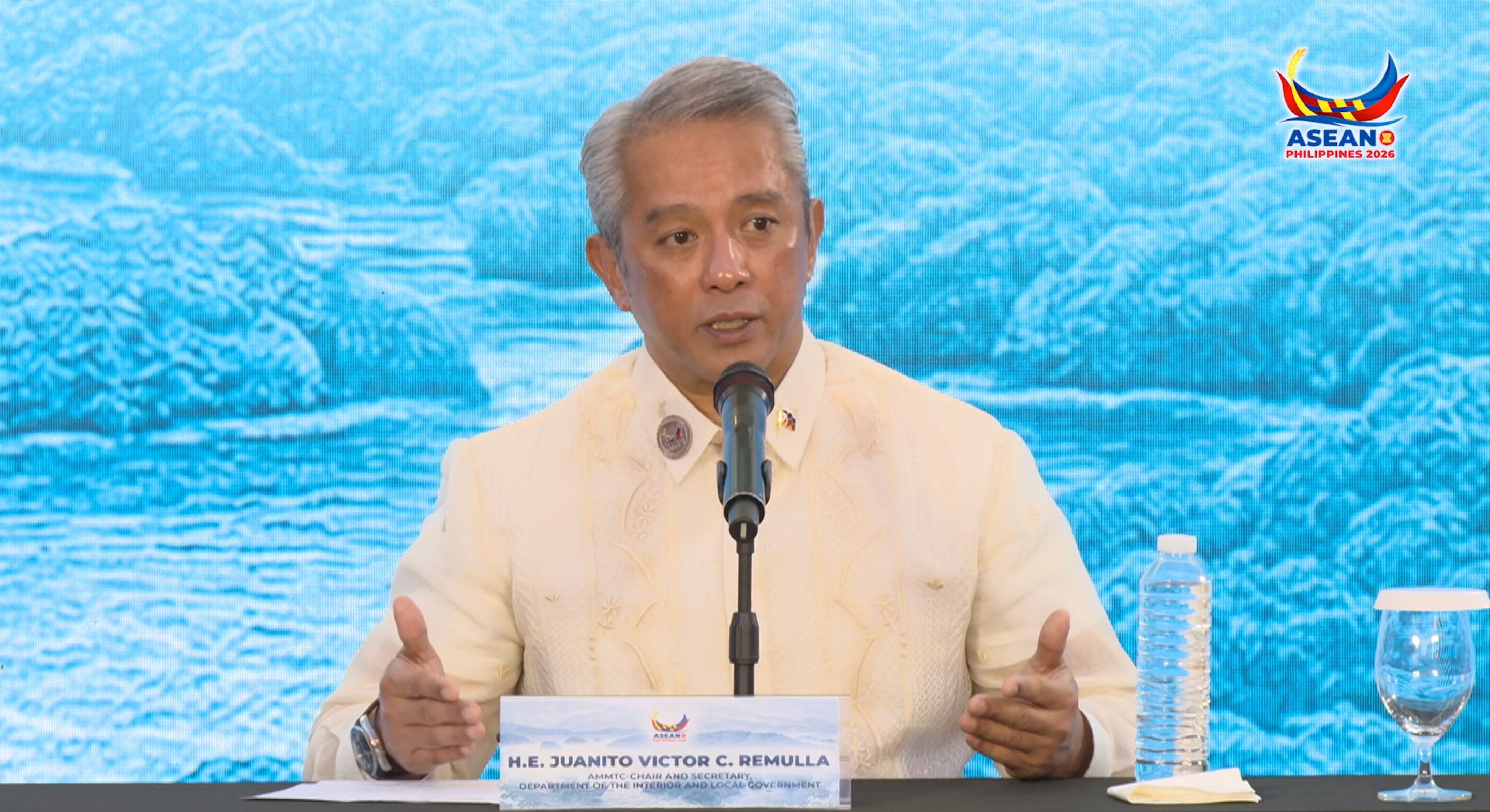
Philippine Interior and Local Government Secretary Juanito Victor Remulla, chair of the 20th ASEAN Ministerial Meeting on Transnational Crime, at a press briefing on Wednesday, October 21.
Anna Mogato | October 21, 2026
MANILA — Southeast Asian nations vowed to crack down on transnational crimes proliferating in the region, especially with the increasing trend of “micro” scam hubs, strengthening law enforcement and inter-state collaboration.
Philippine Interior and Local Government Secretary Juanito Victor Remulla, chair of the 20th ASEAN Ministerial Meeting on Transnational Crime, said Southeast Asian states are considering a regional extradition treaty to facilitate the transfer of criminals operating across borders.
“We share information, but as far as law enforcement is concerned, that is a local matter,” Remulla said.
“So what is important is that we share information, and I give credit to all ASEAN nations for being active in that area.”
A report from the United Nations Office on Drugs and Crime said cyber scam operations in parts of Southeast Asia lead to potential economic losses of $114 billion every year. (Also read: Philippines investigates drug syndicate in Mindanao after 500 kilos drug haul in Laos)
The Philippine law enforcement authorities are currently tracking three active “micro” scam hubs operated by foreign and local nationals within the country, but no information was given on the number of similar types of operations happening in other ASEAN states.
“The new trend is that micro hubs have 10 to 15 to 20 [people] who stay in one house, Remulla said. “It’s not like before. Before, what we had was like 5,000 people in one building. Now they rent small houses.”
In October alone, law enforcement authorities raided three operations in Makati City, Quezon City, and in Zamboanga Sibugay. The Zamboanga raid was dubbed the largest bust with the arrest of 244 foreign nationals.
“[Tracking these scam hubs] is not as difficult as it seems, but it is also more complicated in their location,” Remulla said.
“We use tracking methods such as monitoring their electricity, consumption of broadband, movement of suspicious persons.”
In 2023, the Philippine government led a massive crackdown on Philippine Offshore Gaming Operators (POGO), mostly catering to Chinese nationals after it was revealed that these businesses also committed human trafficking and other illegal activities.
The following year, the government banned all operations under the Anti-POGO Act of 2025. (Also read: Unmasking Rodrigo Duterte and his Communist Chinese Connection)
“China did not particularly address [the scam hub] issue,” Remulla said, noting that China, along with South Korea and Japan took part in the ASEAN Plus Three ministerial meetings on Transnational Crime on Wednesday.
“They did mention though [that] transnational crime is a pressing issue [for them]. It is not a local problem, it is an international problem.”