

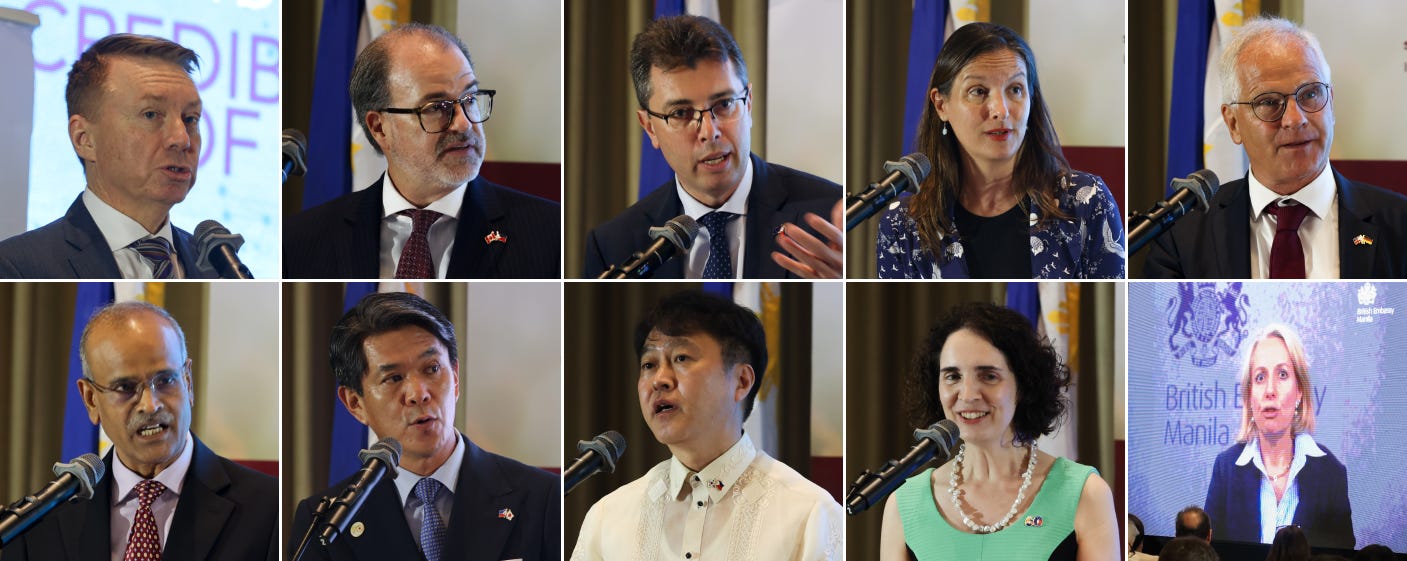
Official handout
Krixia Subingsubing, Stratbase Institute | July 12, 2026
MANILA — At least 10 ambassadors from like-minded countries reaffirmed support for the Philippines as it marks the 10th anniversary of the landmark legal victory, awarded by the Permanent Court of Arbitration in The Hague, on the West Philippine Sea.
At the same time, these states promised to deepen cooperation with the Philippines through a wave of defense and technical initiatives that could shore up the country’s credible defense posture in the contested territories.
Victor Andres “Dindo” Manhit, head of the Stratbase Institute, said support from like-minded nations has reinforced earlier findings of a commissioned survey showing 86 percent of Filipinos wanted the government to continue defending the West Philippine Sea with like-minded nations.
“Every port call, every joint patrol, every diplomatic statement citing the award carries the same message,” Manhit told a forum on the arbitral award’s 10th anniversary.
“The defense of the West Philippine Sea is no longer the Philippines’ burden to carry by itself. It is part of the broader defense of a rules-based order that every state in this intercontinental network depends on.”
Manhit continued: “As China’s gray zone activity persists, and as the contest extends into cyber and information domains, defending the gains of the award requires a modern, integrated, multi-domain defense posture. One built to deter coercion, protect our interests, and respond across every domain where we are being tested.”
At the forum, the ambassadors reaffirmed their commitment to the Philippines and called for continued dialogue and practical cooperation to maintain peace and stability in the Indo-Pacific region.
Representatives from Australia, Canada, the European Union, France, Germany, India, Japan, South Korea, New Zealand, and the United Kingdom also stressed their support for the U.N. Convention on the Law of the Sea (UNCLOS), which underpins the arbitral ruling, and expressed their commitment to stronger ties with the country to ensure that the region remains governed by law and not by coercion.
“Legal principles alone are not enough,” French ambassador Marie Fontanel said. “Whenever rules are challenged, like when nations speak up, words must be backed by practical cooperation.
She also said: “Defending international law requires power. Power requires ships, aircraft, joint drills, and agreements. It requires that like-minded partners can operate together quickly, credibly, and lawfully.
For his part, Australian Ambassador Marc Innes-Brown said Canberra was looking forward to signing a new defense cooperation arrangement with Manila in 2026, building on the country’s $160 million, 10-year investment in maritime cooperation with Southeast Asian partners including the Philippines.
He said Australia has doubled its bilateral maritime assistance to the Philippines through a new $18 million investment to “[help] strengthen maritime domain awareness, supporting legal and policy development, enhancing operational capabilities, building cyber resilience and delivering professional education and law of the sea training to nearly 800 officials and practitioners in recent years.”
British Ambassador Sara Hulton said it has started formal negotiations for its own SOVFA: “We’re pursuing joint military exercises and capitalizing on opportunities to observe others,” she said.
“We were particularly pleased to be a part of Exercise Balikatan ‘26 as an observer nation, with aspirations to be a participating nation in the future, and are planning to participate in Exercise Sama-Sama ‘26 later this year, deepening our interoperability with the Philippines and our allies.”
Similarly, Canadian Ambassador David Hartman highlighted the recently signed Visiting Forces Agreement and said Ottawa looked forward to co-chairing several practical initiatives with ASEAN partners, including workshops on UNCLOS, climate security, cybersecurity, and defense cooperation.
Indian Ambassador Sri Harsh Kumar Jain said the Philippines has joined the Indian Navy’s Information Fusion Center, while New Zealand Ambassador Catherine McIntosh said it was using its Starboard Maritime Intelligence Program to help regional partners reduce the risk of miscalculation through better data.
Jain said that the first India-Philippines disaster management exercise will be held in Manila next month with the aim of “strengthening both countries’ collective preparedness and enhancing our joint capabilities in disaster response, crisis management and resilience.”
Beyond diplomacy, partners are providing the physical tools necessary for the Philippines to monitor its exclusive economic zone (EEZ).
Japanese envoy Endo Kazuya said both countries were now advancing discussions for the transfer of five second-hand Abukuma-class vessels and an additional five TC-90 training aircraft as a “demonstration of our concrete resolve to build a future-oriented security partnership.”
South Korean Ambassador Lee Sang-hwa said the two countries have shifted their focus toward shipbuilding, commissioning Korean-built offshore patrol vessels and supporting local vessel construction at the HD Hyundai Subic Shipyard to foster Philippine self-reliance.
Technological initiatives were also a central theme for enhancing maritime domain awareness. EU Ambassador Massimo Santoro highlighted its IORIS platform, a real-time information-sharing tool for maritime authorities, and hinted at “additional instruments will allow us to translate our shared objectives into even more tangible support on the ground and at the sea…stay tuned because I think we’ll have good news soon.”
The ambassadors were also unified in their concern regarding “dangerous and destabilizing conduct” by China, citing its recent water cannon incidents and the launch of nuclear-capable missiles in the region.
Germany’s Ambassador Dr. Andreas Michael Pfaffernoschke summarized the collective sentiment, stating that stability in the West Philippine Sea is a “litmus test for the global rule of law.”
“We are convinced that the strength of the law must always prevail over the law of the strong. Right makes might, not might makes right. The 2016 Arbitral Award is final, and it is legally binding on all parties to the dispute. It is not a disputable opinion, it is an authoritative clarification of maritime entitlements,” he said.