

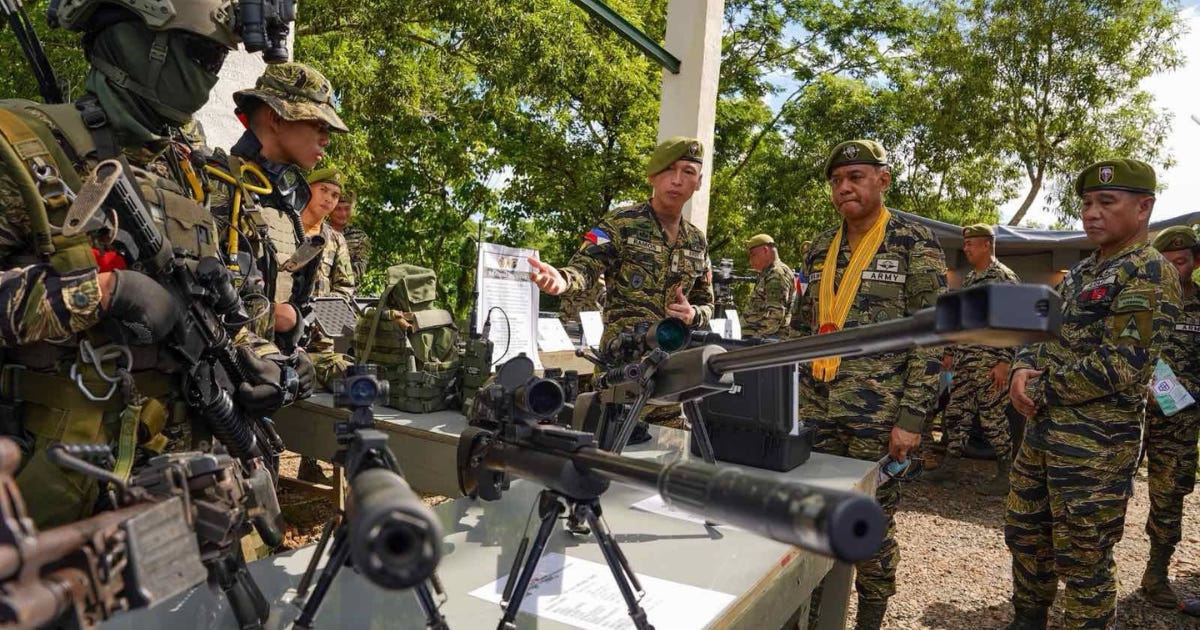
Rifles in display during the 63rd founding anniversary of the Special Forces Regiment (Airborne), Philippine Army on June 28, 2025 at Camp Aguinaldo, Quezon City. Photo from AFP Facebook page.
By: Manuel Mogato| Published: June 29, 2025
Reading Time: 5 minutes
As the Philippines begins acquiring new and modern weapons systems – aircraft, vessels, missiles, and command-and-control equipment – it requires a robust defense industry to support the military modernization.
Defense Secretary Gilberto Teodoro has restarted the military’s Self-Reliant Defense Posture (SRDP) to create a local supply chain to support the military’s weapons system requirements.
This is not new. Former President Ferdinand Marcos Sr initiated the SRDP program during his term to produce local military mobility assets, rockets, and munitions.
But it had limited success as he was weighed down by efforts to suppress twin rebellions from the Maoist-led rebels and Bangsamoro separatists in Mindanao.
Subscribe to the API Newsletter
Bite-sized updates sent straight to your inbox.
Success!
First Name
Last Name
By signing up, you agree to our User Agreement and Privacy Policy & Cookie Statement. This site is protected by reCAPTCHA and the Google Privacy Policy and Terms of Service apply.
During the time of former President Corazon Aquino, the SRDP was revived after her administration acquired a lead-in fighter trainer (LIFT) and a British-made armored vehicle, Simba.
There was supposed to be an in-country production, but the experiment failed because of a lack of funds. The Armed Forces could not sustain the production of the armored vehicles.
Why can the SRDP succeed now?
Some US-based companies have expressed interest in relocating some of their production facilities to the Philippines, jump-starting the SRDP.
Local companies could benefit from US companies relocating to the Philippines through subcontracting, and will eventually develop their production line and ensure a supply chain.
For instance, a US Navy contractor has expressed interest in a ship repair facility at the former US naval base in Subic, where an American company took full control of the bankrupt Hanjin shipyard.
Across the former Hanjin Shipyard, a local company has been producing small patrol boats – the Multi-Purpose Assault Craft.
Some of the MPAC had been fitted with a short-range Israeli Spike ER missiles. The Philippine Navy has ordered about 42 MPAC but 12 had been delivered as of 2019.
The US Army has also expressed interest in leasing a portion of the sprawling naval base to put up a logistics hub.
There were reports the US Congress is looking at the former US naval base as an ideal site to put up a munitions factory, bringng closer logistics to its forward-deployed forces in the Indo-Pacific region.
The Government Arsenal, which supplies the small arms munitions requirement of the Armed Forces, could also benefit from the relocation of the US munitions plant through the transfer of technology and equipment support.
Lockheed Martin has expressed interest in a long-term relationship with the Philippines, despite no guarantee that the defense department will acquire its high-end F-16 multi-role fighters.
It has started discussing with several local universities to offer technical and advanced studies in maintaining civilian and military aircraft.
It envisions creating a pool of aircraft maintenance talent in the country that could be sent to other Lockheed Martin facilities in the US and elsewhere in the world.
Lockheed Martin has faith in Filipino talent and skills in aircraft maintenance, as hundreds of local aircraft mechanics, technicians, and engineers were employed when the US 13th Air Force was still home-based at Clark Air Field.
Lockheed Martin’s initiative can serve as a model for the partnership among the government, industries, and universities to sustain a pool of skilled workers for high-tech industries.
Eventually, the SRDP can benefit from this skills training and help prepare the technology-driven air and naval forces.
The Philippines must take advantage of its alliance with the United States to gain technology, knowledge, skills, and training to modernize the armed forces.
It could also use close defense cooperations deal with other allied countries, like Australia, Canada, France, India, Japan, New Zealand, and South Korea to train local servicemen.
For instance, Indonesia took a generation to learn how to operate a conventional submarine.
The Philippines has been sending a few personnel to train how to operate and maintain a submarine in Canada, France, India, and South Korea. France and South Korea have been offering to sell conventional submarines.
The Philippines can take advantage of its alliance with Australia, Japan, and the United States under the status of forces agreement to train in operating and maintaining high-tech equipment.
The skills and training could eventually benefit the SRDP program, the Philippines’ poor copy of the United States’ well-funded military-industrial complex.
The post Building a local defense industry appeared first on asiapacificinsights.com.