


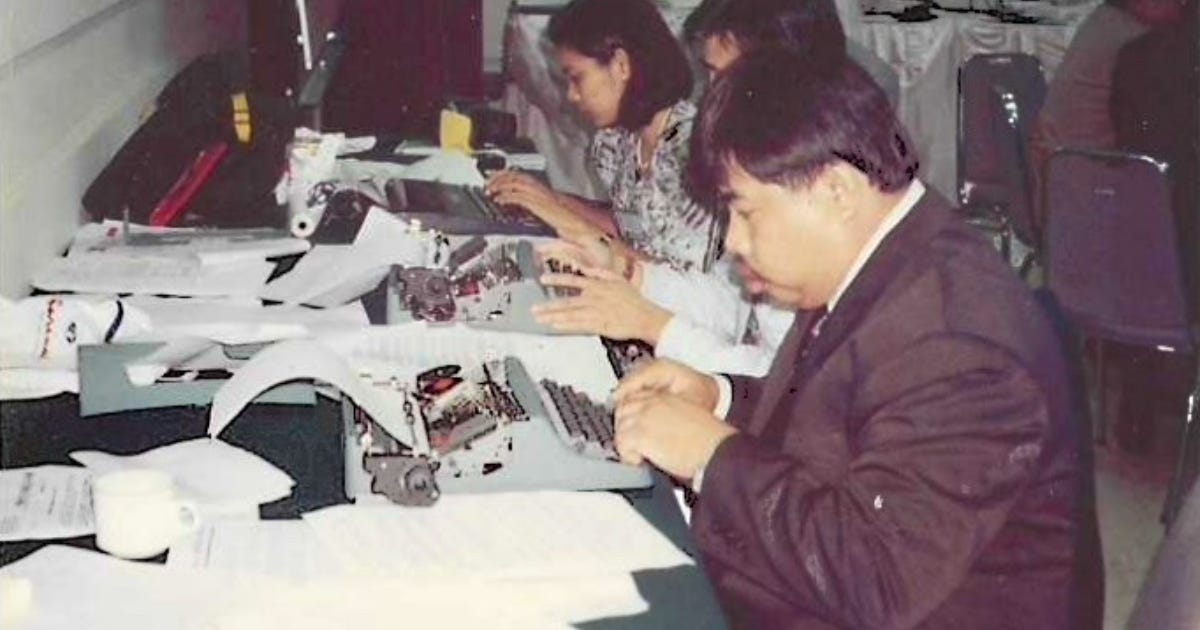
EDITOR’S NOTE: This is a sneak peek of Manuel Mogato’s memoir “It’s Me, Bok!” A second edition will be available later this year. Get your copy here
Why did I choose to be a journalist?
At an online lecture for a private high school in Jakarta, where I spoke during the pandemic, a student asked that question.
“Why not?” I asked back. “It’s the best job in the world.”
And why so? Journalism gives you a front-row seat to history as it unfolds. You travel to places on assignment. You meet all kinds of people – the wealthiest, the poorest, the most powerful, the most powerless.
Four full decades of my life as a journalist has introduced me to all sorts of news sources. The honest and the diligent ones dazzled. The crooked and devious others disappointed.
The latter include some politicians, military and police officers, and diplomats who twist and and tweak stories to keep or promote career or ambition or wealth. Some reporters danced to their beat and condoned their wrongdoings, and the credulous ones unwittingly spread their yarn.
In truth, in my early years in journalism, I may have condoned or even participated in some wrongful acts of some sources. In the 1980s under the first Marcos government, I saw nothing wrong about accepting money from the police or public relations officers. In part, that was because everyone did, too.
My first brush with payola for the media came when, as an on-the-job training intern at IBC13, a broadcast network owned and controlled by a Marcos crony, a cameraman told me to approach the PR guy and ask for the envelope. I thought at first that I was only getting a press release but there was also money inside.
“Eto pala kalakaran dito (This must be how things are done here),” I told myself one night when I joined a TV crew at a Rotary Club event in Makati.
Later as a reporter for a newspaper, I caught one of my editors opening an envelope filled with cash. He shoved the envelope inside his desk in a jiffy when I came approaching.
I’ve covered the police and other beats where some other reporters openly discussed the weekly or monthly payout from news sources.
At the Bureau of Customs, once dispatched as a reliever for a colleague, I witnessed how a top official distributed cash to reporters while he moved around a table as he talked on his wireless phone. The official was supposed to hold his weekly press conference but it turned out to be the day for dispensing payola to reporters.
Six years later, in the throes of the first People Power revolt at EDSA, I joined the Manila Chronicle and you might say, had a career reboot, too. I started to avoid sources who tempt reporters with envelopes, and turned to the company of reporters who scorned such temptation.
They soon became among my best buddies. They all said no to accepting envelopes.
If there were reporters allergic to money in envelopes, there were also police officers allergic to dishing them out. They were not schooled in the elite Philippine Military Academy (PMA) but demonstrated more than elite behavior as good and hardworking men in uniform.
Two stand out in memory. Manila Police Patrolman Raffy Sosa had diligently investigated homicide cases by himself, trusting his life to me in one case in Gagalangin, Tondo. Sergeant Eliseo Canares of the Manila Police was quite a father figure to young reporters.
For a time, the payola system seems to have crept into Malacañang or the Office of the President as well. I was assigned there during the term of President Fidel V. Ramos. That was when I learned that some reporters were on the take and given allowances when they joined presidential visits abroad.
By the example of other good colleagues, I learned to say no to bribes. And that, even when the envelopes seemed to be bursting at the seams with dough.
It happened in 2012 when Reuters was investigating a land deal of Japanese gaming tycoon Kazuo Okada. A lawyer offered cash in a thick envelope after our interview at a coffee shop in a shopping mall in Quezon City. I told the lawyer that my editors would fire me if I accepted the money.
It happened again in 2016 in a hotel in Manila, when a staff of then presidential candidate Rodrigo R. Duterte tried to push an envelope to a Reuters team, after an interview.
A fallacious thought infects the minds of some news sources. They think that everyone in the media has a price. They should know better: Not all journalists can be bought, coopted, and coerced.
A fallacious thought infects the minds of some reporters, too. They think that all news sources could be extorted, harassed, and cowered in fear before bad press.
Indeed, there are reporters who celebrate good public service, as there are good sources who value the work and ethics of good journalism.
In the military, I came to know some who dealt with reporters as true officers and gentlemen: Generals Ramon Montaño, Alfredo Filler, Oscar Florendo, Mariano Adalem, Romeo Padiernos, Victor Obillo, Rolando Tenefrancia, Giovanni Carlo Bacordo, Rex Robles, and Colonel Ramon Martinez.
They speak their minds and talk facts, not propaganda. They lend succor to reporters being harassed for exposing the powerful.
In mid-2001, on a tip from an intelligence officer, we learned about the wiretapping operations directed by former President Joseph Estrada against his critics, using equipment purchased from Israel.
One of our The Manila Times reporters, Alcuin Papa, worked on a series of reports. The police, then headed by director-general Panfilo Lacson, promptly denied it in an interview with my editor Malou Mangahas at the Manila Mandarin Hotel in Makati.
The reports earned the police and Estrada bad press. It earned me a police tail. Intelligence agents were sent to monitor my travels from office to home and back. But the late Commodore Rex Robles assured my safety; he had spoken with people in the police to stop harassing me.
Our reliable “secret” source in the police intelligence gave me dozens of scoops. He also opened doors to our interviews with police officers directly involved in Duterte’s war on drugs, which helped inform our reports that won the Pulitzer Prize in International Reporting in 2018.
I have also seen men in power at their lowest moments.
Days before election day in 1992, presidential candidate Fidel V. Ramos sat with reporters at his ancestral residence in Asingan, Pangasinan. I felt at the time that he felt unsure about victory, or maybe he was just tired. The morning after, he was in a jovial mood at his Miting de Avance in Luneta.
Renato de Villa was Armed Forces chief of staff in January 1989 when former patrolman Rizal Alih and his men staged a three-day siege of Camp Cawa-Cawa in Zamboanga City.
Detained for his role in the murder of Zamboanga City Mayor Cesar Climaco in 1984, Alih was facing impending transfer to a Manila jail. He protested, overpowered the prison guards, and took hostage a general, a colonel and 18 other police personnel.
To retake Cawa-Cawa, de Villa ordered an assault: The Air Force dropped bombs that burned down the camp, but also killed all the hostages. Alih escaped, made his way to Basilan and then to Sabah, Malaysia via a boat he rented for 20,000 pesos.
In Sabah, Alih assumed a new identity but was arrested and sentenced to 12 years in jail for the murder of a Malaysian marine during a raid on a known criminal den there. He was deported to Manila in 2006, detained at Camp Crame, and died there in August 2015.
Before the assault, on his way to Zamboanga City, de Villa pondered about the uncertainty of the situation, his voice shaking because of his cough and cold.
Experience tells me that it is sometimes more difficult to squeeze information from diplomats than from soldiers and policemen. A handful, however, like Ambassadors Rodolfo Severino, Lauro Baja, Erlinda Basilio, Eduardo Malaya, and Henry Bensurto were more helpful and less tight-lipped than the rest.
Severino was the best in giving blow-by-blow accounts of diplomatic meetings, while Baja and Basilio were very candid in their press briefings. They helped journalists understand the nuances and the twists and turns of diplomatic negotiations. Other diplomats, just as helpful, had opted for anonymity.
Get your copy now!
Limited copies of “It’s Me, Bok!” second edition is now available at select bookstores in Luzon and Cebu. You can also order a copy directly:
Patricia Paez was one of the best career diplomats I have met. She made me understand the nuances of Philippine relations with the United States at a time when Manila felt it had been abandoned by Washington after the Philippine Coast Guard pulled from Scarborough Shoal in 2012.
I first met Ambassador Paez during the Ramos presidential campaign in 1992. We lost track but learned she stayed long at the Philippine embassy in Washington during the 2000s. She returned to Manila and became head of the American desk at the Home office before she was assigned to Poland as ambassador.
She was also a good friend of two of my military friends — Major General Rolando Tenefrancia and Commodore Roland “Rex” Recomono, graduates of PMA class 1979.
As a reporter covering the defense department, I made good friends with many officers who would later rise to the top hierarchy, like Hermogenes Esperon and Ike Insierto, both members of PMA class 1974. Although many hated Esperon when he served under former presidents Gloria Macapagal Arroyo and Rodrigo Duterte, I found him to be a good source; he always took my calls, even when he was abroad on an official trip.
Esperon was an army major when I met him first during the presidency of Fidel Ramos. It was when he lost his wife in a vehicular accident in Tarlac while en route to Baguio City to join him. He remarried later.
Ike was an Air Force major and military assistant to Defense Undersecretary Eduardo Ermita in the late 1980s when we first met. Strict but friendly, Ike was my source when some soldiers had grown restive after the “Hello Garci” scandal involving then President Gloria Macapagal Arroyo.
At the height of Typhoon Frank in Cebu City where Reuters sent me to cover the story of hundreds of bodies fished out from the choppy waters of Romblon after a ferry accident, Ike ensured I got all the access I needed in the province.
That helped me score a scoop. He was the highest-ranking military commander in the Visayas then.
Another Air Force general, Roy Deveraturda, who became commander of the Visayas Command, assisted our trips in and out of Tacloban City during Typhoon Yolanda. He made sure we got on a C-130 flight to the disaster area and came back to Cebu City every time we wanted to leave.
In Pampanga, I had my first encounter with another good source, Gregorio Pio Catapang Jr., PMA class of 1981. A member of the Reform the Armed Forces Movement, he was implicated in a coup against former President Corazon “Cory” C. Aquino. He later became AFP chief of staff in 2014, under Cory’s son, Benigno, and later director-general of the Bureau of Corrections in 2022.
My respect goes to two retired senior generals – Rafael Ileto and Fortunato Abat. I came to know them when they were already retired from the military service and had civilian positions at the defense department. Ileto had opposed the declaration of martial law in 1972 by Ferdinand Marcos Sr., was later sent off to diplomatic posts in Iran and Turkey, and retired from military service in 1978. Abat helped save the government from defeat by the Muslim rebels in the 1970s in central Mindanao. Both were fatherly figures to young journalists in the defense beat.
In the late 1980s and early 1990s, when I was a young defense reporter, the military was dominated by members of the PMA class of 1962, who were fiercely loyal to the Republic. But Rodolfo Biazon, a member of PMA class of 1960, made a mark as a straight, no-nonsense Marines commander in Davao City and a defender of democracy. He was said to be a favorite general of Cory Aquino, who promoted him as chief of staff three months before his retirement.
Under former President Benigno S. Aquino III, it was the members of the PMA class of 1979 who dominated key posts in the military. Many of them were my long-time sources. They included former chief of staff General Eduardo Oban, whom I met when he was still a major and the Air Force public information officer; Admiral Alex Pama, a Rhodes scholar like Bill Clinton who later became the Navy’s flag officer-in-command; Lieutenant Generals Gaudencio Pangilinan, a seasoned intelligence officer; and Anthony Alcantara; Major General Rolando Tenefrancia; and Commodore Rex Recomono.
Dana Batnag, a journalist-lawyer friend, and I often had breakfast with Alcantara even after he had retired from military service. I also visited him often in Cotabato City when he was made the commander of the Army’s 6th Infantry Division right after the Maguindanao massacre in November 2009. He enforced former President Gloria Macapagal Arroyo’s martial law in the province.
In March 2025, as head of the Philippine Center for Transnational Crime, he served the warrant of arrest issued by the International Criminal Court (ICC) to former president Rodrigo Duterte inside a Cathay Pacific flight from Hong Kong as soon as it landed in Manila. He was with Police Major General Nicolas Torre, the head of the Philippine National Police Criminal Investigation and Detection Group (PNP-CIDG).
I have known many good, but also many not-so-good, soldiers and policemen. Some had done unspeakable things in their younger days. Some had been identified as torturers in the early days of Marcos Sr.’s martial law. In their twilight years, some became sober and faith-centered. I hesitate to pass judgment on some of them, including the sources I met and became friendly with later.
Rain or shine, in good weather or bad, politicians could be the friendliest and easiest sources. And that is perhaps by design or purpose, the image they want to project. Reporters must thus be extra careful. Absolute loyalty to or eternal friendship with politicians is not something wise, nice, or possible for reporters to achieve.
Writing about people in and out of power gave me a front-row seat to experience Philippine history, from the turbulent period of the Corazon C. Aquino administration to the murderous regime of Rodrigo R. Duterte, and now to the fitful return to power of the Marcoses.
Some fellow journalists – fierce rivals at work and close friends after work – made the job lighter and more fun. Through thick and thin, we toiled through good and bad coverage days together.
My close friends – Glenda, Dario, Marielle, Lynda, Dana, Johnna, Girlie, Jason, Raul, Jim, Ignacio, Charie, and Frank – were there during my lowest moments and my days of high. They have never abandoned me, and I, them.
Together in the field, we ran after rogue soldiers, Muslim guerrillas, and Communist rebels. Together at ground zero, we covered plane crashes, disasters, and conflicts.
Together, we waited endlessly at press conferences and on the sidelines of diplomatic summits.
Chase stories. Ascertain the truth. Unmask untruths. Expose wrongdoing. Write for the people. A journalist’s work is never done.