

By: COL Dencio S Acop (Ret) | Published: June 29, 2025
One of the worst things we can do to our own country is to allow China to establish an Artificial Intelligence data center allegedly catering to business interests and critical infrastructure — like the Hive Hybrid Data Center. Initially, the Chief Executive Officer was a Filipino but when it was finally established, a Chinese CEO took over.
Perhaps to make the venture more locally acceptable, the company got executives who are politically connected. But from our recent experiences with spying from China through the once notorious Philippine Off-Shore Gaming Operations (POGOs), caught spies, and inroads made by Chinese operatives into our defense and security infrastructure, word is abuzz that this newly-established Chinese AI data center in Pasig is nothing but a spying hub of China according to reliable sources who requested anonymity.
To put it bluntly, the enemy can spy and sabotage local business and critical infrastructure. They can use the hub to inject multiple AI agents. End-to-end encryption becomes useless and just like in Mission Impossible and Person of Interest, what you see and hear, AI can do the same. It would be even worse than DITO as the backbone of the AFP or those spies taken by police with hi-tech equipment. Whoever allowed this cybersecurity infiltration into the country are worse traitors than those Filipinos caught with the Chinese spies.
Thus far, this is what we know about the Hive Hybrid data center in the Philippines:
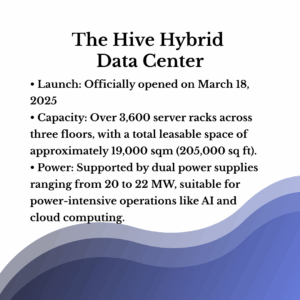
Beeinfotech PH (Bee Information Technology PH, Inc.) is a premier digital infrastructure service provider in the Philippines, established in 2020. It operates the largest telco-neutral data center in the country, known as The Hive Hybrid Data Center, located at Bridgetowne Boulevard and East Drive, Pasig City, Metro Manila, Philippines 1609
Here are key details about the company:
Now, what are some of the dangers we Filipinos face if spied upon by the hub for reasons other than Philippine national interest and security? One danger is access to facial recognition data through our airports (picked up by local news networks recently) which will rely on the Chinese data center. Handing over such personal data to the enemy is not only obviously dangerous, but a gross violation of privacy which ignores the people’s consent.
Another danger posed is access through IoT (Internet of Things) by artificial intelligence. If people are still not aware, almost all products connected through the internet can be monitored, in this case by the Chinese hub. These are things like your gadgets at home including cameras, gates, locks, appliances, computers, mobile phones, cars, etc. – you name it.
Even the safety and security watches or gadgets worn by children in security-prone areas around the world can become vulnerable as well since the same technology that protects these children can likewise become compromised through its connection to cyberspace. Thus, tampered feedback messages can deceive parents or guardians. In such a scenario, it would be better to return to the old manual ways of protection which leaves no cyber footprints to be tracked.
Through cyber-hubs, millions of AI agents can be deployed. These agents can act autonomously so they would be a force to be reckoned with in a wartime scenario.
Then there are the elections. These hubs are strategic and deadly in their capacity to spread self-serving propaganda as well as black propaganda and fake news against political opponents.
Moreover, big tech companies already know this and so there is the danger to the Philippine economy that these big investors might skip the country thereby potentially and adversely impacting an arterial industry – the BPO sector.
Furthermore, there is yet no law regulating artificial intelligence which is still evolving across the globe. We’d like to believe that every deployed AI will be an ethical AI. Unfortunately, this hub does not seem to know the meaning of the word “ethical” judging from the way it is and would be deploying AI.
Thus far, only the European Union and the United States do have AI ethical guidelines deployed precisely to guard against AI malware. Still, it will be tough and such a huge challenge to monitor compliance due to the mega volumes of e-data and meta-data which are everywhere aggravated by the deployment of multi-agent AI.
In the face of what’s happening to the country presently, it would do well for all Philippine stakeholders to be a patriot especially at this time for the sake of our national security and interest. All inroads by the enemy into Philippine data infrastructure must be protected at all levels and at all costs. Public policy legislators, judges, and executives, as well as the people, must be one in pushing back against the compromise of our national security using every means possible – before it is too late.