


Manuel Mogato | March 24, 2026
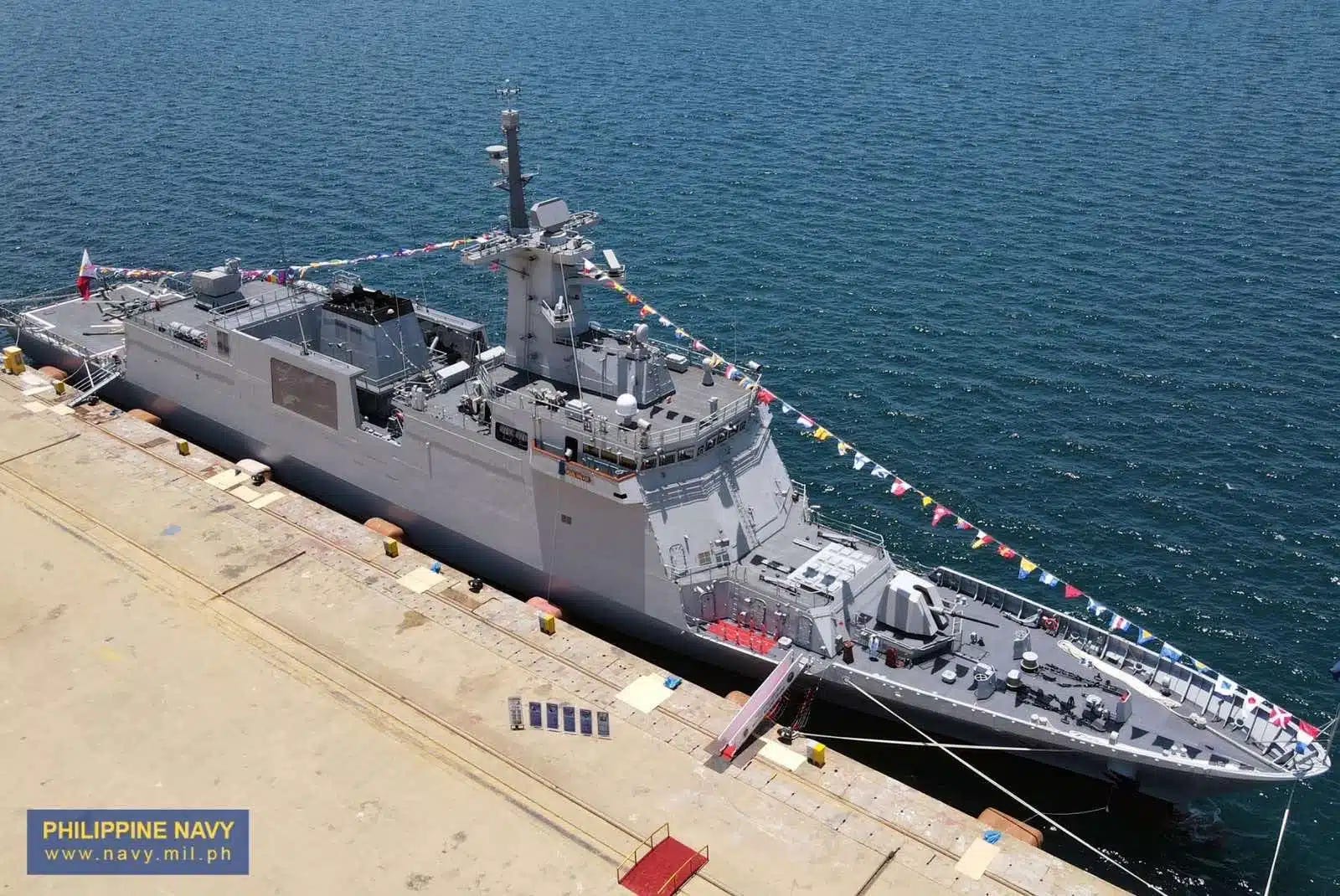
Manila — The officers and crew of one of the Philippine Navy’s powerful warships froze for a few seconds when a Chinese warship’s fire control radar locked on their vessel.
It was ready to fire and destroy them, but quick-thinking officers at the bridge of BRP Miguel Malvar did not respond to escalate the situation.
Instead, they issued a radio challenge and, in accordance with international protocol, insisted that the Chinese warship was violating international rules.
They said BRP Miguel Malvar is on a freedom of navigation in the West Philippine Sea, and is not recognizing China’s sovereignty in the South China Sea.
On patrol in the West Philippines Sea en route to a naval operating base in Subic, BRP Conrado Yap has reached Escoda Shoal, a low-elevation tide feature within the Philippines’ 200 nautical mile exclusive economic zone (EEZ), when the Chinese corvette harassed the Filipino vessel.
“This was an alarming and provocative action that created unnecessary risk and could have led to misinterpretation and misunderstanding at sea,” Rear Admiral Roy Vincent Trinidad, a spokesman for the Philippine Navy on the West Philippine Sea issue.
China was provoking the Philippines to fire the first shot and then retaliate harder to destroy the Philippine warships.
In 1988, China defeated Vietnam in a naval battle near Fiery Cross in the South China Sea as well as in the Paracels.
This is not the first time a Chinese warship has threatened to fire at a Philippine Navy vessel in the West Philippine Sea.
In February 2020, a similar incident happened when BRP Conrado Yap, a corvette donated by the Republic of South Korea, was on a territorial defense operation near Rizal Reef in the West Philippine Sea.
The Chinese vessel claimed that BRP Conrado Yap was in China’s maritime territory when it sailed close to Rizal Reef, which hosts a small Philippine military detachment, one of the nine features the country occupies in the disputed South China Sea.
The officers and crew of the former Pohang-class corvette, which was the most powerful warship in the Philippine Navy at that time, held their ground, challenging the Chinese vessel, which was in the Philippines’ EEZ.
In both cases, the Chinese vessels stowed away its radar fire control, defusing tension. But it was obvious that China was challenging the Philippines’ most powerful warships.
In 2020, BRP Conrado Yap, which has anti-submarine capability, was the most advanced warship. However, it has no missiles, electronic warfare, or countermeasures.
In 2026, it was BRP Miguel Malvar, a guided-missile frigate with anti-ship, anti-air, anti-submarine, and anti-electronic warfare capability. It is the most advanced, capable warship in the Philippine Navy.
The Chinese People’s Liberation Army-Navy’s actions in both cases indicated a shift in Beijing’s gray-zone tactics to a hybrid strategy combining gray-zone and conventional, as the Philippines acquired more capable vessels.
The Philippine Navy used to operate World War II vintage destroyer escorts, mine sweepers, and transport vessels. Some were transferred from South Vietnam after its defeat in 1975 by the Communist North.
The Philippines acquired more advanced but second-hand vessels from the United States and South Korea in the 1990s.
Then came the Cyclone-class and later the Hamilton-class weather-high-endurance cutters (WHEC) during the Aquino administration.
The real warships were acquired when two guided-missile frigates were delivered during the Duterte administration.
It now has anti-ship, anti-air missiles, electronic warfare, anti-submarine capabilities, and other countermeasures.
But these are not enough to match other Southeast Asian states, which have conventional submarines.
The Philippines is looking forward to a 50-vessel fleet to patrol the country’s vast maritime zones and overlapping exclusive economic zones.
It also has to build facilities, such as dry docks, oil and water depots, and sheltered ports, to homeport the vessels.
The Philippines is not starting a conflict in the West Philippine Sea, but will continue to patrol its maritime zone, together with like-minded countries, such as Australia, Canada, France, Japan, Germany, New Zealand, the United Kingdom, and the United States.
The Philippines will also continue to call on China to respect international law and comply with the 2016 arbitral ruling by the Permanent Court of Arbitration in The Hague.
