


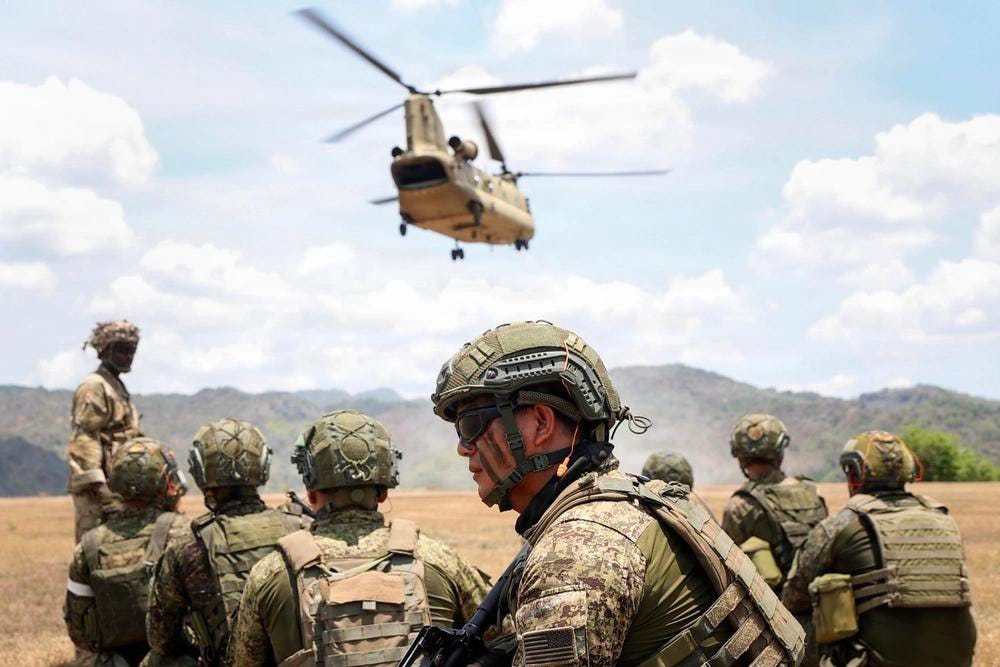
US Army's Chinook medium-lift helicopter takes off from Colonel Ernesto Ravina Air Base (CERAB) in Capas, Tarlac to Fort Magsaysay, Nueva Ecija on May 16, 2026. Photo from Philippine Army.
Manuel Mogato | May 22, 2026
MANILA — Coalition forces descended from US Army UH-60 Black Hawk and CH-47 Chinook helicopters to capture imaginary targets in northern Luzon during ground troops exercises to rehearse an air assault.
Filipino ground forces working closely with American, Australian, Japanese, and New Zealand rappel from US Army choppers to take ground targets as part of the Joint Pacific Readiness Center Exportable (JPMRC-X) Exercises.
Army spokesman, Colonel Louie Dema-ala, said the soldiers from five countries took off at Colonel Ernesto Ravina Air Base (CERAB) in Capas, Tarlac for short ride to Fort Magsaysay, Nueva Ecija where several targets were attacked.
“The combined air assault operation showcased enhanced interoperability, rapid deployment, and coordinated multi-domain capabilities among the participating ground forces operating in a contested archipelagic environment,” Dela-ala said in a statement.
He said the combined ground forces, aboard the US Army’s CH-47 Chinook and UH-60 Black Hawk helicopters, carried out a seamless assault mission from CERAB to the Combat Readiness Training Area (CRTA) in Fort Magsaysay.
He said the Army drills highlighted the enduring commitment of allied and partner nations to strengthen the collective readiness in promoting peace, security, and stability across the Indo-Pacific region. Army Chief Lieutenant General Antonio Nafarrete said the air assault operation is also part of the JPMRC-X Exercise that is among the highlights of Salaknib Phase 2 from May to June 2026
“Our alliance and key partnerships make us collectively stronger to deter any act of aggression,” Nafarrete said. “Through exercises like Salaknib, we enhance our ability to work together, building upon our collective strength towards ensuring a peaceful and stable Indo-Pacific Region.”