

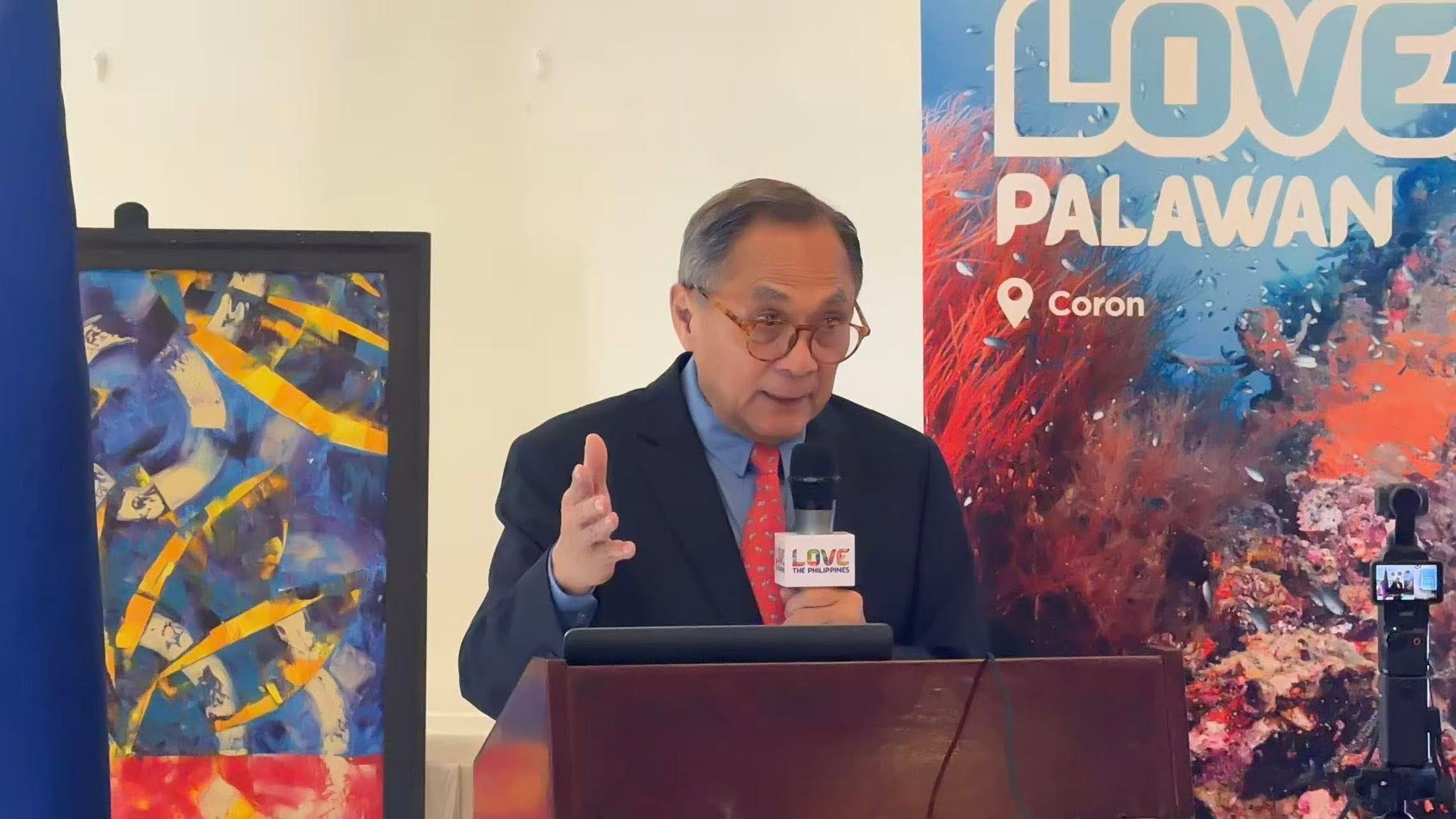
Philippine Ambassador to China Jaime FlorCruz pitching the Philippines as a “highly accessible and profitable destination” for Chinese travelers last March 19, 2026, shortly after the Philippine government granted visa-free entry for up to 14 days. Official handout.
Rommel C. Banlaoi | July 25, 2026
MANILA — Philippine Ambassador to China Jaime FlorCruz has recently taken to social media to promote the spirit of cooperation and friendship between Manila and Beijing.
This is an innovative diplomatic strategy that leverages his unique background as a veteran journalist in China and his intimate knowledge of the country’s hard‑won accomplishments over the past decades. FlorCruz’s digital diplomacy illustrates how media skills can be harnessed to advance foreign policy objectives in an era when public opinion is shaped as much by online narratives as by official communiqués.
FlorCruz’s messaging appears guided by President Ferdinand Marcos Jr.’s fundamental proposition: maritime disputes are not the sum total of Philippine–China relations. This proposition, shared by China as well, recognizes the seriousness of disagreements in the South China Sea but insists that the bilateral relationship must be understood more broadly. Trade, investment, education, culture, and peopletopeople exchanges are equally vital pillars of engagement. By echoing this framing, FlorCruz helps ensure that the Philippines is not confined to a single issue relationship defined solely by conflict.
The ambassador’s social media posts highlight cooperation, shared progress, and friendship. In doing so, he counters prevailing narratives of confrontation and hostility. His ability to communicate in ways that resonate with ordinary citizens, both Filipino and Chinese, stems from his journalist’s instinct for storytelling. He knows how to frame complex realities in accessible language, how to humanize diplomacy, and how to project goodwill without sounding naïve. This is precisely the kind of public diplomacy needed to balance the harsher tones of geopolitical competition.
Yet digital diplomacy also has its pitfalls.
A recent example is the controversial “monkey video” released by China Daily, widely criticized in the Philippines for its offensive undertones. Such media missteps can inflame nationalist sentiments, undermine goodwill, and reinforce perceptions of disrespect. For Filipino audiences, the video was seen as a symbol of insensitivity that could erode trust. For diplomats like FlorCruz, the challenge is to avoid being entangled in such narratives and to deal with their consequences in ways that preserve the spirit of cooperation. (Also read: Philippine, Chinese FMs meet at sidelines of ASEAN Ministerial Meeting)
Avoidance requires vigilance. Philippine diplomats must be careful not to amplify or legitimize content that can be construed as derogatory. They must instead highlight constructive stories through shared achievements, cultural exchanges, and cooperative projects that reinforce mutual respect. FlorCruz’s own social media strategy, grounded in positive messaging, is a model of how to steer clear of provocative narratives. By focusing on friendship and cooperation, he ensures that the Philippines’ digital diplomacy does not get dragged into controversies created by others.
Dealing with the consequences of missteps such as the monkey video requires a balanced, nuanced, and constructive perspective. On one hand, the Philippines must register its displeasure when content is offensive, signaling that respect is nonnegotiable. On the other hand, it must avoid allowing such incidents to derail the broader relationship. The key is to contextualize—to treat the video as an unfortunate episode that does not define the entirety of China’s engagement with the Philippines. By responding firmly yet constructively, diplomats can mitigate the damage while keeping the door wide open for cooperation. (Also read: Marcos summons Chinese ambassador over Ayungin Shoal incident)
The significance of FlorCruz’s approach lies in its timing. The Philippines is navigating a complex regional environment marked by intensifying U.S.–China rivalry, heightened maritime tensions, and domestic debates over foreign policy direction. In this context, projecting friendship and cooperation seeks to engage China on multiple fronts, that it values dialogue, and that it refuses to let disputes, or offensive videos, define the entirety of the relationship. This is a message that resonates with ASEAN’s broader preference for constructive engagement and regional stability. (Also read: The Philippines as ASEAN Chair Should Build Bridges of Cooperation Through a Code of Conduct in the South China Sea)
Ultimately, FlorCruz’s efforts highlight the importance of a nuanced, multi‑dimensional foreign policy. The Philippines cannot afford to reduce its relationship with China to a single contentious issue, nor can it allow offensive media portrayals to dominate the narrative. By promoting friendship and cooperation, FlorCruz advances a vision of Philippine foreign policy that is pragmatic, balanced, and forward‑looking. It is a vision that aligns with Marcos Jr.’s proposition and reflects the Philippines’ broader interest in stability and prosperity. (Also read: Friends to all, enemies to no one)
Ambassador FlorCruz’s digital diplomacy should therefore be viewed as a strategic effort to broaden the narrative, to remind both publics that disputes and missteps are only parts of a larger relationship, and to project a vision of engagement that is constructive rather than confrontational.
In an era of heightened tensions, digital diplomacy is a valuable contribution to Philippine foreign policy. It demonstrates that diplomacy is building bridge and that in the digital age, those bridges can be built one post at a time.
Rommel C. Banlaoi, PhD, is the President of the Philippine Society for International Security Studies and Director of the Philippines-China Studies Center at Diliman College.