

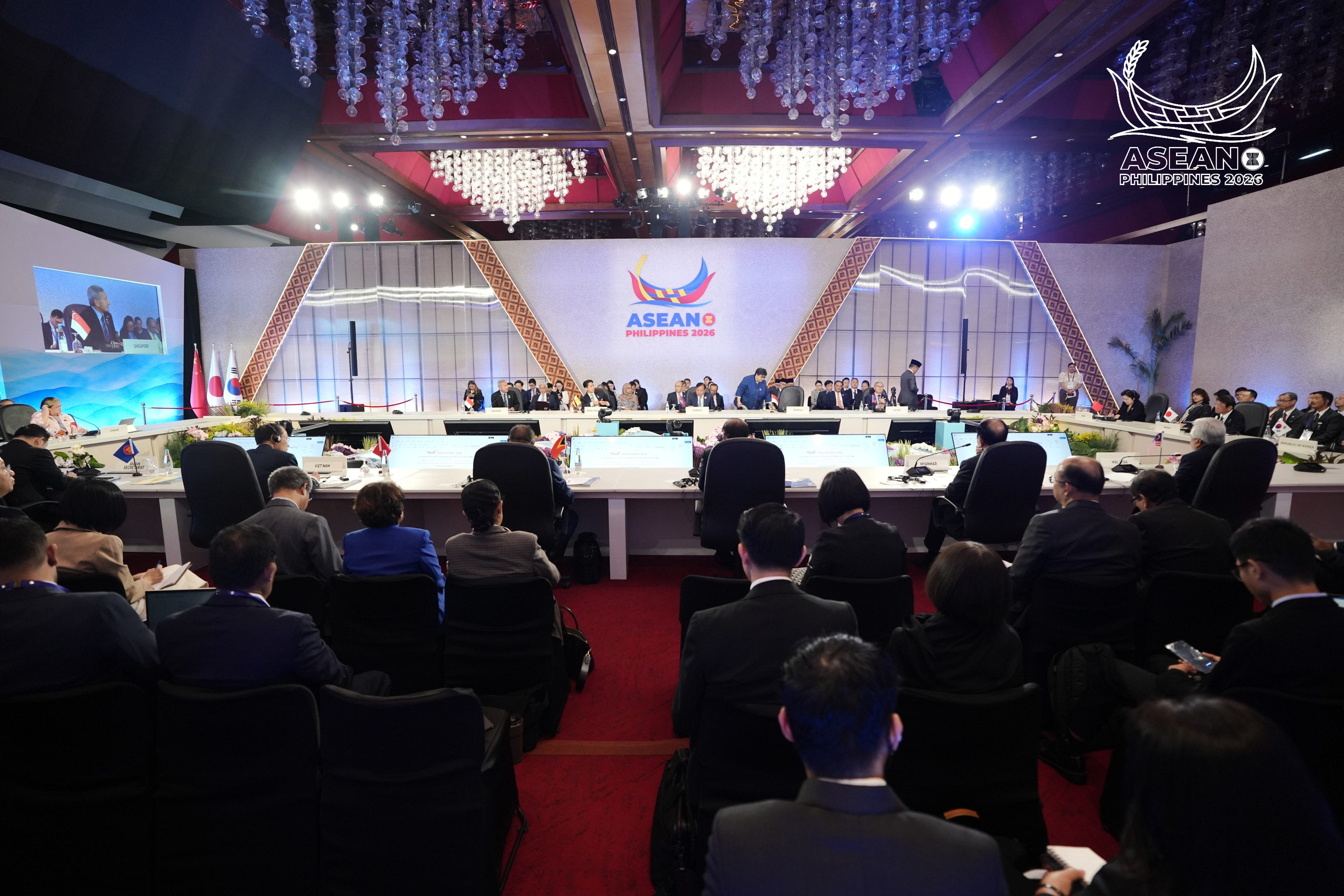
Foreign Ministers at the 27th ASEAN Plus Three Foreign Ministers Meeting. Official handout.
Anna Mogato | July 23, 2026
MANILA — Southeast Asian foreign ministers have set alarm bells ringing on the looming food and energy security amid the El Niño phenomenon and continued tensions in the Middle East.
In a joint statement issued at the end of the 59th ASEAN Ministerial Meeting in Manila, the foreign ministers underscored regional commitments to cooperate on mitigating the impact of the prolonged drought in the region, which “could be intensified by climate change.”
“We committed to deepen cooperation to mitigate these risks and transboundary impacts to protect public health and minimize economic repercussions, and underscore the urgent need for early warning systems, coordinated regional preparedness, strengthened disaster risk reduction, and resilience-building measures to safeguard the well-being of ASEAN peoples and the long-term sustainability of the region’s development,” the joint statement read.
The Philippines’ weather bureau has warned of a “strong El Niño” this year that could dry up water levels in major dams, affecting agricultural, energy generation, and potable water supply in cities.
For instance, the water level at Angat Dam, the main source of drinking water in the capital region, has gone below the critical level due to a lack of rainfall despite successive typhoons.
ASEAN Foreign Ministers earlier raised concerns about the renewed tensions in the Middle East. They also called on the United States and Iran to “exercise utmost self-restraint and avoid any acts that may further aggravate the situation.” (Also read: US claims Iran “not serious” with peace talks)
In a separate ASEAN Plus Three (APT) meeting, Korean Foreign Minister Cho Hyun also raised concerns about food and energy security.
“The crisis before us today is no less serious. Disruptions in the Strait of Hormuz have posed vulnerabilities that have long since been hypothetical,” Cho said.
“They have placed our food and energy security under severe strain. And yet, paradoxically, this crisis also opens a window of opportunity for ASEAN Plus Three to once again demonstrate the value of this mechanism.”
Cho also proposed to expand the scope of ASEAN Plus Three Emergency Rice Reserve (APTERR) to cover other foodstuffs.
APTERR was set up in the East Asian region due to natural disasters, as a mechanism to stockpile reserves which can be used as aid to afflicted communities.
“We should mobilize the necessary political will and engage technical experts to explore and articulate an actionable road map,” Cho said.
“On energy, our experts have already been exploring possibilities on region-wide cooperation for over a decade. Now is the time to turn the accumulated thinking into concrete action.”
China’s Vice Minister of Foreign Affairs, Hua Chunying, and Japan’s Foreign Minister, Motegi Toshimitsu, also pledged their country’s willingness to cooperate in resolving challenges in food and energy security.
The joint communiqué also recalled preliminary recommendations to reinforce regional energy and food security, and agreed to ensure timely implementation of these measures.
“We recognized evolving global challenges, including the situation in the Middle East and its impacts on food systems, supply chains, and agricultural inputs, and underscored the importance of continued regional cooperation and coordination, including through the [APTERR] and the ASEAN Food Security Information System (AFSIS),” the joint statement read.
“We supported sustainable and innovative approaches, including the ASEAN One Billion Trees initiative, nature-based solutions/ecosystem-based approaches, and stronger private sector engagement, to promote climate resilience, environmental sustainability, disaster preparedness, and sustainable growth across the sectors.”
Around 20% of global energy passes through the Strait of Hormuz, which was closed after the conflict between Iran and the United States flared up anew. The blocked channel has also affected trade and agriculture.