


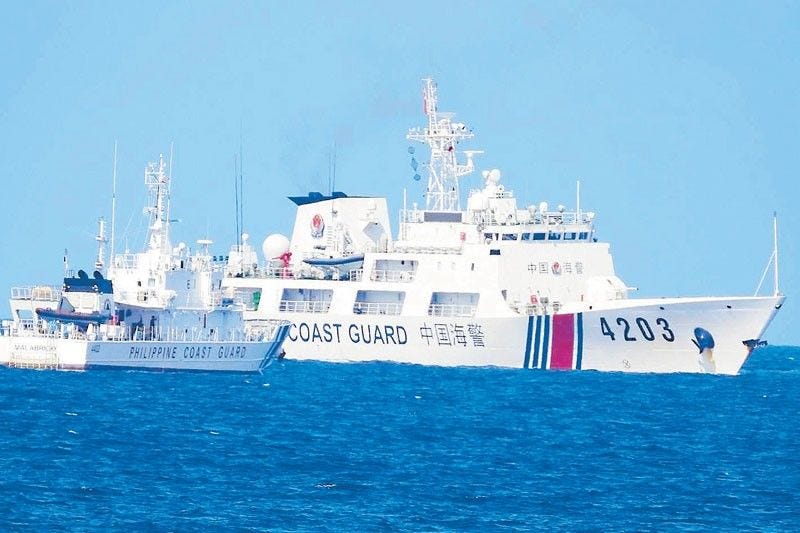
File photo from the Philippine Coast Guard on June 30, 2023 showed a Chinese Coast Guard vessel maneuvering close to patrol ship BRP Malabrigo near Ayungin Shoal in the West Philippine Sea.
Rommel C. Banlaoi | August 26, 2026
A month after the Philippines commemorated the tenth anniversary of the Arbitral Award, it remains the benchmark of Manila’s sovereign assertion. But it also exposes the limits of international law in restraining great power behavior, as Beijing’s activities in the South China Sea continue unabated.
The verbal clash between the Department of National Defense and the Chinese Embassy in Manila is complicating the current situation. China’s ban on Defense Secretary Gilberto Teodoro is a concrete signal that defense cooperation has collapsed. Military dialogue is frozen, and the Philippine defense attaché in Beijing has been recalled. (Also read: Philippines condemns “actions” against Filipinos in China)
Teodoro’s blunt characterization of China’s reported immigration action against more than 100 Filipinos as “plain and simple extortion and blackmail” has further poisoned the atmosphere, prompting sharp counterattacks from Beijing.(Also read: Teodoro accuses China of “interference” in Philippine affairs)
What remains is a dangerous vacuum in defense relations. With dialogue suspended and rhetoric escalating, the risk of miscalculation in contested waters is rising.
From the lens of pragmatic nationalism, this inconvenient reality is untenable. Advancing national interest requires both the protection of sovereign rights and the management of disputes through practical engagement. Without reliable defense channels, Manila’s security is undermined and its diplomatic maneuverability constrained.
Pragmatic nationalism insists that sovereignty must be defended, but also that engagement with China is necessary to safeguard Philippine interests and regional stability.
Resuming the Annual Defense and Security Talks
The Bilateral Consultative Mechanism (BCM) provides political dialogue, but it cannot substitute for defensespecific engagement. Reviving the Annual Defense and Security Talks (ADST) is therefore a pragmatic step to rebuild confidence, restore cooperation, and advance preventive diplomacy.
Established under the 2004 Memorandum of Understanding on Defense Cooperation, the ADST was designed to address not only maritime disputes but also broader regional security concerns. Early rounds produced tangible gains: naval encounter protocols, humanitarian and disaster relief exercises, and informationsharing on piracy, terrorism, and cybercrime. These outcomes demonstrated that structured dialogue can deliver stability even amid unresolved sovereignty issues.
Suspending the ADST, however, removed the only mechanism tailored to prevent miscalculation at sea. Its restoration is a calculated safeguard of Philippine interests.
Stabilizing Ties Through Pragmatic Engagement
A decade after arbitration, the absence of sustained defense dialogue magnifies risks. Restoring the ADST would stabilize bilateral ties and reassure Southeast Asia that both nations remain committed to responsible dispute management. (Also read: Marcos defends two-year deal with China on Ayungin)
For Manila, resuming the ADST embodies pragmatic nationalism: defending sovereign rights while keeping channels open to reduce risks. For Beijing, it signals willingness to act as a responsible regional power. The ADST fills the operational gap left by the BCM, providing a structured platform for defensespecific exchanges on rules of engagement, crisis management, and escalation avoidance.
Pragmatic nationalism does not require abandoning national positions. It requires recognizing that miscalculation is a shared danger, and that regular defensefocused communication is the most effective safeguard against it.
Maritime Cooperation and Ocean Governance
Reviving the ADST offers more than risk reduction. It opens space for maritime cooperation and ocean governance where collaboration can yield mutual gains in fisheries management, marine protection, scientific research, maritime safety, and energy security. These practical projects are achievable regardless of sovereignty disputes and directly advance Philippine interests.
The ADST can complement the ASEAN Defense Ministers’ Meeting Plus (ADMM+) by linking bilateral initiatives with regional frameworks. As 2026 ASEAN Chair, the Philippines can align ADMM+ priorities with the ADST, embedding bilateral confidencebuilding within ASEAN’s collective security architecture. This synergy strengthens Manila’s strategic role in shaping cooperative maritime management while ensuring that pragmatic engagement serves national and regional stability.
Conclusion
Pragmatic nationalism demands that the Philippines and China reconvene the ADST. It is imperative or either side to take the initiative. But Manila has the most to gain from restoring defense dialogue as a hedge against escalation and a platform for cooperation. (Also read: Building Bridges Not Walls: The Philippines and the Future of Maritime Order in the Asia-Pacific)
Such a move would signal to the wider region that both nations are committed not only to asserting their positions but also to managing disputes responsibly. Reviving defense talks can facilitate the transformation of the South China Sea from a flashpoint of military conflict into a domain of peace, stability, and cooperation.
Rommel C. Banlaoi, PhD, is Director of the Philippines–China Studies Center at Diliman College and President of the Philippine Society for International Security Studies. He served as President of the Philippine Association for Chinese Studies.
