

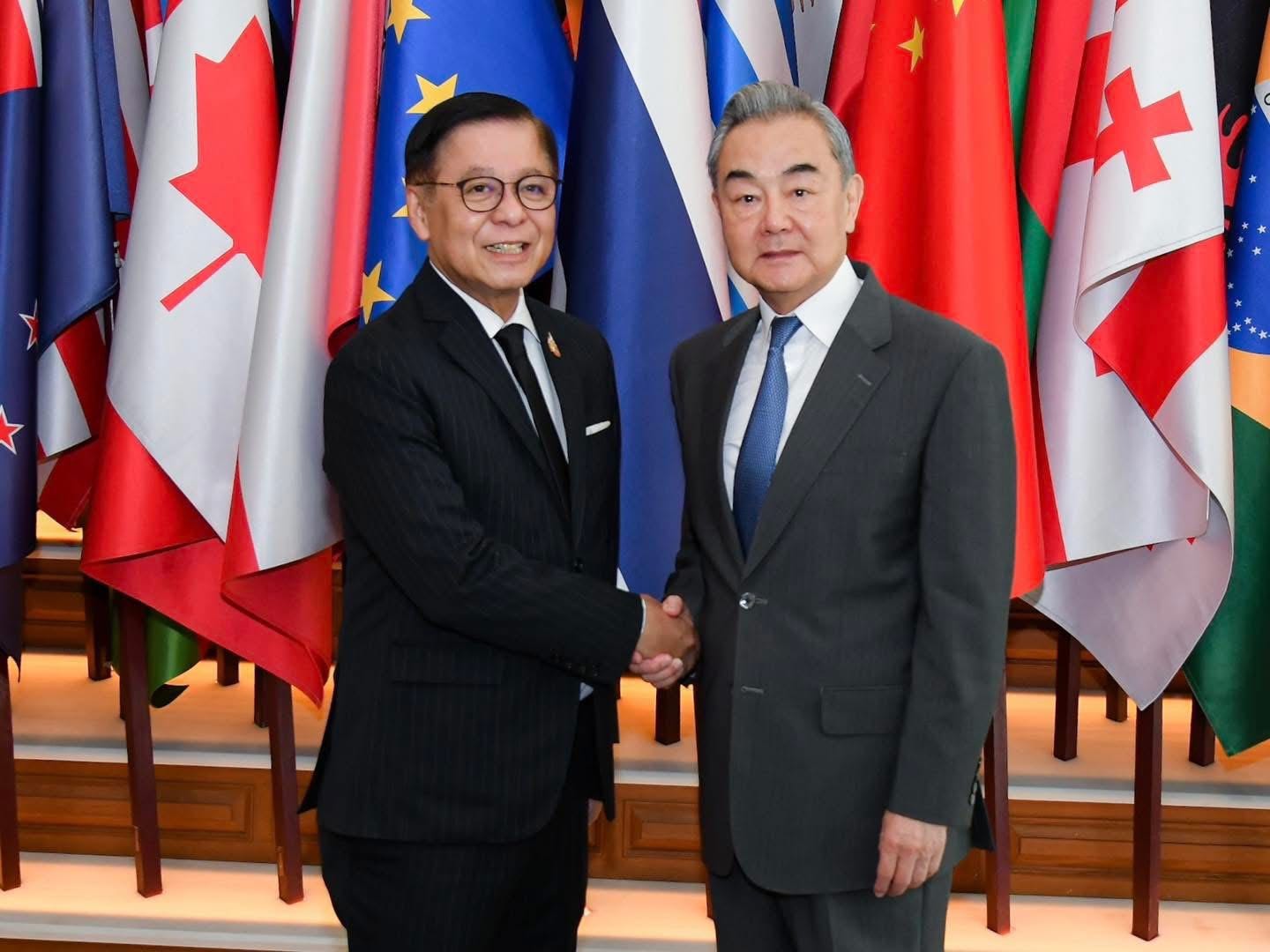
Chinese Foreign Minister Wang Yi and Thai deputy prime minister and foreign minister Sihasak Phuangketkeow. Photo from PR Thai Government
Prapapoom Eiamsom | May 6, 2026
BANGKOK — Foreign Minister Wang Yi’s recent visit to Bangkok has solidified Beijing’s position as a reliable “Big Brother,” for Thailand amid the twin pressures of U.S. tariff disruptions and the energy crisis in the Strait of Hormuz. By offering a model of modernisation without political interference, China demanded a tri-nation crackdown on transnational crime across Thailand, Myanmar, and Cambodia in return.
The Thailand-China relationship has long been described through the lens of “Siblings” or “One Family,” with China as the senior brother and Thailand as the junior partner—a dynamic dating back to the era of Siam. While Chinese Foreign Minister Wang Yi’s visit on April 24th appeared to be a routine diplomatic exchange to synchronize China’s 15th Five-Year Plan with the agenda of Prime Minister Anutin Charnvirakul’s government, it effectively cemented China’s role as more than just a trading partner.
The momentum for this visit was built on the historic state visit of King Maha Vajiralongkorn and Queen Suthida to China in November 2025. As the first-ever visit by the current Thai monarch to the People’s Republic, it provided a powerful symbolic approval for deeper institutional integration.
Economically, the timing is critical. As China embarks on its newly launched Five-Year Plan (2026–2030), its focus has shifted toward “new productive forces”—high-tech manufacturing, green energy, and digital infrastructure. This shift aligns perfectly with the Thai government’s urgent need for foreign investment to revive sluggish growth; the Bank of Thailand recently revised this year’s growth forecast down to 1.5% from an earlier 1.9% projection. Beyond expanding traditional agricultural exports, this partnership is a key driver for Thailand’s transition from a traditional automotive hub into a regional leader for Electric Vehicles (EV).
Looking at the broader itinerary of Wang Yi’s April 22nd–25th trip through Cambodia, Thailand, and Myanmar, the central agenda was the crackdown on transnational crime. By exerting pressure on a framework to dismantle the scams and fraud networks—which lure over $7 billion worldwide and victimise many Chinese citizens—China is positioning itself as the only power capable of providing the regional security ‘teeth’ necessary to eradicate these organised crime groups.
Furthermore, Wang Yi’s emphasis on the “Chinese Model of Modernisation” serves as a calculated soft-power overture to Myanmar’s military leadership, the Cambodian authoritarian, and Thailand’s conservative establishment. By championing a path rooted in “non-interference,” Beijing offers a lucrative framework that bypasses the democratic concessions and human rights benchmarks typically demanded by Western powers. This has become an increasingly attractive hedge for Bangkok against the perceived volatility of U.S. foreign policy.
Perhaps the most striking development was Thai Foreign Minister Sihasak Phuangketkeow’s public expression of frustration toward the U.S. In a Washington Post interview conducted during Wang’s visit, Sihasak highlighted a growing disillusionment with the unpredictability of U.S. policy, ranging from aggressive tariffs, aid withdrawals, to the escalations in the Middle East “that should not have started.” While maintaining that Thailand remains non-aligned, his rhetoric signaled a clear pivot away from its traditional Cold War-era ally. (Also read: India, China pursue ‘strategic autonomy’ as Trump tariffs force global realignment)
This shift is rooted in immediate economic survival. As the U.S.-Iran confrontation disrupted vital energy and fertiliser shipments through the Strait of Hormuz, Bangkok turned to Beijing and Moscow for solutions. Sihasak revealed that while the U.S. offered no assistance, PM Anuthin specifically requested China’s mediation with Tehran to ensure the safe passage of Thai vessels and sought increased fertiliser quotas from both China and Russia to bypass the Hormuz bottleneck.
Ultimately, Bangkok is adapting to a new reality: the U.S. is increasingly viewed as a source of global volatility, while China is positioned as the pragmatic, reliable stabiliser capable of safeguarding Thailand’s national interests. In the eyes of Bangkok, the “Big Brother” has become an indispensable guardian of the kingdom’s stability.