

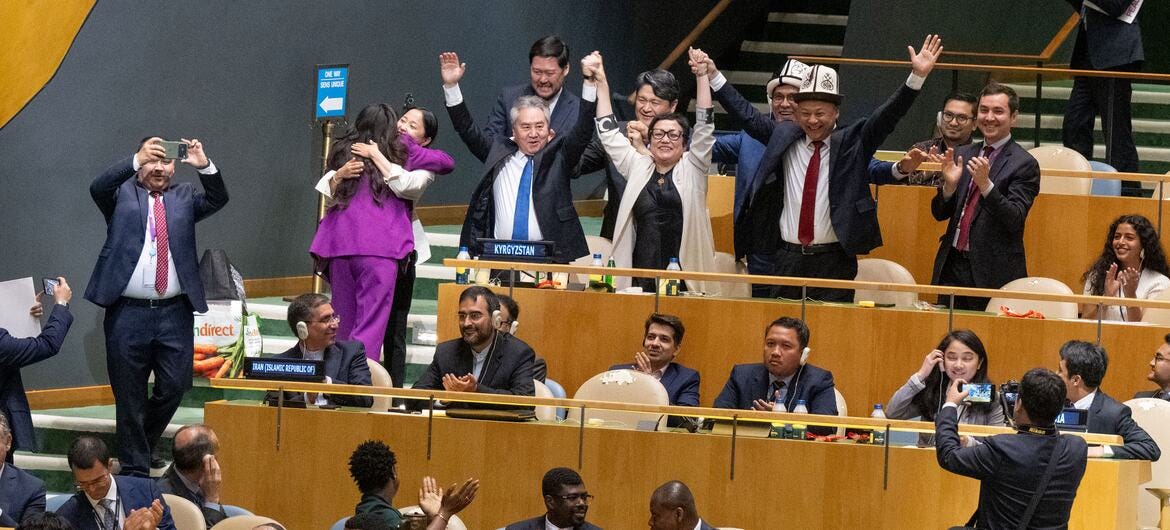
The Kyrgyzstan celebrate after being elected as a non-permanent member of the United Nations Security Council. UN Photo/Eskinder Debebe
Rommel C. Banlaoi | June 22, 2026
Amidst major power politics, the stunning defeat in the Philippines’ campaign for a nonpermanent seat on the United Nations Security Council (UNSC) for the 2027–2028 term, garnering only 49 votes compared to Kyrgyzstan’s commanding 142, offers a vivid case study of how great power dynamics continue to shape outcomes in multilateral institutions.
Kyrgyzstan’s victory reflects the growing geopolitical weight of Central Asia, a region where Russia and China exert considerable political, economic and security influence.
Both powers have strategic interests in elevating regional partners to positions of prominence in global governance. Their support, whether explicit or tacit, can decisively tilt the balance in the General Assembly.
In contrast, the Philippines entered the contest with fragmented support, relying heavily on its longstanding alliance with the United States and other Western partners. However, backing from these powers failed to translate into the necessary votes.
This outcome underscores a structural reality that the UNSC remains a forum where the interests of great powers dominate, and where middle powers must navigate carefully to avoid being marginalized. It highlights the enduring imbalance between the formal equality of member states and the informal hierarchy of influence, reminding us that consensus is often shaped less by principle than by power.
For middle powers like the Philippines, this dynamic necessitates strategic coalition-building and diplomatic agility to ensure their voices are not drowned out in the currents of major power rivalry.
Manila’s campaign was, in fact, severely weakened by its inability to project a coherent foreign policy identity. Its ambiguous balancing act, deepening security ties and enhancing defense cooperation with Washington while pursuing incoherent economic engagement with Beijing amid ongoing disputes in the South China Sea, appeared inconsistent to many member states in the UN. In multilateral settings, inconsistency is often interpreted as unreliability.
The Philippines’ defeat arguably underscores the constraints of its reactive diplomacy and the shortcomings of its ad hoc foreign policy.
For years, Manila’s foreign policy has been shaped primarily by immediate crises, particularly maritime disputes, rather than by a long-term strategic vision. This narrow focus has left little bandwidth for coalition-building in Africa, Latin America, and the Middle East, regions that frequently hold the decisive votes in UN elections. Without sustained engagement in these regions, the Philippines struggled to present itself as a credible candidate for a seat that demands global relevance.
To succeed in future multilateral contests, the Philippines must, therefore, broaden its diplomatic horizons and articulate a more coherent foreign policy narrative. It must demonstrate that it is not merely a security-dependent ally of the United States or an ambivalent partner of China, but a middle power capable of independent contributions to global peace and security.
Countries such as Norway, Mexico, and South Africa have shown that principled positions, consistent diplomacy, and broad coalition-building can secure UNSC seats even in polarized environments. Manila should study these examples closely.
The UNSC defeat is not just a matter of prestige lost. It is also a reflection of the Philippines’ diminished ability to influence global security debates. In an era of intensifying major power rivalry, middle powers must play smarter, not harder, if they want to matter. (Also read: The Philippines as ASEAN Chair Should Build Bridges of Cooperation Through a Code of Conduct in the South China Sea)
For the Philippines, this means moving beyond reactive maneuvering and investing in a long-term strategy that builds credibility across diverse regions. Otherwise, it risks continued marginalization and even alienation in global institutions that claim universality but remain deeply shaped by the geopolitics of few great powers.
Rommel C. Banlaoi, PhD, is the President of the Philippine Society for International Security Studies and Director of the Philippines-China Studies Center at Diliman College.