


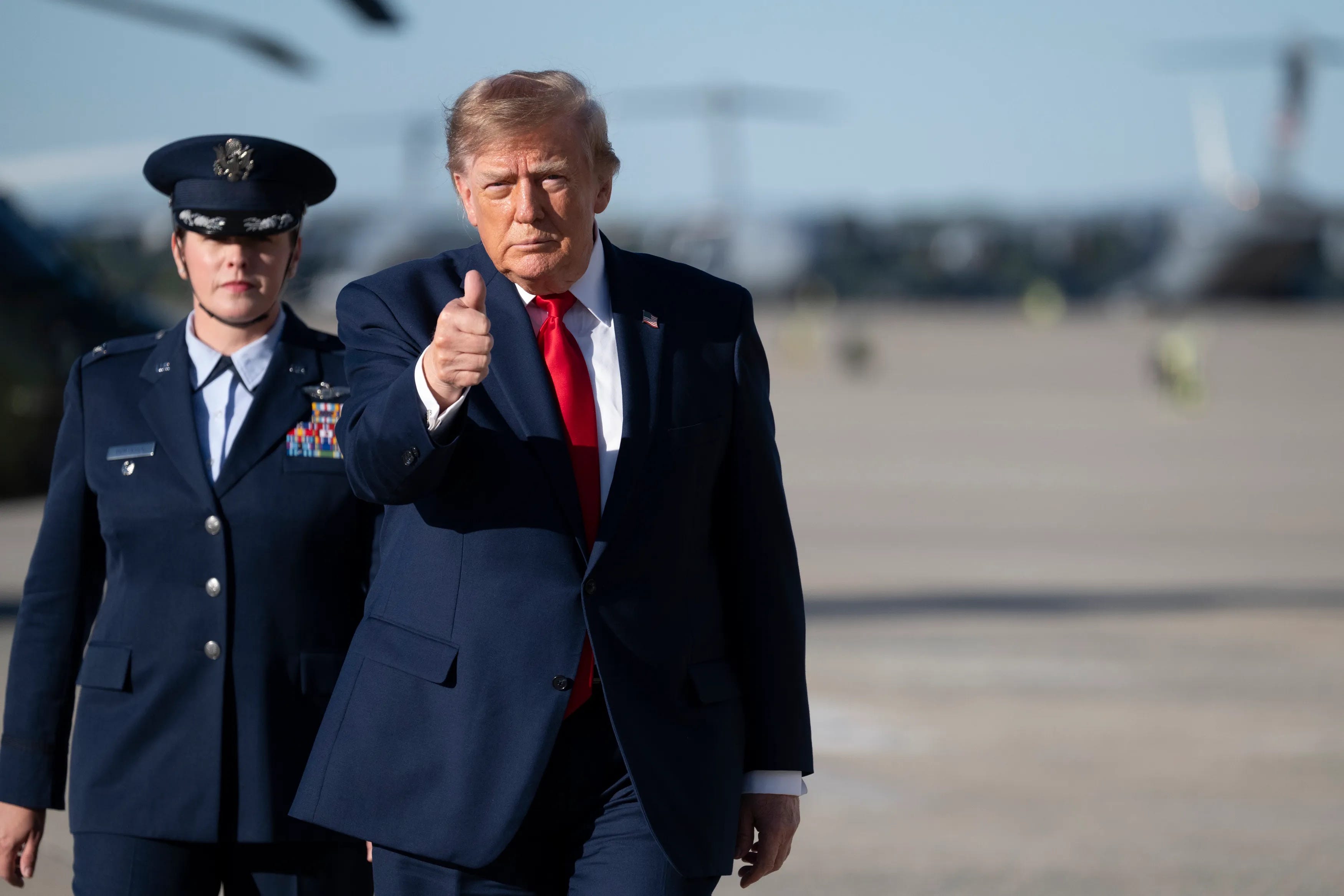
US President Donald Trump addresses the media before boarding Marine One on October 21, 2026. Official handout.
COL Dencio S. Acop (Ret), PhD | October 31, 2026
If the historical job approval ratings of U.S. Presidents by midterm are to be the basis, President Donald Trump would lose an average of 32 to 37 seats in the U.S. House of Representatives. This would mean that by January 3, 2027, the 120th U.S. Congress would be a Democrat-led and dominated congress.
Democrats only need 3 to 6 seats to take control of the 435-seat House. With Democrats holding the speakership and committee control, Congress could effectively stall Trump’s legislative agenda and introduce aggressive congressional oversight. This would transition the Trump administration into a “lame duck” for its final two years.
Moreover, it would completely shift the legislative and investigative landscape. The first Republican loss would be legislative control. Republicans would no longer be able to pass bills or federal budget resolutions without negotiating for Democratic support.
The second loss is subpoena and committee power. Democrats would assume committee leaderships, giving them the authority to launch expansive investigations, demand internal administration documents, and force senior officials to testify. Observers note potential targets could include everything from general administrative policies to the Trump family’s cryptocurrency initiatives and even the Jeffrey Epstein files.
And the third loss is the risk of impeachment. While a president cannot be removed from office by the midterms alone, a Democratic House would have the power to pass articles of impeachment with a simple majority. Trump himself has publicly acknowledged this risk, warning supporters of a potential third impeachment inquiry if the G.O.P. loses heavily.
If Republicans lose even the Senate, and there is a real possibility they could, the loss will carry separate and longer-term consequences for the Party.
First, Personnel and Judicial Nominees could be blocked. The Senate holds the exclusive power to confirm or reject presidential appointments. A Democratic majority could completely stall the confirmation of cabinet officials, ambassadors, and federal judges — including lifetime-appointed Supreme Court justices. And second, it will be a Democratic Senate that would subsequently try a president impeached by the House.
However, removing a president from office requires a strict two-thirds supermajority which is a challenging threshold though not totally impossible to hurdle. Whatever the result, gridlocks are expected as the Republican and Democratic Parties have never been so polarized as they are today. Immediate legislative and political frictions are likely to come about resulting in budget standoffs, policy gridlock, withheld pledges, and midterm results disputes.
Since the U.S. midterm polls’ outcome impacts the second half of Donald Trump’s term, America will certainly be dealt with accordingly by a world anxious about where it is headed led by countries in regions destabilized by Trump’s unparalleled wars.
Where are these concerns found? First is the Indo-Pacific Region. While Republicans and Democrats have traditionally manifested bipartisan support for both Taiwan and the Philippines containing China in relation to these two allies, Trump’s ambivalent actions in attacking Iran then making deals with Xi Jinping and Vladimir Putin which appear to jeopardize the interests of Taiwan and Ukraine/NATO do not reassure the world or allies than confuse them. Consequently, a Democratic-led Congress may soon tilt the balance of power, internally and externally, away from Trump’s seemingly incoherent policy actions. (Also read: Is the US politicizing the US dollar?)
For the Philippines, Democratic lawmakers have actively pushed to protect and increase funding for programs countering Chinese Communist Party (CCP) aggression in the region. There has been bipartisan support for the 1951 US-Philippines Mutual Defense Treaty which covers armed attacks against Philippine military forces, vessels, or coast guard units in the South China Sea. Democratic officials have routinely condemned Chinese maritime pressure, water-cannoning, and coercive maneuvers near features like Scarborough Shoal and Second Thomas Shoal, emphasizing adherence to the 2016 UNCLOS arbitral ruling.

For Taiwan, Democratic lawmakers have routinely supported providing Taiwan with defensive military equipment in line with the Taiwan Relations Act. As surveyed by the Chicago Council on Global Affairs, 70% of Democrats are in favor of sending military arms and supplies to Taiwan. Democrats also strongly support non-military deterrence, such as imposing economic and diplomatic sanctions on China and backing Taiwan’s inclusion in international organizations despite the One China policy. (Also read: Taiwan seeks higher defense budget for 2026)
Prominent Democratic leaders, like former House Speaker Nancy Pelosi, have visited Taiwan in the past to demonstrate political solidarity, showcasing cross-party support for high-level diplomatic engagements. Historically, top congressional Democrats on national security committees have often pushed for reaffirming U.S. commitments to cross-strait peace and Taiwan’s self-defense. But there are also nuances and limits on direct involvement of U.S. troops which differentiate between Republican and Democratic support of Taiwan against China.
While Democrats and the broader American public back supplying weapons and economic pressure, majorities typically oppose sending combat troops to directly fight a war against China over Taiwan. Public and congressional data reveal that while both parties strongly support Taiwan, Republicans occasionally poll slightly higher on certain hardline military or confrontational measures toward China. Democrats, on the other hand, frequently emphasize a mix of diplomatic stability, regional alliances, and defensive deterrence.
As the U.S. midterm elections get underway, China’s Communist Party is itself having an internal party plenum even as it awaits with great interest the results of the electoral exercise. As we write, top Chinese leaders are holding a critical four-day closed-door meeting — the Fifth Plenum of the Central Committee — to tighten party discipline, perform a loyalty check, and advance another “anti-corruption” campaign led by President Xi Jinping.
Xi is using this opportunity to address party vacancies and restructure leadership control, including those sensitive positions within the Central Military Commission, ahead of the upcoming Party Congress occurring only once every five years. The Communist Party is also watching closely the U.S. midterm elections scheduled for November 3, 2026. Its expectations hinge around how a Republican or Democratic majority in Congress could impact President Trump’s legislative agenda, foreign policy, and domestic situation.
By all indicators, Beijing continues to operate under the assumption that U.S. congressional views on China will remain largely adversarial regardless of which party rises in power, while looking for points of stability or leverage in trade and technology (e.g. rare earths and semiconductors). Historically, and leading into the 2026 cycle, U.S. intelligence and security assessments note that Beijing utilizes a mix of digital influence operations, covert networks, and cyberespionage to monitor U.S. political developments and shape public perceptions beneficial to China’s interests.
At the just-concluded ASEAN Defense Ministers’ Meeting (ADMM)-Plus in the Philippines, regional defense leaders further solidified their commitments to shared common interests toward upholding what they termed a “free and open Indo-Pacific” even as China “has increasingly flexed its muscles in the region.”
Composed of defense leads from ASEAN’s 11 member states, ADMM-Plus also includes 8 dialogue partners: Australia, China, India, Japan, New Zealand, Russia, South Korea, and the United States. The just-ended conference came ahead of the scheduled APEC Leaders’ Summit from November 18 to 19, 2026 in Shenzhen, China. In this conference, the 33rd of its kind, Donald Trump and Xi Jinping will be among global leaders meeting for the nth time to discuss their respective economies relative to world developments.
Since the economy is increasingly part of today’s global security and vice-versa, the dialogues likewise have their implications on national security. By all indicators, the just-concluded ADMM+ has set the tone for the upcoming economic-plus discussions among APEC leaders. With China represented in the ADMM+ meeting, Defense Secretary Pete Hegseth proposed the creation of a new security framework in Southeast Asia led by the U.S. to counter China’s aggression. Calling it a US-ASEAN Framework for Defense Cooperation, Hegseth again emphasized that the “United States would defend its interests and those of its allies and partners.”
With a likely Democratic-led Congress or even Senate by January, how this new framework would eventually develop remains to be seen. Given the Democratic Party’s character, a Democratic-led Congress would be expected to exhaust all idealistic measures to advance mutual interests before it acquiesces to the undesired alternative option of realist measures.
The second strategic area of concern is Ukraine. The almost 5-year war in this country invaded by Russia has the potential to gain more relative support from a Democratic U.S. Congress and possibly Senate. A Democratic-controlled Lower House is expected to push for increased and faster military and financial support to Ukraine, although potential presidential vetoes and executive authority over foreign policy can limit how much support can be delivered.
The delivery of military aid needed by Ukraine could be speeded up from months to days due to reduced approval time by Congress which can also push for veto-proof legislation to restore weapons and Starlink access. Lawmakers have introduced or backed measures such as the Ukraine Support Act providing billions in military assistance, extending the Ukraine Security Assistance Initiative, and blocking presidential actions that ease sanctions on Russia. While legislations passing through a Democratic-led Congress would still need a two-thirds majority in both chambers to override an executive veto, requiring bipartisan support from Republicans, forecasts and polling data ahead of the November midterm elections predict a 75% to 80% probability of Democrats winning control of the Senate (according to Nate Silver’s FLIPR and Harvard Electlt Forecast Models).
If the predictions are accurate, the current 53-47 majority held by Republicans in the upper chamber will be flipped. To prevent this from happening, Trump has been doing the rounds vigorously campaigning for his G.O.P. candidates. But facing criticism and unpopularity ahead of the midterm polls, Trump has pressured Volodymyr Zelenskyy to halt Ukrainian strikes on Russian oil refineries blaming them for driving up global diesel prices impacting American voters.
To this, Zelenskyy has offered a 60-day energy ceasefire but only if Vladimir Putin reciprocates by also halting Russian strikes on Ukrainian energy infrastructure during the election period. But Russia did not halt its attacks as proposed by the two leaders, instead continuing to launch missiles and drones on Ukrainian power plants, thermal energy facilities, and substations. Trump’s last-ditch efforts therefore to arrest looming Democratic victories in possibly both houses of congress are falling short.
Finally, the third area of concern is the Middle East. The Iran War initiated by Israel and the U.S. is heavily impacting the midterm elections by driving up the cost of living and becoming a major political liability for Republican candidates. Surging gas and energy prices, higher inflation, and public opinion on the war are the key economic impacts driving votes.
The conflict has caused a sharp spike in energy costs, with the national average price of gasoline rising to around $4.28 per gallon (up significantly from under $3 before the war) and diesel nearing record highs (according to Al Jazeera, et. al). Reportedly, voters have directly linked the conflict to higher prices at the supermarket, increased transportation costs, and limited access to agricultural fertilizers.
Polling by the Chicago Council on Global Affairs has shown that roughly 86% of adults view the war as harmful to the cost of living, while 72% believe it has damaged America’s global reputation. Meanwhile, the war’s being a “roadblock” for Republicans, Trump’s low approval ratings because of it, and democratic strategy will be the key determinants of the political and electoral consequences of the polls. According to NDTV+2, GOP candidates — particularly those in competitive races in energy-sensitive or agricultural states like Iowa, Kansas, Ohio, Texas, and Michigan — are facing severe pressure as voter fatigue mounts over an eight-month conflict which was initially predicted to last only weeks.
As reported by various media outlets, Trump’s approval ratings have continued to drop into the mid-to-high 30s as a direct result of economic strains tied to the war. Moreover, Democrats have focused their campaigns upon the idea that foreign policy has merged with the economy, using the war’s unpopularity to peel off Independents and challenge Republican majorities in both houses. Recent polls, such as PBS News/NPR/Marist poll and New York Times/Siena data, show that a significant share of likely voters view the midterms as a referendum on Trump, with Democratic candidates leading in several key congressional districts.
If a Democratic-led Congress and even possibly Senate come about by January, American involvement in Iran will most certainly see a draw-down, if not entirely. It could also include heavily scrutinized U.S. engagements with Israel which itself is currently facing unstable politics with Benjamin Netanyahu’s right-wing Likud Party, Gadi Eisenkot’s centrist Yashar Party, and Arab-led Parties dead-locked. The just-held national parliamentary elections there have resulted in a severe political standoff with no clear winner.
But Netanyahu’s once dominant party has lost its majority in the 120-seat Knesset, falling short of the 61 seats needed to govern. The Arab vote, which turned out in droves, turned back Netanyahu’s dominance. While not exactly a “dove”, former military chief Eisenkot is rumored to consider forming a coalition with the Arab leaders. Naturally, Netanyahu has been wooing him but the former general wants to replace the prime minister. Surely, they and other Israeli leaders are looking closely into the political affairs of their American counterparts.