


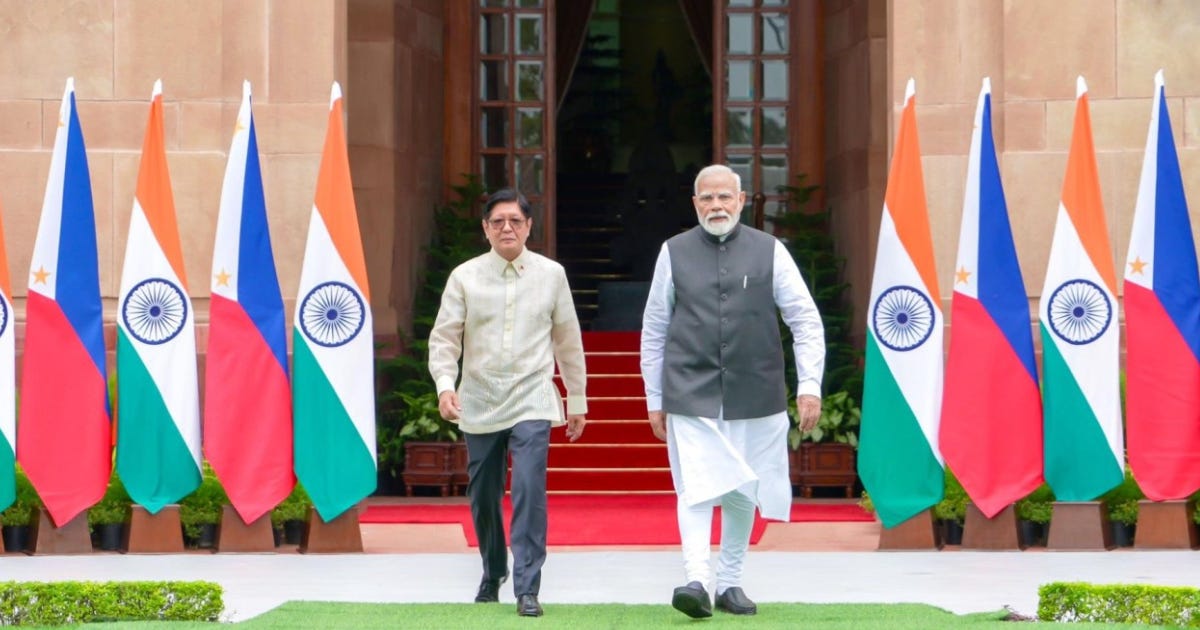
President Ferdinand R. Marcos Jr. and Prime Minister Narendra Modi declared the establishment of a Strategic Partnership, strengthening bilateral ties between both countries on August 5. Photo from Presidential Communications Office.
By: Pirzada Shakir | Published: August 19, 2025 (Updated: August 26, 2025.)
Editor’s Note: The last quote of the Former Indian ambassador to the Philippines, Yogendra Kumar, has been updated for more clarity.
New Delhi — India and the Philippines have taken a major step in strengthening their relationship, upgrading it to a strategic partnership, a move seen as sending a clear message to Beijing and reshaping the balance of power in the Indo-Pacific.
The announcement came last week during Philippine President Ferdinand Marcos Jr.’s high-profile visit to New Delhi, where the two countries signed 13 agreements covering defence, maritime security, technology, trade, and cultural exchange. (Also read: Marcos returns from India with 18 big business deals)
Analysts say this is more than a symbolic gesture. It’s a calculated alignment between two maritime nations facing a common challenge: an increasingly assertive China.
Indian Prime Minister Narendra Modi and Philippines President Marcos Jr. pledged a shared vision for a “free, open, and rules-based Indo-Pacific.”
Their joint statement pointedly referenced the 1982 UN Convention on the Law of the Sea (UNCLOS) and the 2016 Arbitral Tribunal ruling that tore down Beijing’s expansive “nine-dash line” claims in the South China Sea.
“I thank Prime Minister Modi for India’s support for the peaceful settlement of disputes and adherence to international law, especially UNCLOS and the 2016 award in the South China Sea,” Marcos said, referring to the July 12, 2016, ruling at the Permanent Court of Arbitration that Manila won against Beijing.
On August 3, just a day prior to President Marcos’ arrival in New Delhi, Indian and Philippine warships cut through the same waters for the first time, conducting joint patrols inside the Philippine exclusive economic zone. Billed as a “maritime cooperative activity,” the exercise marked India’s most visible military presence yet in Southeast Asian waters.
Former Indian ambassador to the Philippines Yogendra Kumar noted that the relationship between two nations “has always been friendly since independence” and that “there have been no conflicts of strategic interests even when the two countries had different policy orientations during the Cold War period.”
He said the current convergence is shaped by “China’s geopolitical and geo-economic assertiveness in the region” and ASEAN’s increasingly “ambivalent” stance due to internal divisions.
According to Dr. Shubhamitra Das of Jawaharlal Nehru University’s Centre for Indo-Pacific Studies, the shift was “inevitable” given the countries’ converging security priorities.
Senior foreign affairs expert Robinder Sachdev agreed, saying ties have “moved from polite diplomacy to purposeful alignment… This is no longer just about bilateral goodwill, it’s about two maritime democracies finding common cause in trade, security, and a rules-based Indo-Pacific.”
China’s wary eye
China has reacted with alarm. Its Foreign Ministry accused the Philippines of “inviting external forces to interfere” in regional matters, warning the partnership “escalates tensions rather than promotes peace.”
Sachdev cautioned that Beijing is unlikely to confront the growing India–Philippines relationship head-on. Instead, it will “probe through calibrated diplomatic pressure, economic incentives, and grey-zone maritime activities” aimed at creating hesitation or sowing divergence between partners. “The measure of resilience will be whether New Delhi and Manila can respond in sync without overplaying their hand,” he told Asia-Pacific Insights.
Das noted that China has historically been “apprehensive with every kind of alignment in the Indo-Pacific,” from the Quad to bilateral defence cooperation. “India needs to strengthen its ties with each ASEAN country as part of its “Act East Policy”. “China will warn both countries time and again, but India and the Philippines can withstand such obstructions given their close defence and security arrangements with many regional partners,” she told Asia-Pacific Insights.
While the United States is not directly referenced in the new agreements, analysts say the move complements Washington’s Indo-Pacific strategy. (Also read: India’s tightrope: Balancing BRICS ambitions amid rising US tariff threats)
Kumar pointed out that Manila’s outreach “does not mean that its traditional alliance with the US has lost its salience” but rather reflects its desire to “manage its own tensions and protect its own interests with China on a real-time basis before any major international response can be mobilised.”
“India–Philippines strategic cooperation actually fills the gap left by the US absence at the moment,” said Dr. Das. “Both countries emphasise a ‘Free and Open Indo-Pacific,’ aligning with US objectives while reinforcing ASEAN centrality.”
She added, “On the other hand, the very unpredictability of US engagement in the Indo-Pacific will see the fruition of many such deals by regional countries.”
Larger Indo-Pacific realignment
The 13 agreements signed in New Delhi commit the two countries to stronger maritime cooperation, joint defence production, and sharing real-time information on what’s happening across their seas. The pacts also branch into new frontiers, cybersecurity, space, renewable energy, and academic exchanges, giving fresh momentum to India’s “Act East” policy while fuelling the Philippines’ ambitious drive to modernise its navy in the face of near-constant run-ins with Chinese vessels.
This deepening partnership comes at a time when Asia’s geopolitical plates are shifting. China is growing more powerful and more willing to test its neighbours. The United States is rethinking how it engages in the region. ASEAN is speaking up more often, though not always with one voice. In this uncertain climate, countries like India and the Philippines are no longer content to be bystanders, they’re stepping forward, determined to have a hand in shaping the Indo-Pacific’s future rather than letting others shape it for them.
“India and the Philippines are friends by choice and partners by destiny. From the Indian Ocean to the Pacific, we are united by shared values. Ours is not just a friendship of the past. It is a promise to the future,” PM Modi asserted during the joint press conference in New Delhi.
Both India and Philippines have signalled that the agreements are only the beginning as annual bilateral summits, expanded naval exercises, and deeper defence production were on the table.
Kumar cautioned against overstating the strategic shift: “Having observed the swings in the Philippines-China relations over the years, ‘axis’ could indeed be considered a strong word to describe the current state of India-Philippines relationship as it is suggestive of a quasi-alliance which can be founded on identical strategic interests and complementary strategic and military capabilities to uphold them.”
“‘Quad-plus’ is equally indeterminate because the evolution of the Quad follows a different dynamic. India acknowledges the centrality of ASEAN in this architecture which it seeks to bolster through its multi-pronged Indo-Pacific policy,” he added.
Sachdev sees this as part of a broader trend: “The India–Philippines partnership is a visible example of middle-power alignment that reinforces international rules without necessarily forming formal blocs.” “It signals growing regional confidence and agency, a willingness to act collectively to shape the ‘under construction’ world order rather than be shaped by it,” Sachdev added.
