


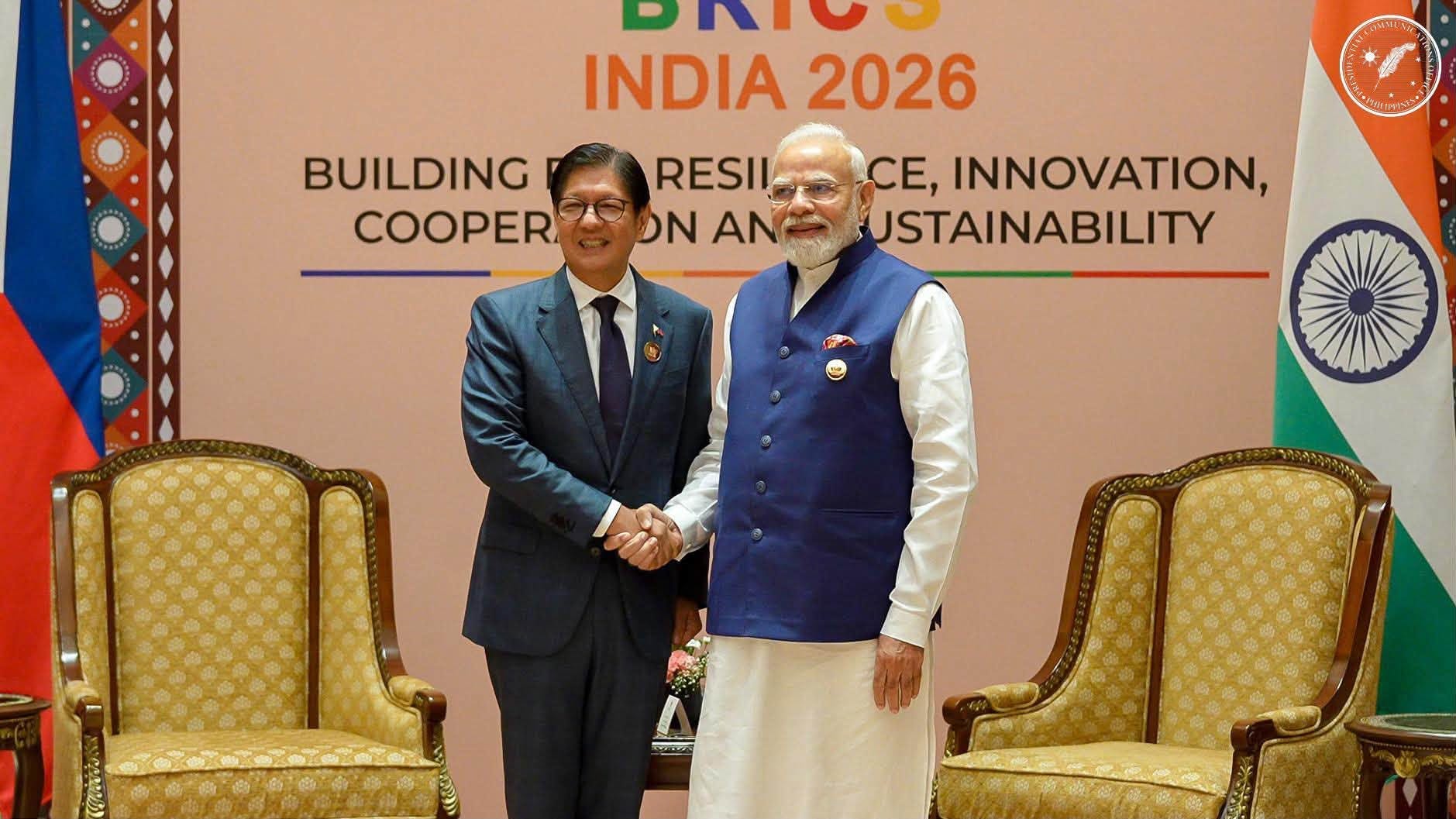
Philippine President Ferdinand Marcos Jr. met with Indian Prime Minister Narendra Modi on the sidelines of the 18th BRICS Summit in New Delhi last September 13. Official handout.
Manuel Mogato | October 19, 2026
India has emerged as the strongest power not only in South Asia but also in the world, emerging as the 4th military power behind the United States, Russia, and China.
Based to the Global Firepower Index, New Delhi’s rise was driven by its consistent defense spending rate, rapid military modernization, and a growing standing army.
India’s military has been focusing on advanced missile systems, nuclear capacities and an expanded naval footprint and power, which further reinforced its status as a global power.
For instance, its naval forces have extended their reach beyond the Strait of Malacca and into Southeast Asia’s disputed waters.
Three weeks ago, two Indian warships took part in naval drills in the Philippines together with a vessel in Singapore, displaying maritime power that made China take a second look at as a potential regional rival.
President Ferdinand Marcos Jr. has visited New Delhi, held security and trade dialogue with Prime Minister Narendra Modi to explore deeper and broader defense cooperation.
Manila has acquired three batteries of India’s BrahMos coastal missile system for more than $300 million and was considering a second order, on top of an air defense missile system as well. (Also read: Vietnam seals $700 million Brahmos deal with India)
But Manila was also counting New Delhi to support its territorial claims over the South China Sea as India is also at odds with China over its borders in the Himalayas. (Also read: India, Philippines elevate ties to strategic partnership amid rising China tensions)
New Delhi’s recent interest in the region would certainly boost its alliance with the United States and other like-minded states, such as Australia and Japan.
Collectively, the four powers are known as the Quad partners, a counterbalance to a rising China, seen as a regional bully for harassing smaller and weaker Southeast Asian neighbors, such as Malaysia, the Philippines, and Vietnam — all claimants in the South China Sea.
Despite India’s steady rise, most Western countries do not respect and recognize New Delhi’s military and economic power.
Although India gained independence after the Second World War, the British have not treated New Delhi as a co-equal within the Commonwealth, looking down on it as a former colony for three centuries.
Canada, another Commonwealth country, also has no high regard for India. Canadian leader Mark Carney has labelled New Delhi a “middle power”, overlooking India’s geopolitical weight.
The British also supported relentless Canadian attacks on India on the issue of Sikh separatism, blaming Indian officials behind the killings of Sikh leaders in Canada with the collusion of US intelligence officials.
Although US President Donald Trump considers India’s Modi a personal friend, Washington does not see New Delhi as a co-equal.
India is treated as a secondary power, much like Australia and Japan, with limited military capabilities. Canberra and Tokyo have small armed forces, with no nuclear-powered submarines. They have a secondary role and have seen limited combat experience since the Second World War.
Like Australia, Japan, and some Southeast Asian states, such as Indonesia, the Philippines, and Singapore, Washington wanted New Delhi to follow the US policy line, particularly its anti-China strategy.
The United States has been exerting pressure on India to stop military and technical cooperation with Russia, its main adversary, and refrain from importing fuel amid the Ukraine conflict, which Washington supports.
Thus, it will never share its advanced military and nuclear technologies with India, worried that a third country could gain or steal them.
Washington only needed New Delhi as an asymmetric tool to deter Beijing. The United States has been treating India the same way with Australia, Japan, and some ASEAN states.
There are real dangers that India’s national economic and security interests, as well as its foreign policy as a rising and independent power, would be affected if it follows the US’ dictates.
It should resist US pressures, hold its ground, and strengthen its position as an independent pole of power in the regional and international arena.
India is an emerging global power. It should not allow the West, particularly the United States, the United Kingdom, and even Canada, to take control of its destiny.
Southeast Asia is counting on India to fill the shoes left by the Americans as they focused on the Middle East and Eastern Europe.
India has earned its place in the world as an economic powerhouse and as an emerging military power. The West — the US and UK — must show respect too.