


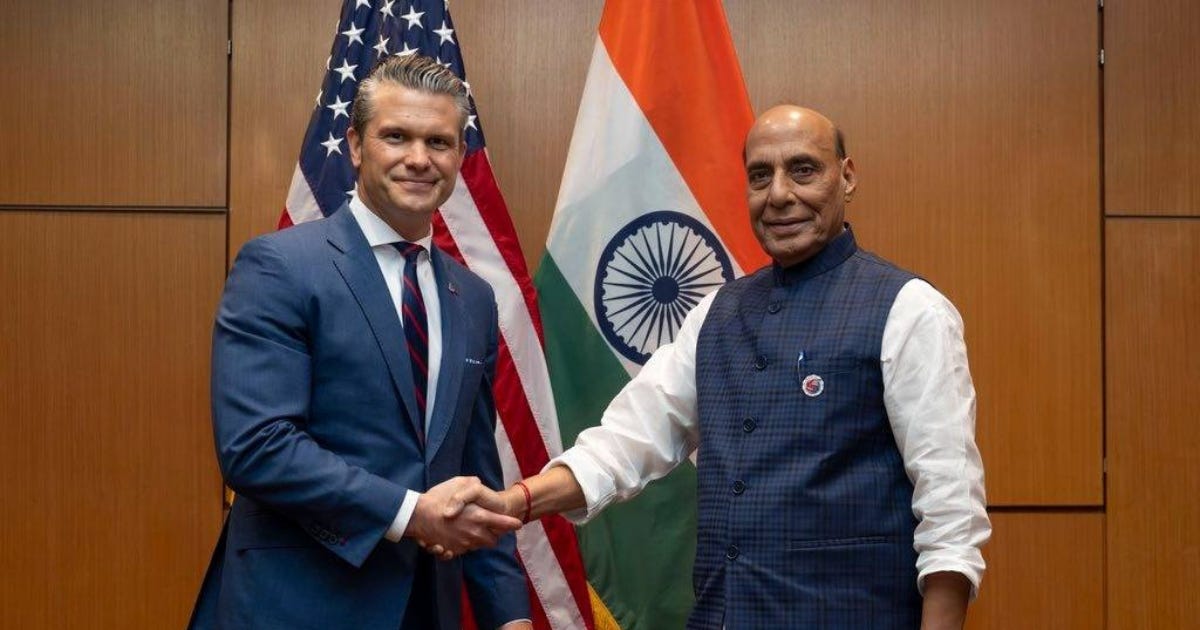
Defence Secretary Pete Hegseth and Indian Defence Minister Rajnath Singh signed the 10-year defence pact Friday, October 31, in Kuala Lumpur. Photo from Ministry of Defence.
By: Pirzada Shakir | Published: November 12, 2025
New Delhi – India and the United States have taken a major step toward redefining South Asia’s security landscape as both nations signed a 10-year defence framework agreement.
The security agreement aimed at long-term military, industrial, and technological cooperation, a move that could shift the balance of power in South Asia.
At the sidelines of the annual Association of Southeast Asian Nations (ASEAN) Defense Ministers Meeting (ADMM) and ASEAN Defence Ministers’ Meeting-Plus (ADMM-Plus) in Kuala Lumpur, US Defence Secretary Pete Hegseth and Indian Defence Minister Rajnath Singh finalized the defense agreement
The accord outlines a roadmap for collaboration in defense production, intelligence coordination, and joint research in emerging domains such as cyber, space, and maritime security.
The pact, one of the most comprehensive military arrangements between the two countries, comes at a time when South Asia’s strategic equations are shifting rapidly, shaped by China’s expanding footprint, Pakistan’s alignment with Beijing, and India’s ambitions for regional leadership.
Titled the “2025 Framework for the US–India Major Defense Partnership,” the agreement builds upon earlier foundational pacts like COMCASA and BECA, but expands far beyond them.
“While much of Washington’s focus on Indo-Pacific security has been on the Taiwan Straits and the South China Sea, there is growing recognition that the Indian Ocean is becoming a significant emerging theater,” said Richard Rossow, senior adviser at the Center for Strategic and International Studies (CSIS).
“China’s expanded naval presence and investments in the region make this a focal point for the India–China rivalry,” he added.
By deepening interoperability and enabling US technology transfers, the framework enhances India’s ability to deter threats along both its continental and maritime frontiers.
The agreement aligns with India’s pursuit of self-reliance through co-development, while embedding it within a network of democratic defense partnerships that collectively underpin the Indo-Pacific order.
“There’s nothing wrong in India signing a long-term pact with the US,” said retired Major General Sanjay Soi, a defense expert based in Delhi. “It ensures supply-chain resilience, allows flexibility in sourcing, and strengthens our preparedness without compromising independence.”
Implications for South Asia’s strategic equations
The pact subtly tilts the regional power balance in India’s favour. Access to advanced US defense systems and real-time intelligence-sharing offers India a sharper strategic edge. It may redefine how deterrence is perceived in the subcontinent.
For Pakistan, the deal highlights a long-term shift. Once a major US ally during the Cold War and the Afghan wars, Islamabad now finds its defense reliance firmly tied to Chinese weaponry and funding.
Analysts in Islamabad have termed the new pact a “strategic imbalance,” reflecting unease over shrinking space for maneuver.
“This agreement is a reflection of existing security threats, not the cause of them,” Rossow noted. “China is aggressively pushing ahead with outlandish territorial claims against India, Bhutan, and Nepal. This has already triggered multiple military confrontations, and based on the trajectory, such confrontations seem more likely to increase over time.
General Soi said India is navigating a “very fine balance”. “We continue defense ties with Russia and Europe while building new operational depth with the US. This approach keeps national interest at the core and avoids over-alignment with any bloc,” he said.
China’s response, meanwhile, is expected to involve tightening its axis with Pakistan and expanding its naval presence in the Indian Ocean through dual-use port facilities in Gwadar, Hambantota, and possibly the Maldives. Beijing sees the Indo–US convergence not just as a security arrangement but as part of a broader containment strategy.
Strategic calculus
For India, the pact fits squarely into its goal of modernizing armed forces while preserving strategic autonomy.
It supports New Delhi’s ambition to become a global defense manufacturing hub under “Make in India, Make for the World,” and complements ongoing co-production efforts with Russia and Europe.
“Technological cooperation will be a game changer for India’s defense industry,” a senior Indian official involved in the negotiations has been quoted by multiple Indian news outlets as saying. “It’s about building capability, not dependency.”
According to General Soi, the pact will help India to counter China’s expansionism.
“So when it comes to India, China will definitely support Pakistan and our relationship with the USA will definitely help counter the China-Pakistan axis. Because the USA was looking for some strong partner in the South China Sea area and to counter the expansionism and assertiveness of China,” he said.
For Washington, the framework solidifies India’s role as a “critical anchor” in its Indo-Pacific strategy. Enhanced interoperability will allow faster joint responses to crises, from the Himalayas to the South China Sea, and contribute to collective deterrence alongside allies such as Japan and Australia.
“Collectively, Quad nations will indefinitely retain a significant economic and military advantage over China,” Rossow observed. “I do hope that increased cooperation among aligned nations will be a strong deterrent force to allow the people across the Indo-Pacific, including China, to thrive.”
As Rossow put it, “The United States would like to see India retain its position as the dominant power in the region.”