


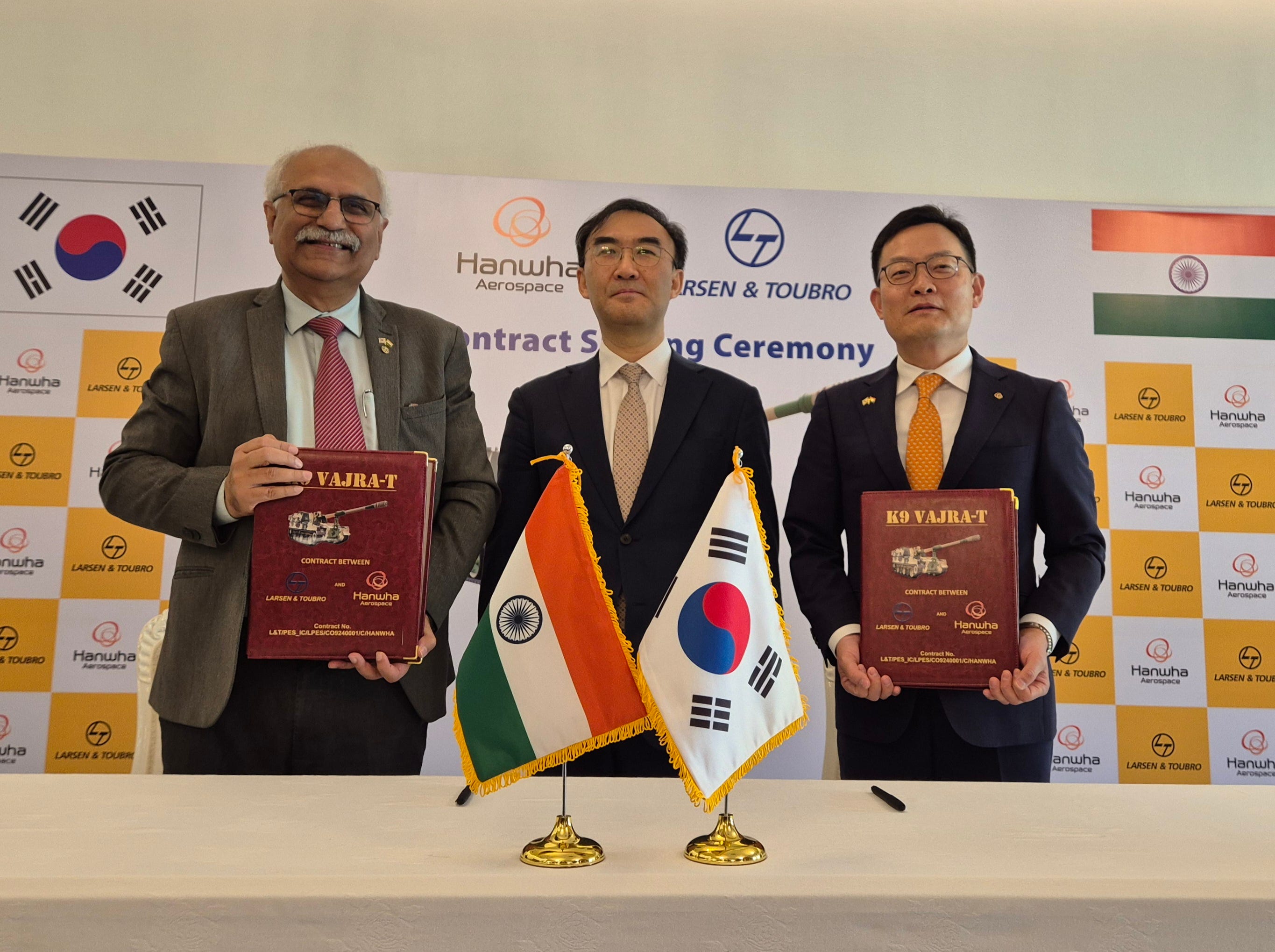
The Indian Army and Hanwha signed a second K9 Vajra-T Contract last April 3, 2025 after the company delivered 100 units in 2017. Photo from Hanhwa Aerospace.
Pirzada Shakir | June 21, 2026
NEW DELHI — The Indian Army is gearing up for one of its biggest artillery modernization moves in decades: buying more than 300 new K9 Vajra self‑propelled artillery guns in a deal worth roughly $2.8 billion.
The proposal, which is now moving through the approval process, signals a clear change in strategy. Instead of making small, step‑by‑step upgrades to old guns, the Army is now planning a full‑scale rebuild of its mobile firepower along the borders with Pakistan, China and Bangladesh.
The K9 Vajra is a self‑propelled, armoured tracked howitzer that can fire, move and re‑position within minutes while protected against small arms, shrapnel and some air‑bursts.
Its 155 mm, 52‑calibre gun can deliver high‑explosive, precision‑guided and extended‑range munitions far beyond the reach of older towed artillery.
The Army’s decision to expand the K9 fleet comes against a backdrop of deep unease following recent border confrontations and India’s Operation Sindoor.
India already operates around one hundred K9 Vajras, built under a technology‑transfer arrangement with South Korea’s Hanwha Aerospace. The new proposal seeks to add more than 300 units.
Defence expert, retired Major General Sanjay Soi, stressed that the procurement is part of a broader, ongoing modernization program rather than a reactive move to a specific incident.
“It is a continuous modernization program which is ongoing,” said General Soi. “The Indian Army also needs self‑propelled artillery guns which can move from one place to another and can engage targets at a very fast pace. It is not a reactive move; it is a normal, proactive move of keeping our armed forces modern.”
Major General Soi also highlighted the K9’s unique ability to operate across India’s diverse geographies.
“The trials of this K‑9 suggest that it can operate in super‑high altitude in the Leh‑Ladakh region also, in mountains and in plains and in deserts,” he adds.
“With its long range and shoot‑and‑spot capability, it can fire and change location immediately, giving us an overall advantage on all three fronts — Pakistan, China, Bangladesh.” (Also read: India, China pursue ‘strategic autonomy’ as Trump tariffs force global realignment)
The K9 Vajra is especially relevant for India’s dual‑front reality. Along the Pakistan border, mobility is critical in the flat, arid plains of Rajasthan and Punjab, where rapid thrusts and counter‑thrusts can unfold over hours. (Also read: Saudi-Pakistan agreement marks structural shift in Gulf and South Asian security order)
Along the China border, the challenge is different: high altitude, thin air and limited infrastructure.
The K9’s all‑terrain mobility, enclosed crew compartment and ability to operate in extreme cold and thin oxygen make it more adaptable than many towed systems.
It can be deployed in forward positions, deliver precision strikes on forward logistics hubs and pull back before enemy long‑range missiles or artillery can respond.
This acquisition is part of India’s larger defence preparedness and modernization architecture. (Also read: India developing deep-strike weapon, challenges US bunker-buster ordnance dominance)
The Army is simultaneously pursuing long‑range precision missiles, advanced drones and next‑generation command‑and‑control systems.
The K9 Vajra is the artillery counterpart to these capabilities, providing the massed, mobile firepower needed to back up strategic strikes and deterrence.
Retired Lieutenant General Sanjay Kulkarni, a former Infantry director-general, underlined that the procurement is not directly tied to recent clashes but is part of a long‑standing standardization and modernization effort.
“It is all part of upgradation, modernization, standardising the 155 mm calibre across the artillery. This is an old process which is going on,” said General Kulkarni.
General Kulkarni also pointed to the K9’s range and its role in strengthening high‑altitude defence.
“This has a range of about 40 kilometres, which is a very good range, an excellent range,” he said.
“All the old guns will be replaced, especially for higher altitude. So it is part of the modernization, upgradation, Atmanirbhar and indigenization drive to strengthen high‑altitude defense.”
General Kulkarni further underlined the K9’s contribution to India’s self‑reliance and border security. These guns are being made in India,” he said.
“They are always there to ensure that the sanctity of the LoC (Line of Control) or the LAC (Line of Actual Control) is at no time compromised.”
In a region where both Pakistan and China are modernizing their own artillery and long‑range strike systems, India’s move is a response to a rapidly changing balance of power on the ground.
