


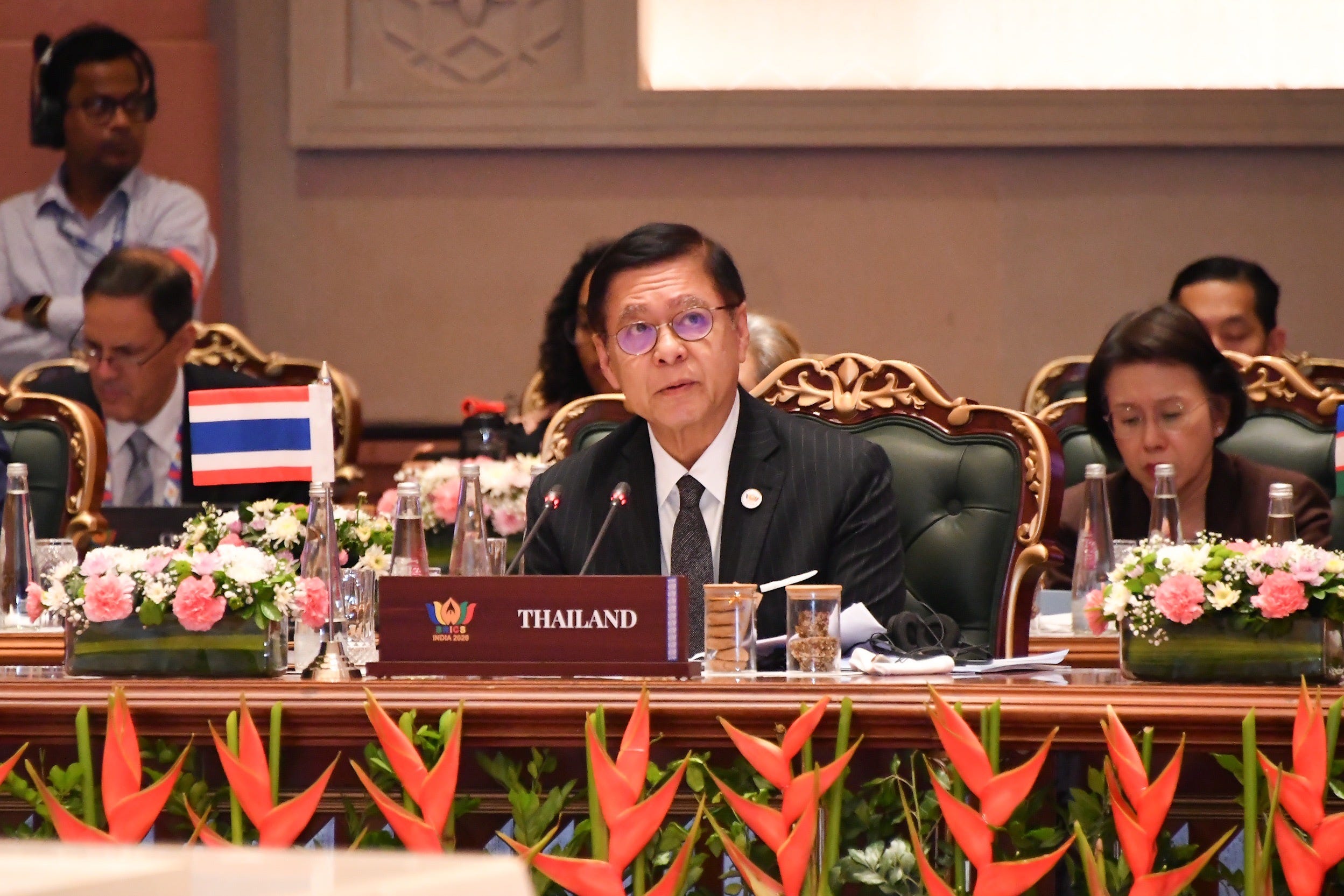
Deputy Prime Minister and Foreign Affairs Minister H.E. Mr. Sihasak Phuangketkeow during the BRICS Foreign Ministers’ Meeting. Official handout.
Prapapoom Eiamsom | June 2, 2026
BANGKOK — On the sidelines of last May’s BRICS Foreign Ministers’ Meeting in New Delhi, Thai Deputy Prime Minister and Minister of Foreign Affairs Sihasak Phuangketkeow held critical bilateral talks with Indian External Affairs Minister Subrahmanyam Jaishankar.
The primary focus of the meeting was the persistent reality: the long-delayed India–Myanmar–Thailand (IMT) Trilateral Highway, intended to link South Asia to Southeast Asia, remains frozen due to the civil unrest in Myanmar.
The ambitious 1,360-kilometre highway—designed to stretch from Moreh in northeastern India through Myanmar to Mae Sot in Thailand—serves as the foundational anchor for New Delhi’s “Act East” policy.
First proposed in 2002 under the “Look East” framework, the corridor was engineered to lift India’s landlocked northeastern states out of geographic isolation, transforming them into an economic gateway to the broader Asia-Pacific. However, because of the intensifying internal conflict following Myanmar’s 2021 military coup, operational targets have repeatedly slipped, with current projections drifting toward 2027.
While both New Delhi and Bangkok have expressed readiness to finalise infrastructural investments, the political unrest in Myanmar has brought physical connectivity to a standstill. (Also read: Securing China’s ‘front door’: Peacemaking mission in mainland Southeast Asia)
In an interview following the bilateral talks, Sihasak said, while Thailand is ready and India remains committed to the project, the ongoing instability in Myanmar is an unyielding bottleneck. (Also read: Philippine Statement on the transfer of Daw Ang Suu Kyi to house arrest)
To overcome the institutional paralysis within ASEAN’s traditional diplomatic channels, New Delhi and Bangkok are leaning toward targeted mini-lateral frameworks.
During their meetings, India proposed a subsequent round of the Six-Country Informal Consultation on Myanmar, which brings together Thailand, Laos, Bangladesh, China, India, and Myanmar.
This tracking group, first convened in Bangkok in December 2024, operates as a pragmatic mechanism to address immediate, cross-border security concerns that larger bureaucratic structures have failed to resolve.
The security consultations focus primarily on securing shared frontiers against shifting territorial control by ethnic armed organisations, coordinating crackdowns on cyber-scam networks and human trafficking rings proliferating in lawless border zones, and crafting local, issue-based peace efforts to complement stalled regional initiatives.
With India assuming the chair for the upcoming consultations, Thailand has voiced full support for New Delhi’s leadership.
Thailand’s current diplomatic strategy toward Myanmar is characterised as a calibrated re-engagement.
This pragmatic policy acknowledges that isolation has failed to yield stability; instead, Thailand seeks to maintain direct communication with all active factions to secure its immediate economic borders and handle mounting humanitarian pressures.
For Thailand, the IMT highway is not merely a trade route but a strategic vehicle to realise its long-term ambition of becoming mainland Southeast Asia’s primary logistics hub.
Positioned at the geographic heart of the region, Bangkok aims to be the seamless link to India’s industrial capacity, with Thailand’s Eastern Economic Corridor (EEC) and the neighbouring markets of Cambodia, Laos, Myanmar, and Vietnam.
By establishing a direct overland alternative, Thailand seeks to bypass the heavily congested and narrow Strait of Malacca, which has historically concentrated maritime wealth in Malaysia and Singapore.
The economic dividends for Bangkok are substantial, providing an overland export pipeline for Thai automotive components, electronics, and agricultural products directly to India’s rapidly expanding middle class.
Crucially, this opens up a vital channel to diversify trade and balance Thailand’s heavy economic reliance on China.
For India, the stakes are equally high. Economically, regional connectivity with ASEAN is projected to unlock more than $70 billion in incremental regional GDP. (Also read: Vietnam seals $700 million Brahmos deal with India)
Strategically, the highway provides an essential counterweight to China’s expanding footprint in Southeast Asia.
Access to Myanmar’s domestic energy markets would help India in diversifying its oil and natural gas imports away from the volatile Middle East. Ultimately, the consensus from the New Delhi meetings indicates that India cannot truly “Act East,” and Thailand cannot fully secure its logistics future, until a durable peace is restored to the fractured state that lies between them.