

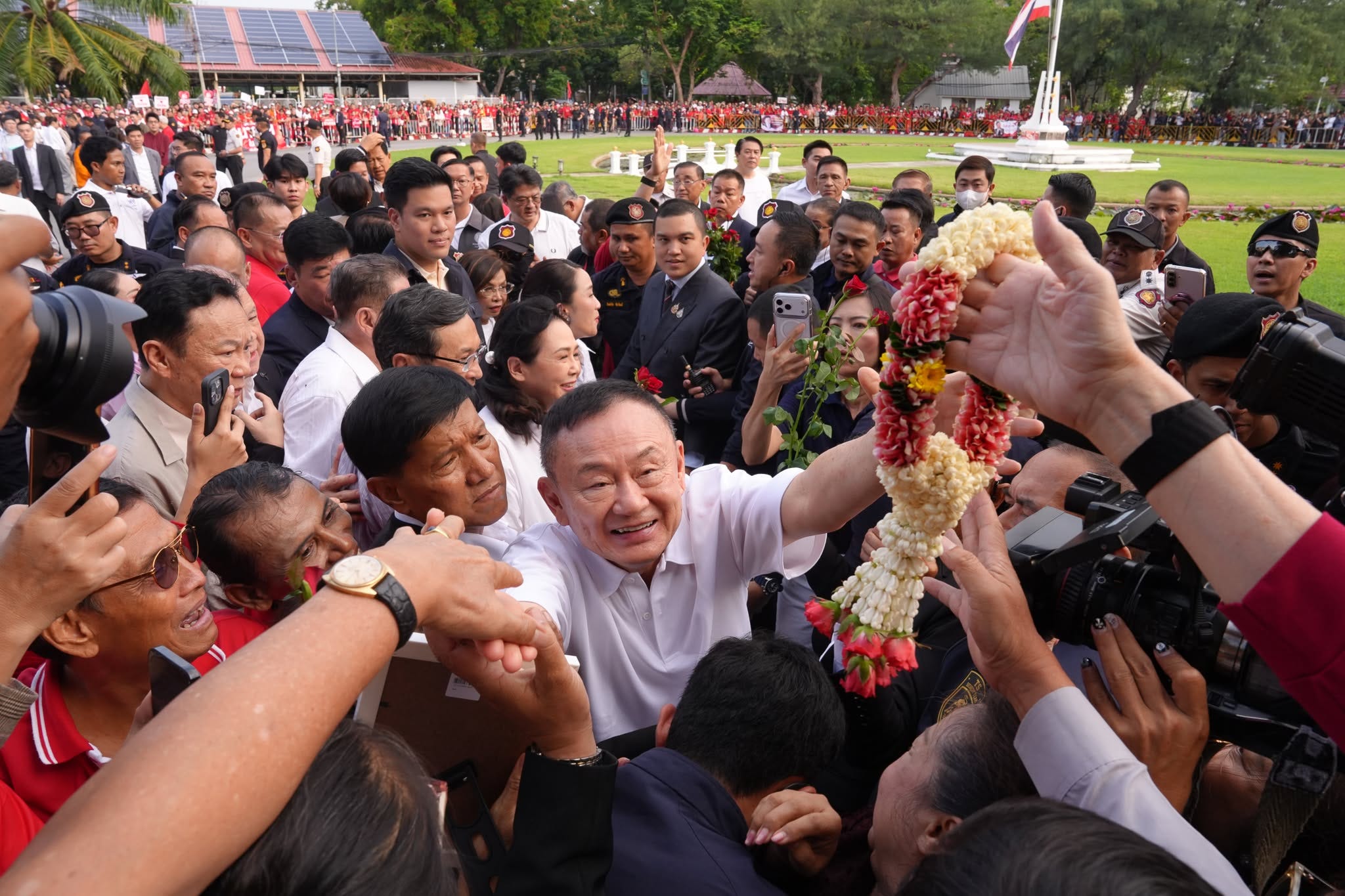
Shinawatra supporters gather outside Klong Prem Central Prison to welcome former Prime Minister Thaksin Shinawatra on 11 May 2026. Photo from Voice TV.
Kunravee Sukhimoke | June 19, 2026
BANGKOK — Crowds of media and supporters gathered outside Klong Prem Central Prison on the morning of 11 May 2026 as former Thai Prime Minister Thaksin Shinawatra, Thailand’s 23rd prime minister, arrived following a four-month parole after serving approximately eight months in prison.
Thaksin’s imprisonment stemmed from a series of cases initiated after the 2006 military coup that removed his elected government and triggered a broad review of his administration.
The cases included allegations linked to a state lottery scheme, an Export-Import Bank loan, and telecom concession arrangements, all pursued in the post-coup period.
Nearly two decades later, Thaksin remains one of the most influential and politically divisive figures in modern Thai history, as debate continues over whether his influence will gradually diminish with time or continue to shape Thailand’s political trajectory from behind the scenes.
No direct role
Following his parole and a broader shift in legal and social status, questions over Thaksin Shinawatra’s relationship with the Pheu Thai Party remain under close public and political scrutiny.
Speaking to reporters, Labour Minister and Pheu Thai Party leader Julapun Amornvivat said the former prime minister has no involvement in the party’s management, either now or in the future.
“Whether he will be involved with the party again, no — that is over. That question should no longer be asked,” he said, adding that the party will continue to operate through its executive structure and organisational mechanisms while maintaining the political legacy of the Thai Rak Thai Party era.
Julapun nonetheless described Thaksin as a “spiritual leader” whose perspectives on economic and social issues may still be considered, but stressed that he holds “absolutely no role” in decision-making or party administration.
Some analysts, however, argue that Thaksin continues to wield significant symbolic influence despite holding no formal political role. They say his political legacy remains closely tied to Pheu Thai, with his network and indirect influence still helping sustain the party’s support base.
In their view, his name remains one of Pheu Thai’s strongest political assets, continuing to shape public perceptions and expectations of the party.
Possible indirect role
In a separate strand of political analysis, politicians and academics offer differing views on how Thaksin’s role may evolve following his parole.
Natthawut Saikua, a former leader of the United Front for Democracy Against Dictatorship (UDD), commonly known as the Red Shirt movement, said Thaksin is unlikely to turn his back on the country and its people, though legal conditions and post-parole restrictions continue to limit his public role.
While he is not expected to return to direct political activity or publicly engage with organisations as he once did, Natthawut suggested that Thaksin’s “spirit” remains connected to politics.
Associate Professor Pichai Rattanadilok Na Phuket of the National Institute of Development Administration (NIDA) said Thaksin is expected to avoid direct political commentary ahead of his full release, citing both legal sensitivities and his continued influence within Thai society.
“Anything he says is highly sensitive, as he remains a figure with considerable political influence. His remarks tend to draw both support and opposition,” he said.
While Thaksin is still regarded by some as a “spiritual leader” of the Pheu Thai Party, Pichai argued that his political influence has declined significantly from its peak. He noted that Pheu Thai’s support base today increasingly resembles that of the Bhumjaithai Party, the ruling coalition’s leading party, relying heavily on lower-income voters, labour groups and older generations, while its traditional middle-class support has weakened.
Pichai said Thaksin could still help the party to some extent through advice and informal networks, but no longer shapes Thailand’s political direction in the way he once did.
Nevertheless, he assessed that after September 2026, Thaksin could re-emerge in an informal advisory role, particularly through behind-the-scenes engagement with political actors and renewed visibility in domestic and international media.
Influence beyond formal office
Although Thaksin Shinawatra’s formal political role has clearly diminished, he remains widely viewed as a key variable in Thailand’s political landscape.
His transition from direct leadership to a more indirect form of influence reflects a broader shift in how political power is exercised outside formal office structures in Thailand.
The question that remains is whether his influence will continue to fade over time, or persist as a lasting force shaping Thailand’s political trajectory from behind the scenes once he completes his sentence and regains full freedom.