


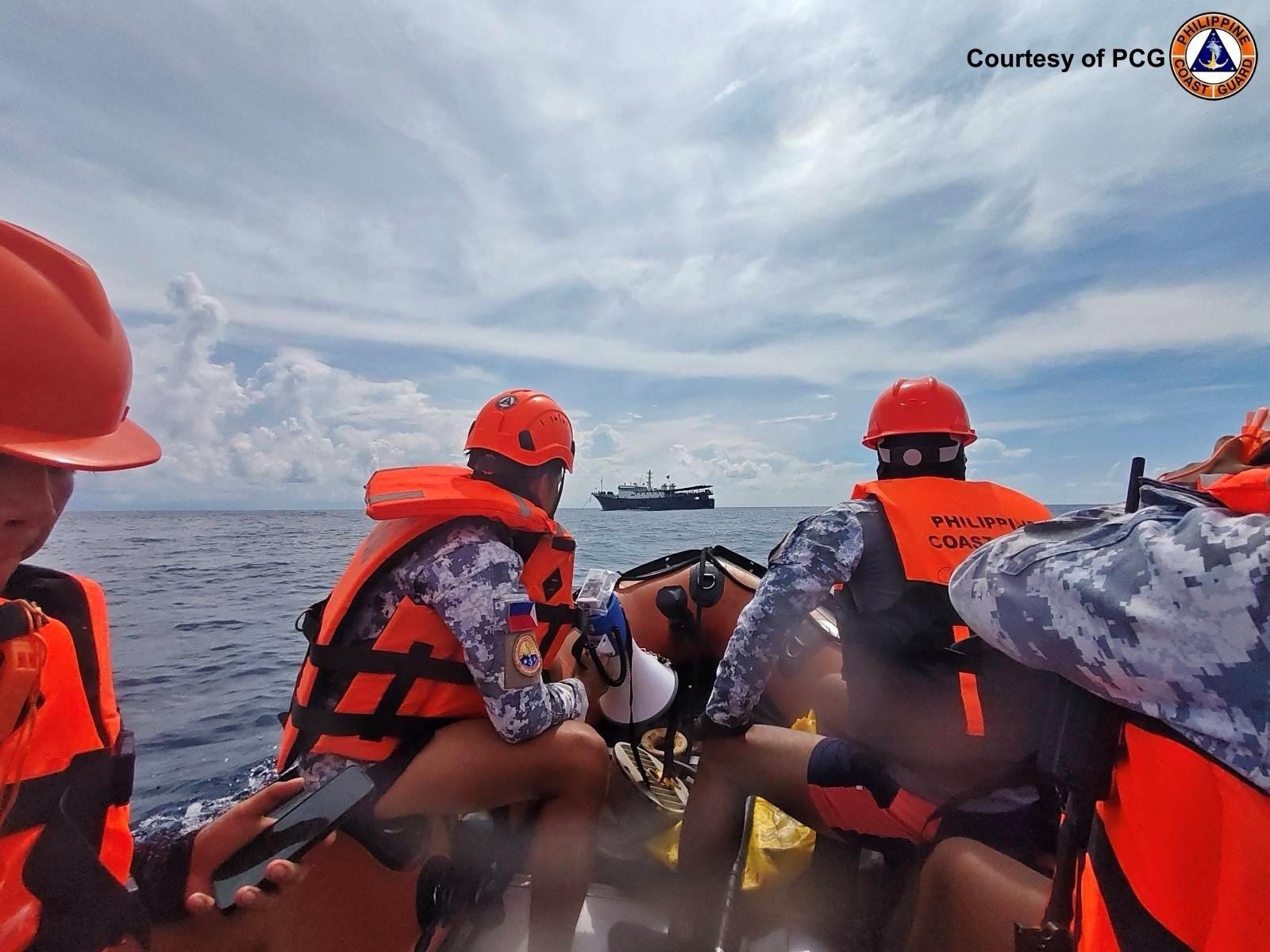
Philippine Coast Guard (PCG) personnel drove away Chinese fishing vessel and four deployed small boats in the sea near Lawak Island last October 15. Photo from PCG.
Manuel Mogato | October 17, 2026
In recent incidents around Bajo de Masinloc and other parts of the West Philippine Sea, China has displayed its firepower to harass the Philippines’ smaller and slower aircraft and vessels.
Faster and more lethal advanced Chinese J-16 fighters buzzed Philippine Air Force (PAF) surveillance turbo-prop aircraft on maritime domain awareness flights near Bajo de Masinloc.
Heavily-armed Chinese frigates also shadowed Philippine Coast Guard vessels not only in Bajo de Masinloc, but in Ayungin Shoal and in other Philippune-occupied features, particularly in Kota island.
In the past, China deployed armed militia vessels in a cabbage approach in the disputed waters to mask how powerful its forces in asserting its claims in almost the entire South China Sea.
It has also rammed weaker and smaller Vietnamese vessels in waters near the Southeast Asian state, sinking fishing boats and damaging maritime law enforcement vessels.
The Philippines thought China would not do the same to its public vessels because of the country’s Mutual Defense Treaty (MDT) with the United States.
But it was wrong. Chinese Coast Guard vessels have activated its water cannon numerous times and have deliberately rammed local maritime law enforcement and fisheries vessels.
And now the intimidation tactics escalated by sending frigaes and fighters. China is still holding its punches by avoiding direct confrontation or a direct attack.
How long can it hold the punches?
In 1988, China sank three Vietnamese vessels in a clash near Johnson and Fiery Cross Reefs, marking the start of Chinese occupation in the South China Sea.
Eventually, China took control of seven features and expanded them into artificial islands with ports and airfields to control the disputed areas.
Thus, it was no surprise that J-16 fighters instantly appeared alongside PAF planes flying over Bajo de Masinloc, as the Chinese planes may have come from either Subi or Mischief Reef, just a few minutes away.
The fighters’ presence was a display of air superiority, not only to intimidate the Philippines, but also to change tactics.
Perhaps the changes came as the Philippines upgraded air and naval assets from second-hand World War II platforms to modest missile-capable planes and ships.
The Philippines now has four guided-missile frigates and is acquiring upgraded FA-50 fighters byb 2028. It also acquired coastal missile defense and air defense systems.
Although the Philippines still cannot match China’s superior firepower, logistics, and stable supply chain, it has acquired minimum capabilities to defend its sovereignty and rights.
China’s escalating intimidation around Bajo de Masinloc and Ayungin Shoal should be a wake-up call for Filipino lawmakers to prioritize the long-overdue military modernization program.
The military needs several dozen multi-role fighters, batteries of coastal defense missiles, a few more surface combatant vessels, conventional sub-surface vessels, and thousands of independent drones to protect Philippine national interests.
It would make another country think twice before making an attack to take over Philippine territories. (Also read: Learning to fight future wars in Balikatan drills)
In late 2024, the military prepared a 2 trillion pesos plan to upgrade its equipment and defense systems, but Congress has not moved to fund them.
For instance, the House of Representatives passed a 7.2 trillion pesos budget for 2027, but realigned more than 200 billion pesos for infrastructure projects and financial aid programs designed to help politicians win elections in May 2029.
The lower house slashed funding for health and education programs and kept the defense sector at the barest minimum.
The 50 billion pesos allocation for the military modernization program is not enough to sign new contracts for ships and planes. It only allocated money to pay for loans made for equipment acquired under the Duterte administration. It means no new big ticket contracts.
Washington has urged its allies to raise defense sector spending to at least 3 percent of its GDP to boost deterrence capabilties in the face of rising threats from China and Russia.
Filipino administration and lawmakers, however, are stubborn. They refused to raise defense spending up to 2 percent of GDP, keeping it at a little over 1 percent.
The United States and Japan have been providing some military assistance, but the Philippines cannot complefely rely on a few pieces of American air defense and coastal missile equipment and second-hand Japanese fixed-wing and detroyer escorts to boost its defenses.
The Philippines’ neighbors have been upgrading their capabilities, like Indonesia, which acquired an Italian aircraft carrier, or Singapore, which ordered a few F-35 advanced fighter jets.
Boosting deterrence capabilities would help keep China beyond the Philippines’ maritime zones if Beijing realized Manila has more than enough equipment to push them out.
This would reduce China’s intimidation tactics, and the Philippines could earn some respect.