


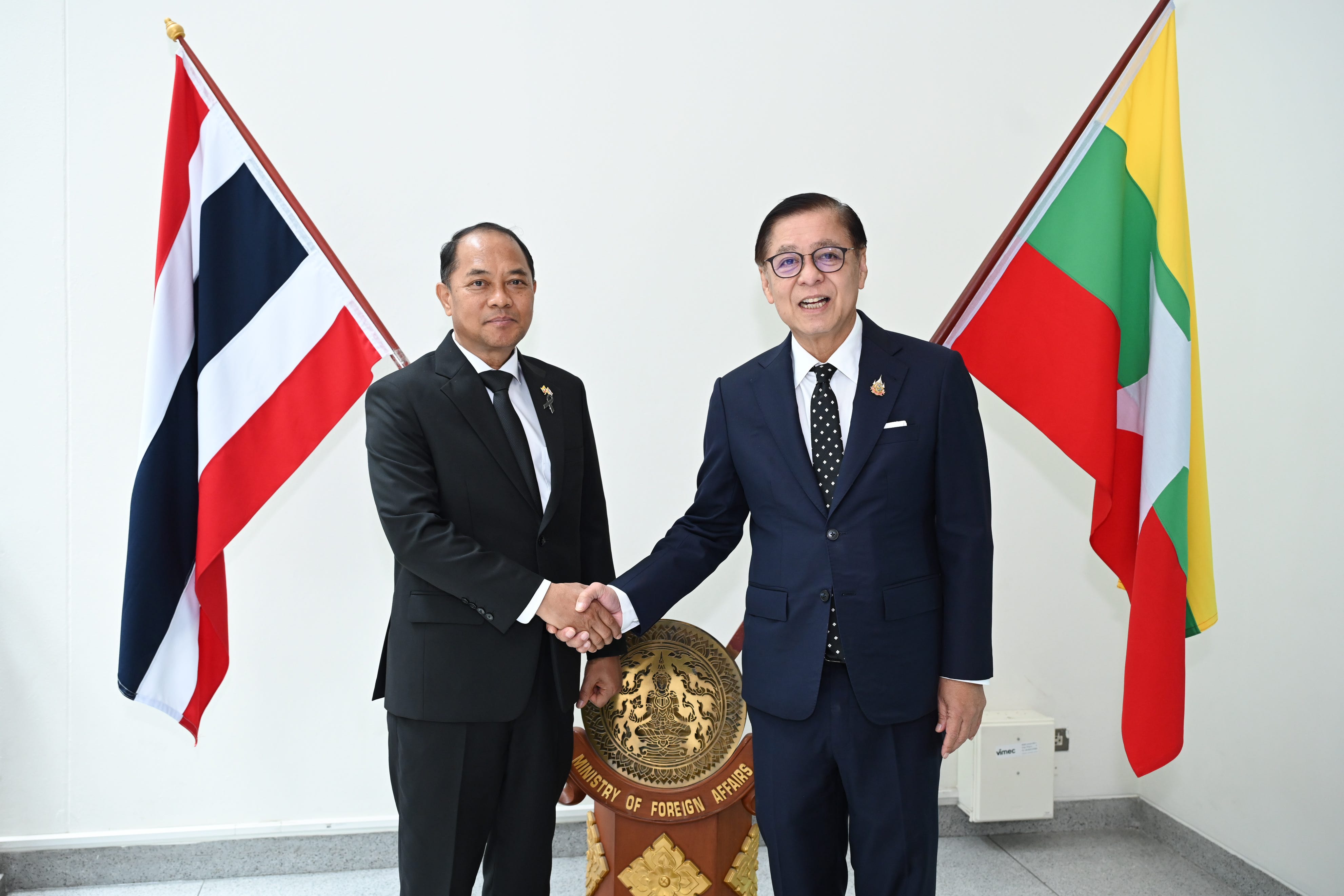
Thailand Deputy Prime Minister and Minister of Foreign Affairs Sihasak Phuangketkeow met with Myanmar’s Union Minister of Foreign Affairs U Tin Maung Swe last July 14 during Tin Maung Swe’s visit to Thailand last week. Official handout
Prapapoom Eiamsom | July 21, 2026
BANGKOK — The ongoing crisis in Myanmar has become the defining test of ASEAN’s credibility as a regional organization.
As conflict intensifies, Thailand—sharing a long, porous border with Myanmar —has adopted a proactive, controversial policy of “calibrated re-engagement” to pull its neighbor back into the ASEAN fold.
However, critics argue this pragmatic pursuit of stability risks legitimizing a military regime while undermining the very principles that ASEAN is sworn to uphold.
Thailand’s urgency is not born of mere diplomatic ambition; it is born of necessity. The instability across the border has translated into tangible domestic crises for Thailand. (Also read: India’s Highway to Thailand Hinges on a Peaceful Myanmar)
For instance, thousands of displaced persons in Myanmar have sought refuge on Thai soil as the lawless border regions have become epicentres for transnational crime, including human trafficking, drug production, and industrial-scale scam centres.
The issues are not merely localized; they have evolved into international burdens that frequently dominate the agenda in meetings between Thai officials and their global counterparts. (Also read: Securing China’s ‘front door’: Peacemaking mission in mainland Southeast Asia)
Consequently, the Thai government views the re-integration of Myanmar into ASEAN as the viable pathway to stabilize the border and mitigate these persistent threats.
The Thai Foreign Ministry has coined the term “calibrated re-engagement” to describe its approach. It is framed as a pragmatic evolution of the ASEAN Five-Point Consensus—a peace framework that the Myanmar military junta has largely ignored.
While international stakeholders generally do not dispute the necessity of Thailand maintaining direct communication channels with its neighbor, the execution of this strategy has become a point of intense contention.
The Myanmar military’s formal rejection of the ASEAN peace framework, coupled with attacks on ethnic groups near the Thai border just days before hosting regional representatives, was viewed by many as a clear “slap in the face.”
Instead of addressing this provocation, the Thai Foreign Ministry has rebranded its role from “mediator” to mere “coordinator.”
By intentionally lowering expectations and distancing itself from the role of a peace broker, critics argue this creates a dangerous illusion of progress.
This strategy has drawn sharp criticism from human rights activists, international relations scholars, and opposition political factions within Thailand.
The central fear is that in its hurry to secure a “quick win,” by providing a platform in Bangkok for the regime to reject the ASEAN consensus, facilitating its participation in summits, and hosting its leaders in August, critics argue that Thailand grants Min Aung Hlaing’s administration an unearned veneer of international respectability, the Thai administration is unwittingly serving as a bridge for the military regime to rehabilitate its image.
It is critical to note that this military-led government is not internationally recognized as a legitimate authority; its power stems from a coup followed by elections that were widely dismissed by the global community as neither free nor fair.
By engaging with them as if they represent a legitimate “transition phase,” the Thai government risks mischaracterising the nature of the regime.
There has been no tangible evidence of political will from this military leadership to engage in a genuine peace process or address the human rights abuses that triggered the crisis in the first place.
By granting this veneer of legitimacy without demanding corresponding concessions, Thailand may inadvertently be eroding the very leverage ASEAN possesses to pressure the junta toward real, meaningful reform.
For ASEAN, the stakes are existential. If Myanmar is welcomed back into the fold without fulfilling its obligations, it will signal to the international community that ASEAN lacks the teeth to enforce its own policies.
If the “calibrated re-engagement” strategy results in a facade of progress while violence continues unabated, the long-term impact on the border may be the opposite of what the Thai government intends. Without a genuine commitment to peace from the junta, regional stability remains a pipe dream.
The Thai government appears to have already chosen its path, opting for a high-stakes “calibrated re-engagement” strategy that leaves the nation walking a dangerous tightrope.
All eyes are now on Bangkok to see if this diplomatic gamble will yield the stability the government desperately seeks, or if it will merely deepen the regional crisis by granting unearned legitimacy to a regime that has yet to demonstrate any genuine commitment to peace.