

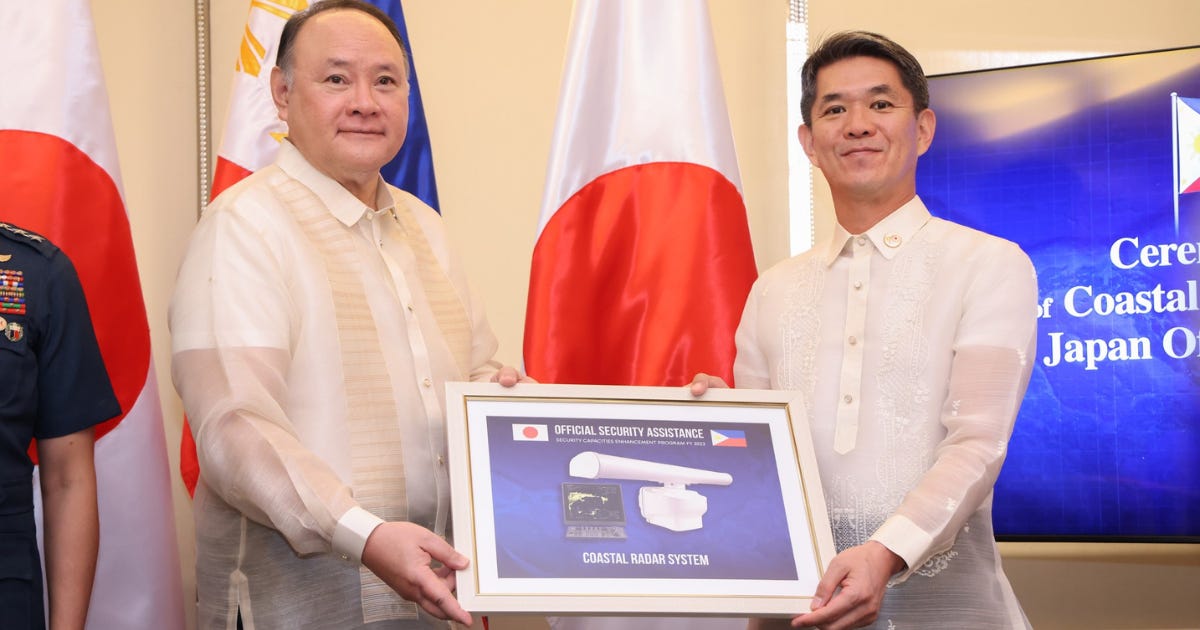
Manila — The Japanese government, through its Official Security Assistance, donated nearly 250 million pesos worth of coastal radar equipment to boost the Philippines’ maritime domain awareness, strengthening the domestic sealanes law.
Started in 2023, Tokyo’s Official Security Act has institutionalized the grant of military-relevant equipment to strengthen the deterrence capacities of partner countries, including humanitarian operations rather than frontline combat operations.
The Philippines is among the largest recipients of the Official Security Act, which has transferred at least five surveillance planes, helicopter airframes and spares, and radars.
Defense Secretary Gilberto Teodoro thanked the Japanese government for its “concrete contributions in widening and deepening our bilateral and multilateral ties” with the Philippines, which will contribute to a “free and open Indo-Pacific Region.”
“Japan’s approach to its bilateral relations with the Philippines has been rooted in fundamental sincerity and values,” Teodoro said in a speech after Japanese ambassador Kazuya Endo handed over the equipment to the Philippines.
Teodoro expressed confidence that the Philippines’ relationship with Japan will continue to grow stronger in the coming years.
Japan has become one of the biggest donors of military training and equipment. It has also signed a Reciprocal Access Agreement (RAA), a Status of Forces Agreement that allows Japanese troops to train and exercise with the Philippines.
The Philippine Senate has yet to ratify the security agreement, the third arrangement with an ally after the United States and Australia. Canada and New Zealand had also signed similar security pacts, and the Philippines and France were negotiating a sixth arrangement.
For his part, Ambassador Endo described Japan’s transfer of the five coastal surveillance radars as a “meaningful milestone.”
“This occasion marks not only the transfer of critical equipment from Japan to the Philippines but also a meaningful milestone in the steadily deepening partnership between our two countries,” Endo said.
“At a time when the security environment is becoming increasingly complex and difficult, strategic challenges in the region serve as a clear reminder that peace and stability cannot be taken for granted.”
“It must be actively and collectively sustained. As maritime democracies positioned along vital sea lanes, Japan and the Philippines are natural partners,” Endo added.
Endo said the OSA Framework reflects Japan’s resolute commitment to working closely with like-minded partners to maintain peace and security across the Indo-Pacific.
Former Prime Minister Fumio Kishida promised to transfer the five coastal radar equipment to the Philippine Navy during his visit to Manila in November 2023.
The Philippine Navy planned to install the coastal radar systems along its western seaboard, facing the contested West Philippine Sea.
The West Philippine Sea is a portion of the larger South China Sea that falls within the Philippine maritime zone under the 1982 United Nations Convention on the Law of the Sea (UNCLOS).
“The South China Sea is a vital sea lane for many countries through which a large portion of our trade and energy supplies pass,” Endo said.
“Safety, openness, and stability of these waters are therefore of direct importance to our own security and prosperity. Enhancing the Philippines’ maritime domain capability is not only an investment in the Philippines’ security, but also a meaningful contribution to regional and global stability.”