

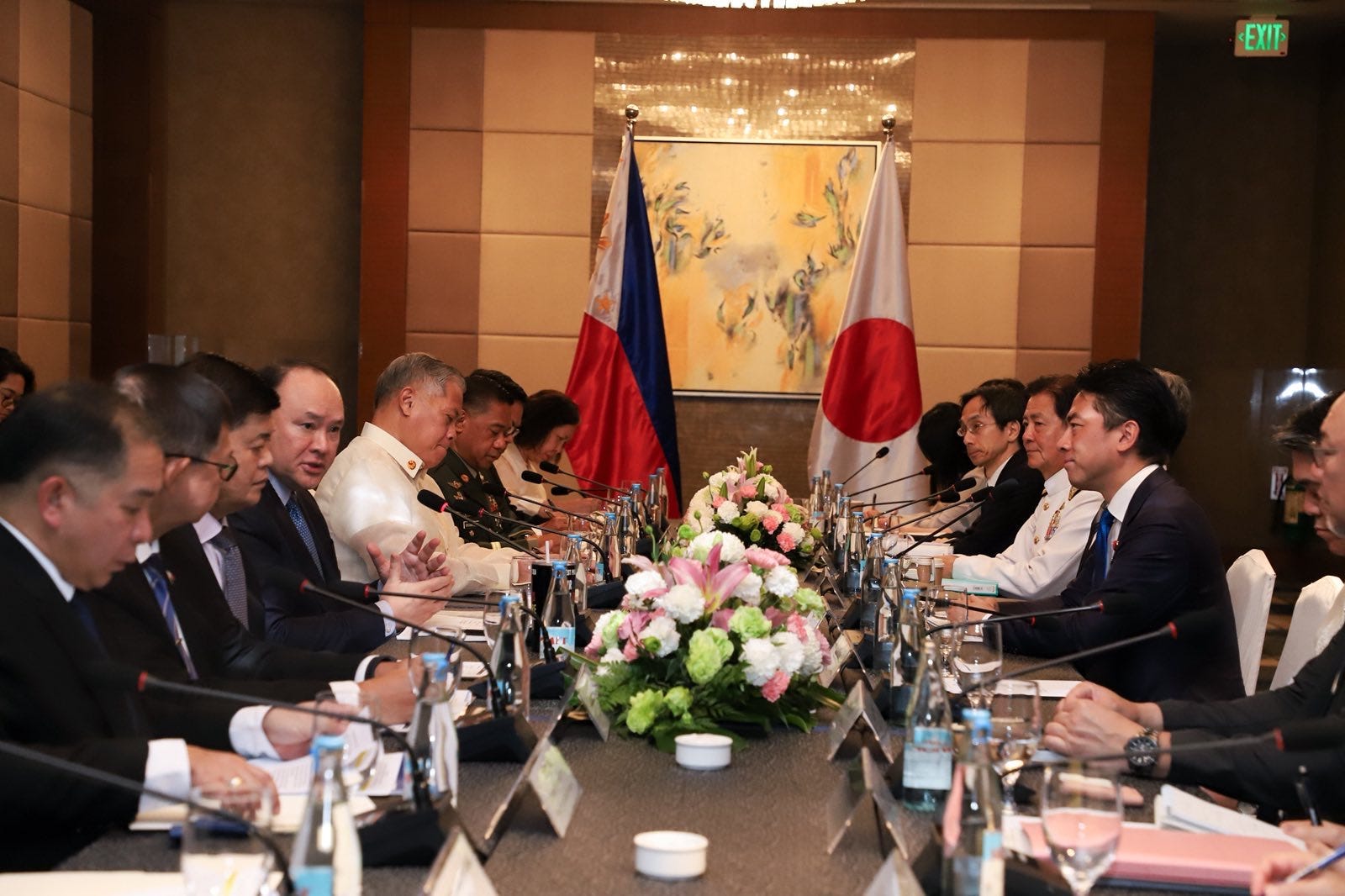
Defense Secretary Gilberto Teodoro Jr. and Defense Minister Shinjiro Koizumi met on Tuesday, May 5, for the Philippines-Japan Defense Ministerial Meeting in Makati Shangri-La. Photo from DND.
Anna Mogato | May 6, 2026
MANILA — The Japanese defense minister discussed with his Filipino counterpart the possibility of transferring lethal weapons to the Philippines after Tokyo changed last month its defense policies to arm its allies to increase deterrence in the region.
Talking to journalists after an hour-long one-on-one talk, Shinjiro Koizumi said he agreed with Gilberto Teodoro Jr. to move forward with discussions aimed at “realizing comprehensive equipment cooperation.”
He said the two sides are looking forward to the “early transfer of Abukuma-class destroyers and TC-90 aircraft, as well as other defense equipment.”
“Under this new framework for the transfer of defense equipment, Secretary Teodoro and I signed today a statement on the further promotion of defense equipment and technology cooperation,” Koizumi told journalists during a joint press conference.
Japan eased its defense policy to transfer of lethal equipment and technology to partners and allies, allowing the Philippine to access defense articles from Japan, including missiles, torpedoes, and electronic warfare equipment. (Also read: Australia signs frigate agreement with Japan)
For his part, Teodoro thanked Japan for easing its policy on the transfer of defense equipment and technology.
“And we are very happy to work with Japan in creating demonstrable results at the soonest possible time,” said Teodoro.
In a joint statement, Teodoro and Koizumi said they reaffirmed their “strong opposition” to unilateral attempts “to change the status quo by force or coercion in the East China Sea and the South China Sea.”
The two defense leaders also expressed “serious concern” over China’s aggressive activities in the South China Sea and East China Sea. (Also read: PH-Japan deeper cooperation no longer by choice ‘but requirement’ in current climate, say experts)
They shared the view that the cooperation between the two nations “is vital for national resilience of both countries.”
The two “confirmed their intention to ensure an integrated functioning of existing and new consultation platforms.”
On the transfer of equipment, the Philippines was interested in acquiring three of six Abukuma-class destroyer escorts, which are due to be decommissioned next year.
Koizumi said the new defense policies “will further strengthen Japan’s contribution to peace and stability in the region and the world.” (Also read: Japan’s destroyer export to Philippine Navy will show how far it’s ready to flex muscles in region)
“We also reaffirmed the importance of sharing situational awareness between our defense authorities,” said Koizumi.
“Against the backdrop of an increasingly tense regional environment, we concurred that both sides would hold consultations when necessary to ensure the security of both countries and the peace and stability of the region,” he said.
He said Japan is committed to further enhance defense cooperation with the Philippines and to work together “to ensure peace and stability in the region.”
The two defense leaders also welcomed the “significant progress” on the implementation of the Reciprocal Access Agreement which came into force in September last year.
The agreement paved the way for the ten-fold increase in Japan’s participation in this year’s Balikatan exercise.
Australia, Canada, New Zealand and France are also taking part along with the United States.
Later this week, Koizumi will travel north to witness one of the highlights of Balikatan — a maritime strike in Paoay, Ilocos Norte where participating countries will sink a decommissioned Navy ship.
Japanese ground self-defense forces will test fire a Type 88 surface-to-ship missile system during the maritime strike.
The US will deploy unmanned surface vessels and the Canadians will use naval guns to sink the old vessel.
In a later interview, Teodoro said he could not immediately say when Japanese vessels will be transferred to the Philippines. (Also read: Reconfiguring Philippine defense forces)
“There are working groups already finalizing the details of potential transfers,” said Teodoro.
For the TC-90s surveillance planes, he said these are just additional donations. Five were transferred earlier.
“We look forward to them,” Teodoro said.
“Now, for the Abukuma-class, I’ll wait until it happens. But hopefully, I want to see it happen very soon,” he added. (Also read: Japan plans to transfer old vessels to the Philippines)
In the future, he said Japan may transfer more coastal radars.
“We are looking to also enhance our domain awareness in terms of radars,” he said. “We are in discussion phase for that. And we need it as soon as possible.”