


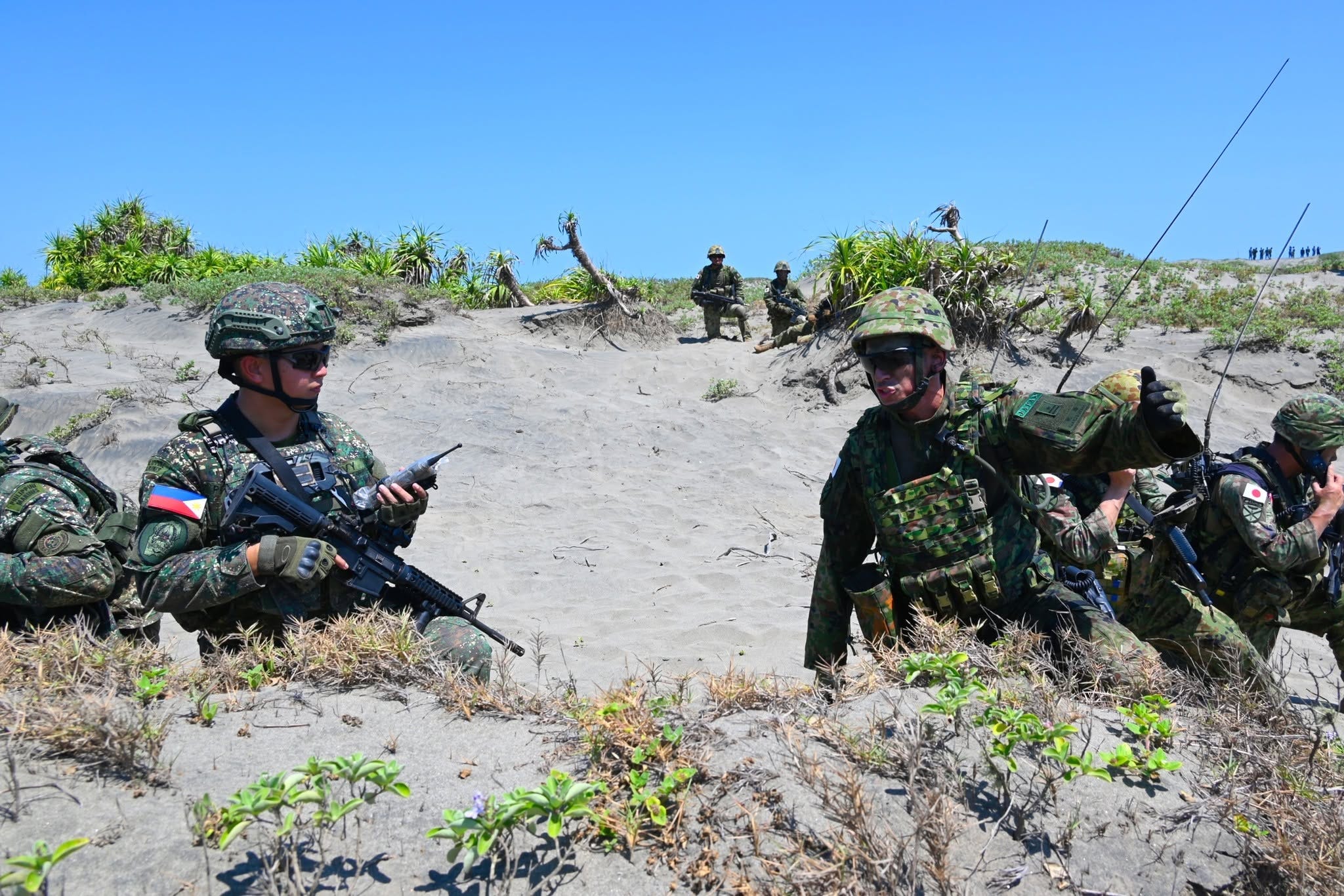
Soldiers from the Armed Forces of the Philippines and members of Japan’s Amphibious/Mine Warfare Group and Amphibious Rapid Deployment Brigade conducting a full sequence amphibious operations during the 2026 Balikatan Exercises. Photo from Minister of Defense Joint State.
Manuel Mogato | September 1, 2026
TOKYO — Japanese Prime Minister Sanae Takaichi planned to ask its parliament to approve a $57 billion budget for the self-defense forces in 2027, a record-high in response to uncertainty in the Indo-Pacific region.
According to Japan’s broadcaster NHK, the 2027 funding includes an unspecified amount for AI-based decision support systems, as Tokyo is set to revise its three national security documents.
It reported that Tokyo will focus on defense capabilities to respond to new methods of warfare that utilize AI and drones.
Tokyo will also prioritize efforts to reinforce the foundation of the nation’s defense and secure the capability to fight for prolonged periods. (Also read: Is a militarized Japan a threat to the region?)
The plans include setting up an AI-based decision support system at the Joint Operations Command, which oversees the Ground, Maritime and Air Self-Defense Forces.
NHK also reported that Japan plans to introduce enhanced cloud systems and develop underwater-launched hypersonic missiles.
Private sector initiative to allow the, to set up to acquire equipment manufacturing facilities, production and management of defense industrial complex would be encourage, the NHK further reported.
As Tokyo expands its international cooperation with like-minded countries, the defense ministry would also set up a new bureaucracy in charge of policies related to international cooperation.
Meanwhile, Japan’s Coast Guard also requested $2.2 billion for next year to counter Chinese presence and activities on Senkaku Islands in the East China Sea.
But Chinese experts immediatelyc criticized Japan for using China as an excuse to justify the continued expansion of its maritime law enforcement agency.
According to another Japanese news agency, Kyodo, Japan will build eight new large patrol vessels. Seven of them will be developed as part of what the Coast Guard described as “enhanced territorial-water security capabilities” around Senkaku and to “prepare for new threats”.
However, Chinese security experts said Japan has been using China as an excuse to expand its maritime security forces.