


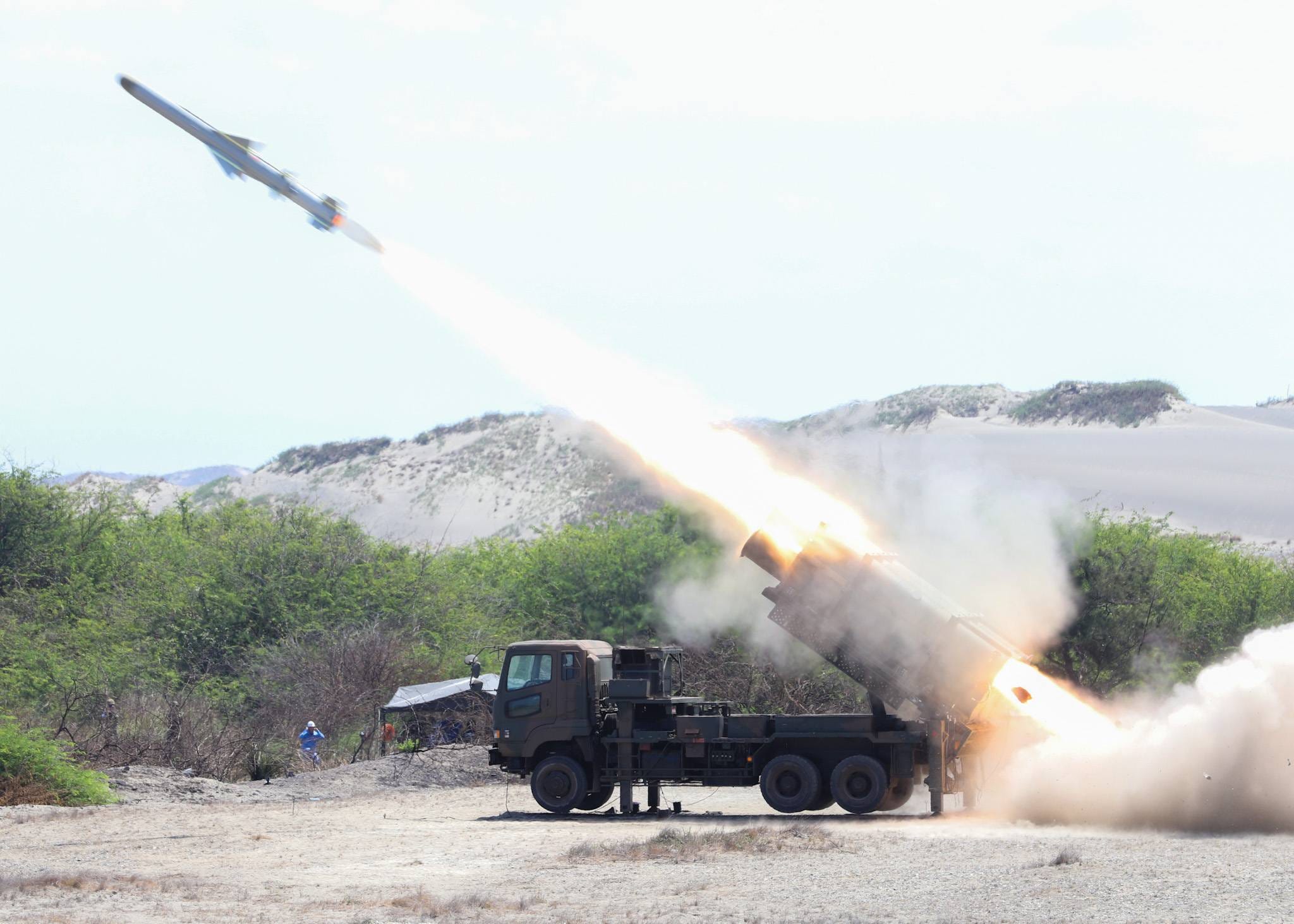
Japan’s Type 88 missile system’s precision strike capabilities was showcased during the live fire exercises in Laoag, Ilocos Norte on Wednesday, May 6. Photo from DND
Manuel Mogato | May 7, 2026
LAOAG, ILOCOS NORTE — A decommissioned World War-era minesweeper sank off the northern Luzon coast after it was hit on the hull by two missiles from a Type 88 surface-to-ship system in a demonstration of Japan’s lethal firepower during a maritime strike exercise.
Colonel Dennis Hernandez, a spokesman for the joint and combined Balikatan exercises, said the aging BRP Quezon had sunk about 40 miles off the coast before US and Philippine aircraft and a US High Mobility Artilery Rocket Systems (HIMARS) could deliver their payload.
“It sank only after 17 minutes,” Hernandez told journalists, adding American also fired multiple guided-rocket systems on the ship.
The whole maritime strike drill was witnessed by Japanese Defense Minister Shinjiro Koizumi and his Filipino counterpart, Gilberto Teodoro Jr. (Also read: Japan may transfer lethal weapons to the Philippines)
Hundreds of kilometers away at the Armed Forces’ General Headquarters in Manila, President Ferdinand Marcos Jr., General Romeo Brawner Jr., and other senior generals watched from large computer screens during the event.
In Manila, Marcos and the generals also watched a computer simulation of the sinking as the tests were made by the Philippine Navy’s C-Star anti-ship missile from a guided-missile frigate and the US Marines’ Navy-Marine Expeditionary Ship Interdiction Systems (NMESIS).
Hernandez said another aging and decommissioned minesweeper, BRP Magat Salamat, will be the target in another maritime strike exercise to give the Canadians and the Americans a chance to display their capabilities. (Also read: US destroys a target in Luzon with a missile fired in the Visayas during an exercise
“BRP Magat Salamat (PS-20) will also be sunk with all the remaining munitions,” he said. “In other words, it’s free for all.”
The Philippine Air Force’s aircraft will have priority in the drill. A Philippine Navy guided-missile frigate will also test-fire its anti-ship missiles.
The maritime strike displayed the allies’ sea denial capability amid China’s growing maritime presence and activities in the South China Sea, asserting its sovereignty claim on the strategic waterway.
An estimated $3 trillion of seaborne goods pass through the South China Sea, where Brunei, Malaysia, the Philippines, Taiwan, and Vietnam also have conflicting claims.
The maritime strike exercise, Hernandez said, was also meant to improve the interoperability of the participating nations, specifically on “how we operate based on the doctrine of finding the target, fixing it, tracking it, and targeting it.”
Hernandez said the president was satisfied with what he had witnessed.
“I cannot speak for the President. But, the way I see it, he appreciated how we are operating with other partner nations,” Hernandez told journalists in Camp Aguinaldo.
In Ilocos, Teodoro was elated: “We were able to pull this off for the first time, and it will only get larger in scope with more partners.”
The maritime strike in northern Luzon was the highlight of this year’s training activities under Balikatan.
This week, the US Army’s Multi-Domain Task Force fired a Tomahawk missile from a Typhon missile launcher from an airport in Leyte in the central Philippines, hitting a target more than 600 kilometers in Nueva Ecija in northern Luzon.
Hernandez dismissed concerns raised by a group of left-leaning activists who claimed the Philippines displayed “shameless puppetry” as the Americans treated the country as “a playground for imperialist interests, while the safety of Filipinos is compromised”.
The Makabayan group, in a statement, called for the immediate halt of the Balikatan exercise and called for an investigation into the missile launch.
Hernandez dismissed the group’s concern.
“First, safety is paramount in every exercise that we do because we are fully aware that we are dealing with live rounds,” he said.
“Local communities were informed of the activities, and there was local government unit engagement before the conduct of the activity. The Tomahawk missile was launched at midnight to ensure that no flights and fewer people were outside.
Hernandez also noted that Notice to Airmen and Notice to Mariners were issued to ensure public safety before the missile firing.
“The flight path of the missile was not overhead since the Tomahawk is a scheming missile. It travelled along the coastline of the eastern seaboard until its re-entry towards the impact area,” added Hernandez.
He also noted that the impact area is not a farming community, but a military reservation area at Fort Magsaysay.
He said the impact area is a target range for AFP artillery and other munitions.
“The AFP is enhancing its capabilities for its future acquisition, such as missile systems, and the only way we can get the knowledge and expertise is from our allied and partner nations,” said Hernandez. (Also read: Learning to fight future wars in Balikatan drills)
