

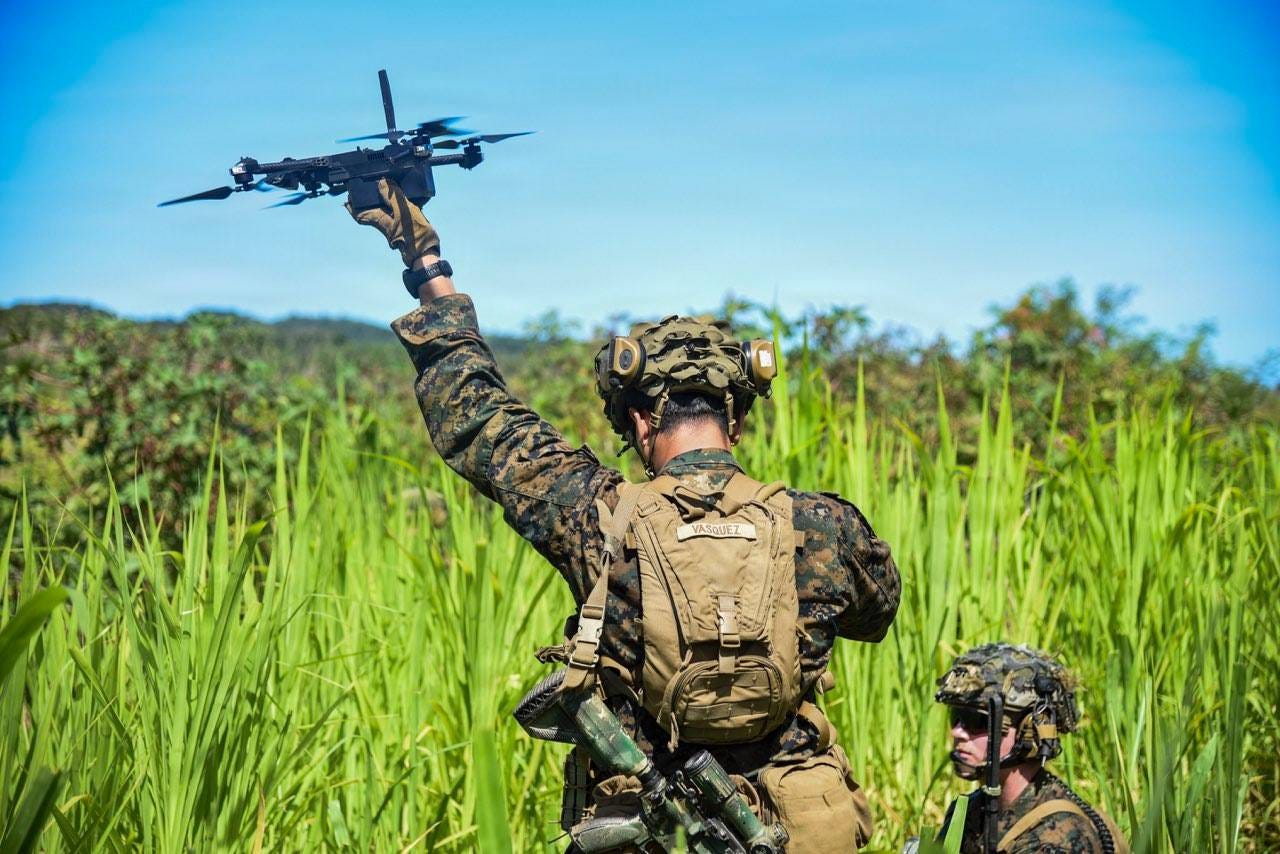
A Marine holds a drone during an airfield seizure operations drill held in Cagayan last April 29. Photo by U.S. Marine Corps Cpl. Ernesto Lagunes.
Manuel Mogato | May 4, 2026
MANILA — Observers had marveled at thousands of soldiers wading in knee-deep waters off beaches either in western Palawan or in Cavite in assaulting beaches during the annual joint and combined military exercises “Balikatan”.
That scenario is past. Landing exercises used to be the centerpiece activity of the annual wargames of the Philippines and the United States from the early 2000s.
The Philippine Marines, with Amphibious Assault Vehicles (AAVs), were the main landing force in these drills, with a token participation from the Army, Air Force, and the Navy. (Also read: Philippines, allies practice how to repulse amphibious assault landing)
As tensions in the South China Sea and Taiwan Strait have risen in recent years, the US military has shifted its strategy to build layered sea-denial operations, expand maritime domain awareness, and enhance deterrence capabilities of its allies in the Indo-Pacific region.
The US and the Philippine military are the driving forces behind the changes in the exercises, drawing lessons from recent conflicts in Eastern Europe, the Middle East, and South America.
In this year’s iteration of Balikatan, US Army units operating with Filipino counterparts tested the effectiveness of unmanned surface vehicles (USLs) along the coastlines in Palawan and in Ilocos Norte during counter-landing activities.
The 125th Intelligence and Electronic Warfare Battalion of the 25th Infantry Division launched an uncrewed Rampage from the beaches to hunt imaginary hostile forces preparing to land on the beaches.
The surface drones worked in tandem with aerial drones in the initial phase of the operations before the full power of the allied forces — Australia, Canada, Japan, New Zealand, the Philippines, and the United States — repulsed the amphibious assault, denying the hostiles the chance to reach the beaches.
Anti-drones, artillery, coastal missiles, armor, and air assets combined to deliver lethal blows to an imaginary hostile force, demonstrating how allies could operate together to respond to any contingency.
The counter-landing drills practiced how the US and its allies would respond to an anticipated Chinese invasion of self-ruled Taiwan from the sea.
It also tested how the allied forces would respond to a swarm of cheap drones attacking military targets in the first-island chain, which includes Japan, the Philippines, and Taiwan. (Also read: The Philippines needs counter-drone aircraft)
Two other military activities in Balikatan, from April 23 to May 8, reinforced the large-scale counter-landing drills - the integrated air and missile defense in Zambales and the maritime strike in Ilocos Norte.
The US Army’s 25th Infantry Division brought, for the first time, its mobile and agile AN/TWQ-1 Avenger air defense missile launcher to shoot down incoming drones.
The weapons systems partnered with the Philippines’ Israeli-made Spyder air defense systems, which were acquired to protect air defense radars in Palawan, Mindoro, and La Union.
The integrated air and missile drills also tested the allied capabilities in countering drone attacks, a sound response to the increasing use of drone warfare as seen in the Ukraine and Iran conflicts.
General Romeo Brawner Jr., the Armed Forces chief of staff, personally witnessed the drone operations during the exercises as the military transitioned into external and territorial defense from an insular counter-terrorism focus mission that dominated for decades.
Brawner wanted more drone and counter-drone operations, as well as cybersecurity operations to protect the country’s critical infrastructures, such as communications, power, and early warning and detection capabilities. (Also read: Reconfiguring Philippine defense forces)
He said more than 2,000 network attacks on military and government computer systems were blocked every day by military cyber warriors, making cybersecurity an integral part of the country’s defense.
Taken together, cybersecurity, anti-missile, and drone operations have become the centerpiece features in the bilateral exercises, which are now evolving into multilateral drills.
Canada has been training Filipino soldiers in cyber warfare, while Japan and the United States have been introducing sophisticated weapons systems in the drills.
Apart from the Avenger anti-drone missiles, the US Army has High Mobility Artillery Rocket Systems (HIMARS), the mid-range capability Typhon, and the Javelin anti-tank missile systems.
The US Marines have the Navy-Marines Expeditionary Ship Interdiction Systems (NMESIS) and the Marine Air Defense Integrated System (MADIS)
Japan, which participated actively for the first time, demonstrated its Type 88n surface-to-ship missile system, which functions similarly to the US NMESIS and the Philippines’ Indian-manufactured Brahmos shore-to-ship missiles.
Closely coordinating with Japan’s air defense and coastal radar networks, the Type 88 destroyed an aging World War II-vintage vessel during the maritime strike, witnessed personally by Japanese Defense Minister Shinjiro Koizumi and General Hiroaki Uchikura, the Japanese Joint Chiefs of Staff, in Ilocos Norte.
The Philippines has learned a lot from the Balikatan, upgrading individual soldiers’ skills and working closely with allied countries at tactical, operational, and strategic levels.
With very limited defense capabilities, the Philippines has also familiarized itself with how modern warfare should be fought with drones, missiles, and cyber networks.
The next step for the Philippines is to configure its military into a forward-looking, external defense posture. It could begin by transforming the counterinsurgency-oriented ground forces into a lethal external defense focus to support maritime operations by the Air Force, Navy, and Coast Guard.
The US 25th Infantry Division, for instance, has demonstrated it can operate on land, sea, and air with the right tools and equipment to communicate, move, and shoot.
It’s about time the Philippine Army develops not only infantry, armor, and artillery tactics and strategies, but also how to operate in multi-domain environments, including cyberspace and, in the future, space, with the Philippines launching its own military satellites and space-related defense systems.