

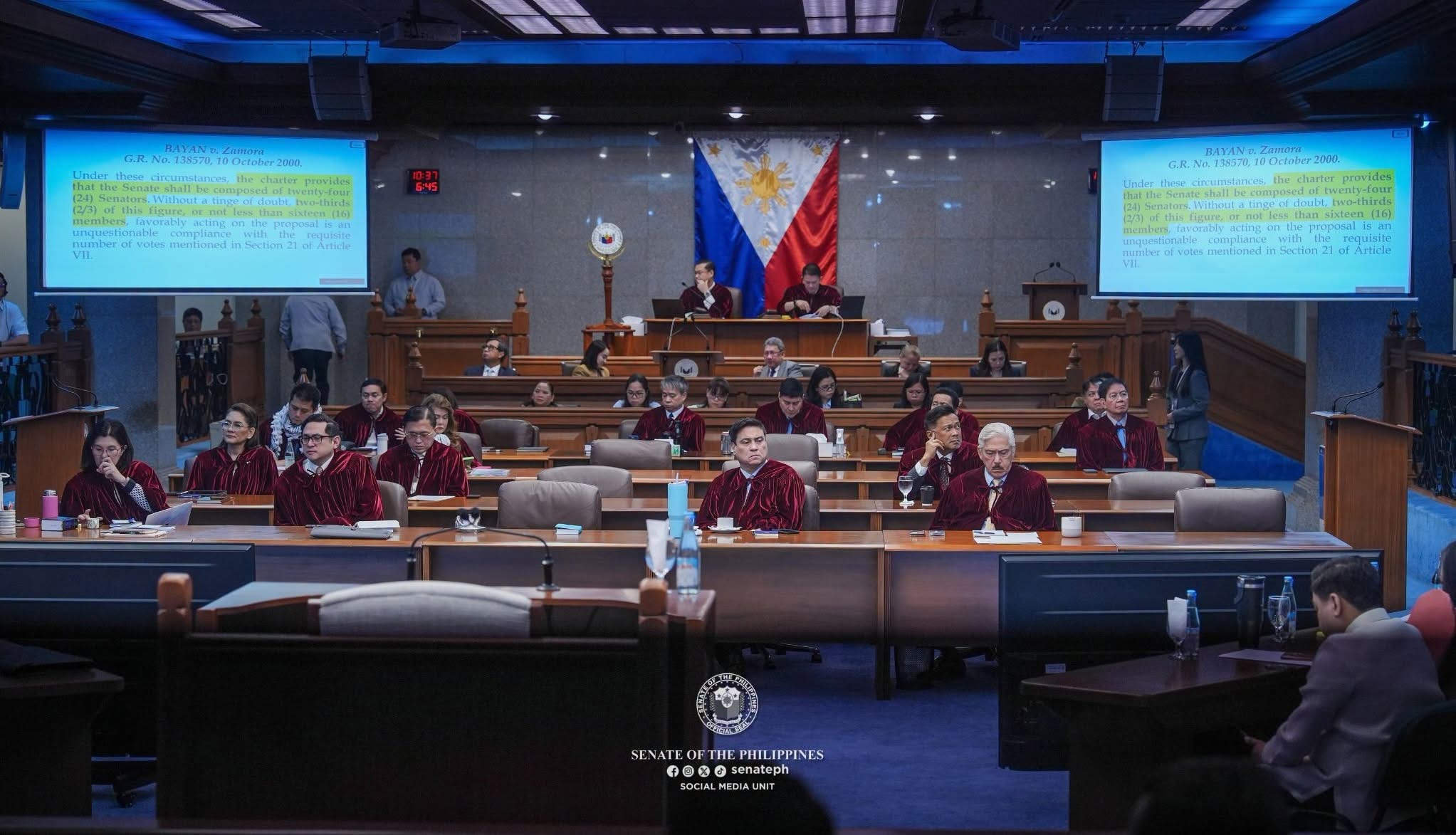
Senator judges deciding on the voting threshold on Wednesday, September 23, 2026. Photo by Joseph Vidal/Senate Social Media Unit.
Rommel C. Banlaoi | September 24, 2026
After intense and even emotional deliberations at the Philippine Senate, the decision to lower the effective voting threshold for conviction in the impeachment trial of Vice President Sara Duterte may appear procedural, but its political consequences are potentially far-reaching. While presented as a matter of legal interpretation, it fundamentally alters the strategic environment of the trial, changes political calculations within the Senate, and reshapes the broader contest for power leading to the 2028 presidential election.
Impeachment is a constitutional process, but it is also an intensely political exercise. Legal arguments define the framework, yet political realities often determine the outcome. This has been the experience of many democracies, and the Philippines is no exception. In impeachment proceedings, rules matter because they influence incentives, shape alliances, and affect perceptions of legitimacy. (Also read: Retired justices told Senate impeachment court it has final say on the proceedings)
For many observers, conviction constitutionally requires the concurrence of two-thirds of the entire Senate. The new interpretation excludes senators who are unable to participate in the proceedings, thereby reducing the number of votes necessary to secure a conviction. Whether one agrees with this interpretation or not, its immediate consequence is clear: conviction becomes easier to achieve.
This development changes the arithmetic of impeachment. Under the previous understanding, the defense could benefit from uncertainty, nonparticipation, or simple political hesitation. Senators unwilling to take a firm position could avoid decisive engagement while indirectly helping maintain a higher threshold for conviction. The revised computation removes much of that advantage. Every participating senator now carries greater influence. Every vote becomes more consequential.
As a result, political actors must reassess their strategies. Senators can no longer assume that the numbers automatically favor acquittal. Instead, they must carefully measure the legal, political, and electoral implications of their decisions. The burden of persuasion on both sides becomes more intense, and the margin for political complacency becomes smaller.
For Vice President Duterte, the lowered threshold substantially raises the stakes. Her defense can no longer focus solely on the legal merits of the case. It must also ensure that political support among senator-judges remains intact throughout the proceedings. The challenge is not simply to defeat specific allegations but to prevent the emergence of a coalition capable of reaching the new threshold for conviction.
More importantly, the impeachment trial has evolved beyond the fate of a single public official. It has increasingly become a proxy struggle between two dominant political camps: the Marcos bloc and the Duterte bloc. What started as a constitutional mechanism for accountability is now widely viewed as part of a larger contest over political succession. In this sense, impeachment has become intertwined with the battle for national leadership in 2028.
If Duterte is convicted, the immediate impact would be significant. Such an outcome would represent a major institutional setback for her political ambitions and would be interpreted as a strategic victory for forces aligned with President Ferdinand Marcos Jr.. A conviction could also weaken the cohesion of the Duterte political network and alter the calculations of local political leaders seeking to position themselves for the next electoral cycle.
Yet conviction does not automatically translate into political extinction. Philippine politics has repeatedly demonstrated that institutional setbacks can become sources of political renewal. Public sympathy often flows toward leaders perceived to have been unfairly treated. If Duterte succeeds in framing a conviction as politically motivated, she may be able to consolidate her support base and transform adversity into political capital. In a polarized political environment, perceptions can be as important as legal findings. (Also read: Vice President declares intention to run for president in 2028)
On the other hand, an acquittal would likely strengthen Duterte considerably. It would reinforce her image as a resilient political figure capable of surviving intense political pressure. Such a result would enhance her credibility as a leading contender in the 2028 presidential race and would inevitably raise questions about the effectiveness of efforts to diminish her influence through constitutional mechanisms.
Regardless of the verdict, the impeachment proceedings are already contributing to deeper political polarization. The process has compelled politicians, party leaders, governors, mayors, and legislators to reveal where they stand. As loyalties become more visible, the space for neutrality narrows. Political alignments are solidifying earlier than expected, effectively turning impeachment into the first major battleground of the next presidential succession.
An equally important concern involves institutional legitimacy. Critics argue that altering the effective threshold during the proceedings could undermine public confidence in the outcome. Supporters maintain that counting only participating senators is both practical and constitutionally defensible. Whatever position one adopts, the perception of fairness will be critical. A verdict viewed as politically predetermined could intensify divisions rather than resolve them.
The Senate therefore faces a responsibility that transcends the fate of any individual. It must conduct the trial in a manner that inspires public trust, protects constitutional integrity, and demonstrates adherence to due process. The credibility of democratic institutions may ultimately prove more important than the verdict itself.
In the final analysis, lowering the impeachment threshold is not merely a procedural adjustment. It is a strategic turning point with implications far beyond the walls of the Senate. It increases the possibility of conviction, heightens political uncertainty, and accelerates the realignment of forces already underway.
Whether Vice President Duterte is convicted or acquitted, this decision will shape the political environment for years to come. The impeachment court may be judging one official today, but history may remember this moment as the point at which the next chapter of Philippine politics decisively began.
Rommel C. Banlaoi, PhD, is President of Philippine Society for International Security Studies and Chairman of the Philippine Institute for Peace, Violence and Terrorism Research. He is also the Director of Philippines-China Studies Center at Diliman College. He finished his BA and MA in Political Science at the University of the Philippines, Diliman and PhD in International Relations at Jinan University, China.