

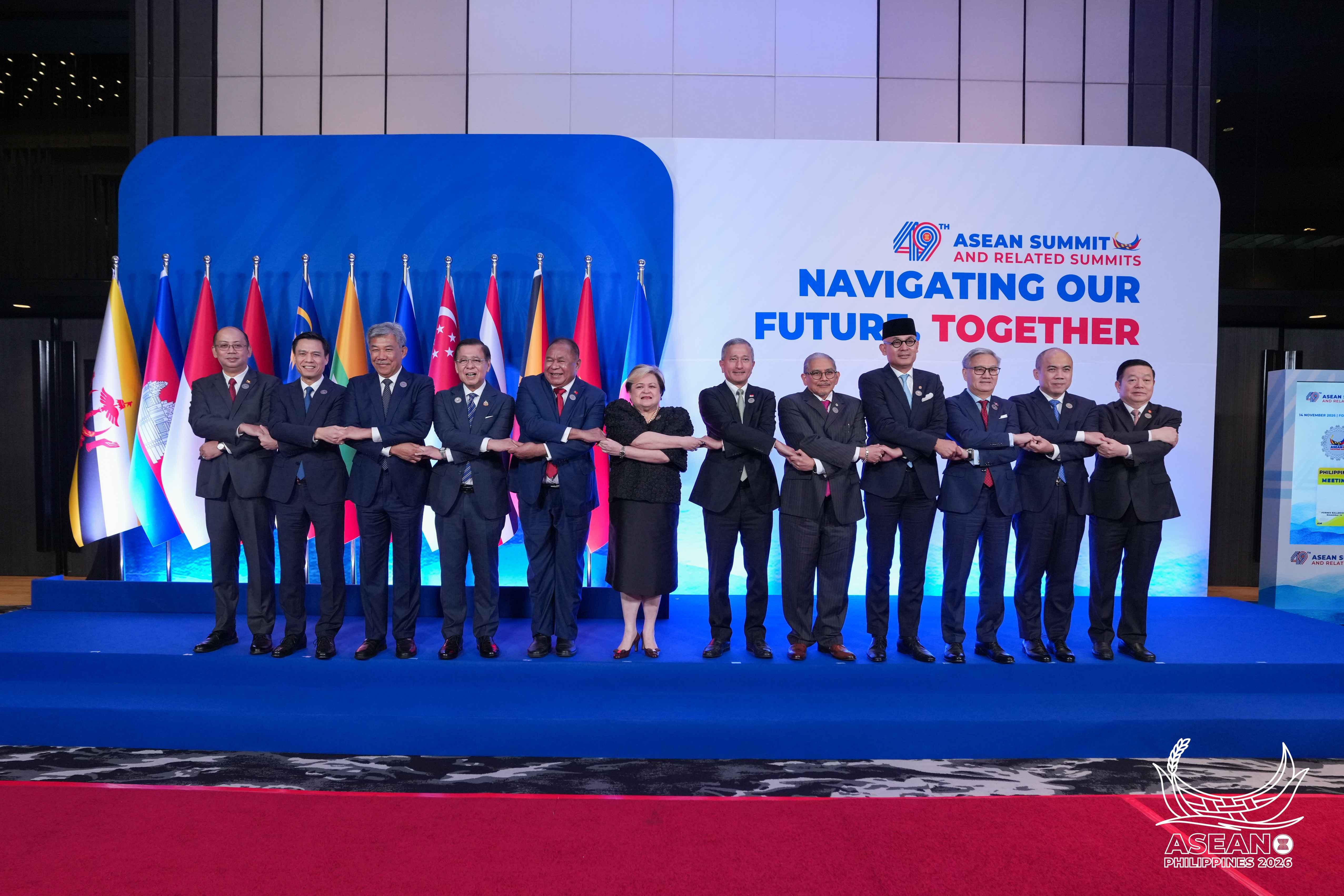
ASEAN Foreign Ministers pose during the 38th ASEAN Coordinating Council (ACC) Meeting. Official handout
Manuel Mogato | November 14, 2026
MANILA — Malaysia and Singapore, the hardest hit by dangerous levels of haze from neighboring Indonesia had accepted Jakarta’s efforts to mitigate transboundary haze.
Speaking before the press in Pasay City, Philippine Foreign Affairs Secretary and current ASEAN chair Ma. Theresa Lazaro said that Singapore and Malaysia had been a “very cordial mood” when Indonesia shared that it had “exerted a lot of effort” to address the haze.
“I surmised that there had been discussions before the formal meeting this morning, but Singapore remarked positively and Malaysia, the same thing,” Lazaro said. “So I think there had been discussions. The actions undertaken by Indonesia really helped. In fact, we’re not experience any haze right now.”
On Saturday, ASEAN Ministers affirmed their commitment to the “full and effective implementation” of the ASEAN Agreement on Transboundary Haze Pollution and its relevant existing mechanisms. During the formal meeting, ministers discussed ongoing national actions and regional cooperation to mitigate land and forest fires.
The legally-binding agreement, signed in 2002, provides the mechanism for prevention and monitoring for transboundary haze. It also encouraged each member state to enact zero-burning policies.
Forest fires have always been a seasonal issue in Indonesia for decades.
In late August, illegal slash-and-burn activities in Sumatra and Kalimantan led to widespread air pollution that travelled as far as Singapore and Malaysia. However, the El Niño phenomenon further exacerbated the haze.
The Philippines also experienced hazed coming from Indonesia in October.
The heavy haze that enveloped the countries led the ministers to accelerate the operationalization of the ASEAN coordinating center on the transboundary haze control
“[But] how it came to me, as chair, there was already an understanding of [how to mitigate the transboundary haze]. And because of the center, which has been a subject of discussion in the past — because the haze did not only appear now — there was already a mechanism, a platform established to discuss the issue. So now it’s being activated,” Lazaro said.
“The countries requested most of us to ratify the agreement so that things will move.”