


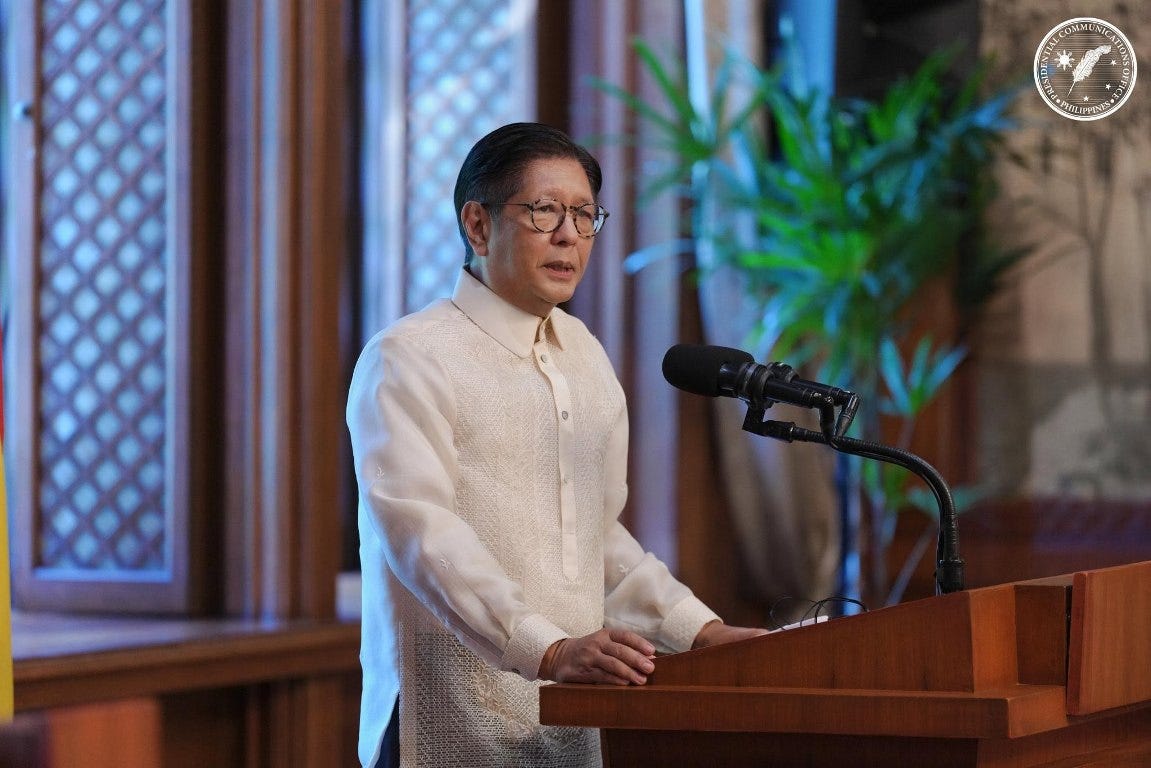
President Ferdinand Marcos Jr. during German Federal President Frank-Walter Steinmeier’s state visit last June 16, 2026. Official handout.
Manuel Mogato | June 27, 2026
MANILA — The International Criminal Court (ICC) held a procedural meeting this week that included the handling of confidential information related to the case against former Philippine President Rodrigo Duterte.
It was the second status conference before the trial would start on November 30, and the court granted Duterte’s request to skip the meeting.
But, Duterte has to be present when the actual trial begins, the second time he will be seen in public after his arrest in March last year. He was also ordered to attend the September 7 meeting.
Duterte faced charges of crimes against humanity and murder for systematic mass murder of poor Filipinos suspected of peddling and using illegal drugs during the time he was mayor in Davao City from 2011 to 2016 and as president from 2016-2019.
He was only liable for the crime against humanity when the Philippines was still a member of the ICC from 2011 to 2019.
Thousands had died in his war on illegal drugs policy.
Several officials and senior police officers were also facing similar charges, including Senator Ronald dela Rosa, who went into hiding after the ICC issued an arrest warrant in November.
Dela Rosa was the national police chief when Duterte carried out the mass killings from 2016 to 2018. His successors, Oscar Albayde, Vicente Danao, and Camilo Cascolan, were also included in the ICC case. Cascolan died in 2023.
The former justice secretary, Vitaliano Aguirre, the former National Bureau of Investigation director Dante Gierran, and Senator Lawrence Christopher Go are also among Duterte’s co-accused.
Go used to be Duterte’s special assistant and was the alleged paymaster for monetary rewards for killing drug suspects.
When he was elected as president in 2022, Ferdinand Marcos Jr vowed not to cooperate with the ICC, promising to protect Duterte and other officials from arrests.
Marcos was elected as president together with Duterte’s daughter, Sara, as vice president in the widest electoral margin and plurality with more than 31 million votes.
Marcos administration officials said the Philippine government does not recognize the ICC, which has no jurisdiction after Manila withdrew from the Rome Statute in 2019.
But things changed after Marcos and Duterte had a falling out in 2024 when Sara Duterte accused the president of being a drug addict and corrupt. (Also read: Marcos starts consolidation, purges Duterte loyalists)
Marcos tried to mask the arrest of former president Duterte in March 2025, saying the Philippines was not cooperating with the ICC but with the International Police (Interpol) under treaty obligations.
However, by May 2026, when the ICC announced an arrest warrant was issued against Senator dela Rosa, the Marcos administration decided to enforce the ICC arrest warrant without an Interpol order, a clear reversal of its earlier policy.
Does this mean the Marcos administration has changed its policy towards the ICC? Does it mean the Philippines is ready to rejoin the ICC?
Some sectors in government wanted the Philippines to go back to the ICC after former president Duterte withdrew to escape accountability and responsibility for the mass murder of suspected drug offenders.
Duterte and his lawyers argued that the ICC had no jurisdiction after the Philippines withdrew from the Rome Statute in March 2019.
However, even the Philippine Supreme Court ruled that the ICC has residual jurisdiction over the Philippines. It said the ICC could go after Duterte at the time, Manila was still a member from 2011 to 2019.
Marcos has been resisting calls for the Philippines to return to the ICC without clearly stating his opposition to the idea.
If Duterte’s arguments are to be followed, the ICC is a foreign court that infringes on the Philippines’ sovereignty.
Moreover, the country’s justice system is working perfectly to go after wrongdoers, citing the conviction of three police officers behind the murder of a 17-year-old schoolboy from Caloocan City, Kian delos Santos.
The ICC’s jurisdiction is not even accepted by most members of the United Nations, including the three major powers - the United States, China, and Russia. Washington has even imposed sanctions on the ICC.
Opponents of the ICC claimed the court is controlled by Western elites who run after African, Asian, and Latin American leaders and criminals, but other powerful leaders like Vladimir Putin and Benjamin Netanyahu have been ordered to be arrested.
Some criticized the ICC for ignoring war crimes committed by NATO, including the United States, in Afghanistan, Iraq, Libya, and other states.
They also said the ICC is biased, selective, and is politically driven in choosing to prosecute only the leaders in developing countries.
There is another school of thought that accuses the US and its Western allies of using the ICC to go after politicians from developing countries who disagree with US and Western policies.
Considering all these arguments against the ICC, President Marcos has to think before rejoining the international criminal tribunal, considering the two opposing schools of thought.
Those pushing for the Philippines to rejoin the ICC would argue it would prevent another Duterte from committing repulsive crimes against humanity.
Those opposing argue that it would surrender Philippine sovereignty, and the Western states could use it as a pressure point against leaders who oppose pro-Western policies.
President Marcos walks on a tightrope, but it is much clearer that he is changing his mind on the ICC due to domestic political pressure. (Also read: Where Do We Go From Here, Philippines?)
He should weigh his options well and consider what is good for the Philippines. It is between protecting the country’s independence and sovereignty and making sure future leaders will not abuse power.
The ICC did not protect the Philippines from a murderous leader, like Rodrigo Duterte.
For seven years now, the Philippines has been outside the ICC jurisdiction. Did it make a difference?