

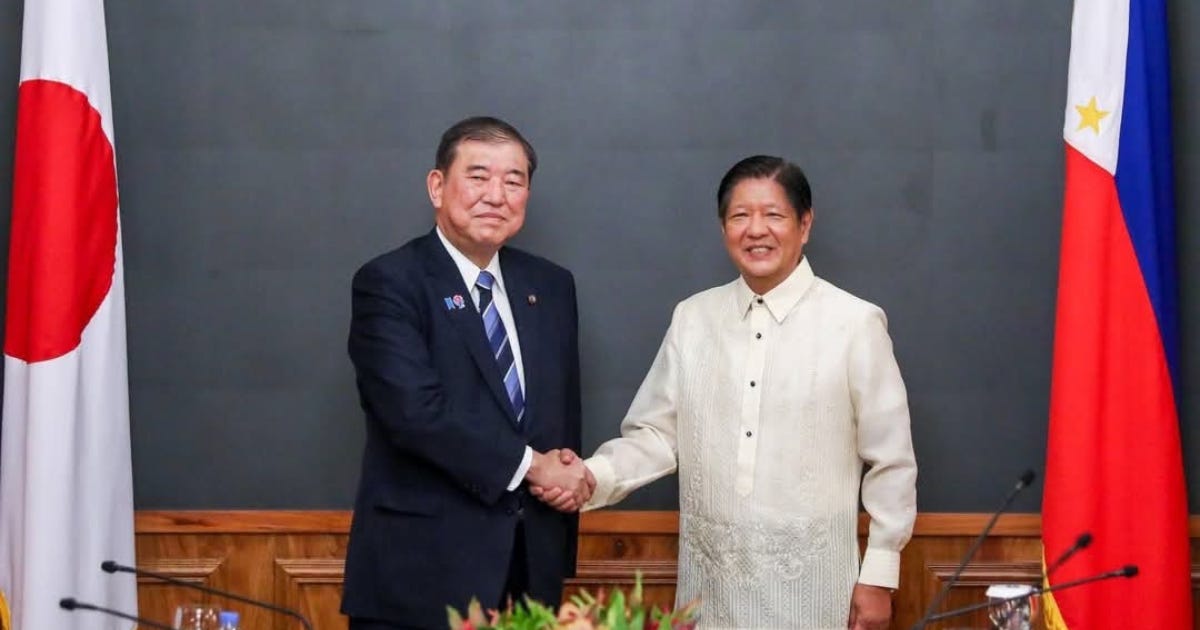
Philippine president Ferdinand “Bongbong” Marcos Jr. and Japanese Prime Minister Ishiba Shigeru vowed to strengthen diplomatic, political, security, and defense cooperation during Ishiba’s visit to the Philippine in late April 2025. Photo from Presidential Communications Office
Manuel Mogato | Published: May 8, 2025
MANILA — Japanese Prime Minister Shigeru Ishiba has announced it has started formal discussions on two military deals to strengthen its alliance in the face of rising threats from China.
In his first visit to Manila as Japanese leader, Ishiba said negotiations have begun on an intelligence sharing and logistics cooperation agreement, patterned after similar deals with the United States.
Manila and Washington signed an intelligence sharing agreement, the General Security of Military Information Agreement (GSOMIA), in November and a Mutual Logistics and Servicing Agreement (MLSA) in early 2000. The MLSA is similar to the Acquisition and Cross-Servicing Agreement (ACSA) that Japan wanted.
“I hope that our two nations can continuously communicate with each other to oppose attempts to change the status quo in the East and South China Seas by force or coercion and to realize a free and open Indo-Pacific based on the Rule of Law,” said Ishiba.
The two security deals would allow Japan to refuel its ships and aircraft in the Philippines and have access to munitions and other supplies.
The two leaders also discussed trade and the impact of US President Donald Trump’s trade war with China and the imposition of higher tariffs.
“On the status of the global economy, we discussed the tariff measures taken by the United States, as well as the impact felt on the multilateral free trade regime and the world economy, because of the reciprocal retaliations seen with the United States and China,” Ishiba said, vowing to “listen carefully” to countries from Southeast Asia.
Japan has been deeply engaged with the Philippines, from maritime security, food security, climate change adaptability, agriculture, health, and even to the peace process in Mindanao.
Before Ishiba’s visit, his foreign minister, Iwaya Takeshi, and his defense minister, Nakatani Gen also visited Manila.
In both those stops, the two ministers emphasized the importance of not just Philippine-Japan bilateral ties, but also the trilateral relationship between Japan, the Philippines, and the US.
It was a trilateral relationship envisioned to preserve the status quo in Southeast Asia.