

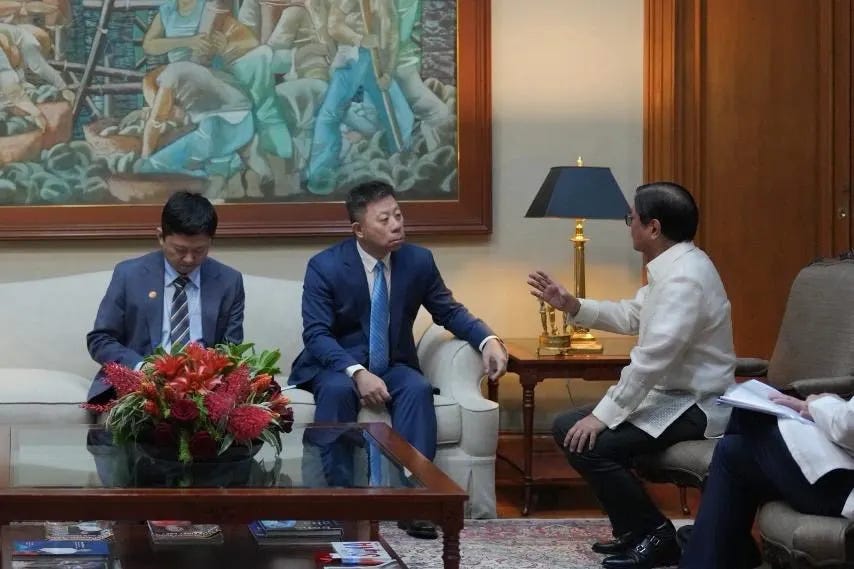
President Ferdinand Marcos Jr. summoned China’s Ambassador to the Philippines Jing Quan last July over the incident at Ayungin Shoal. Official handout.
Anna Mogato | October 17, 2026
MANILA — Philippine President Ferdinand Marcos Jr. said he would summon China’s Ambassador to the Philippines after he made “threat” remarks over the disputed South China Sea, describing it as undiplomatic.
Speaking to journalists during an event at the Philippine Coast Guard, Marcos said he would have a private discussion with Ambassador Jing Quan, asking him what he “exactly meant” with his statements.
Jing, in an event, told journalists that the Philippines should be grateful to have China as a neighbor in the region, despite tensions over contested waters in the South China Sea.
“If we want to use force, we may easily win,” Jing said. “But no, we will not use force [because] we love peace. And in this region, we enjoy the peace.”
The Department of Foreign Affairs (DFA), immediately reacted to the Chinese ambassador’s statement, expressing regrets for the ambassador’s poor choice of words that “seem to convey a thinly veiled threat of the use of force.”
“[This] is hardly helpful in the context of the complicated bilateral ties between the Philippines and China.,” the foreign ministry said in a statement. (Also read: Philippines still seeks diplomatic route over South China Sea conflict)
“It is hoped that all diplomats accredited to the Philippines take greater care in the language used in public statements so as not to further erode mutual trust and confidence, nor derail the advancement of dialogue and constructive engagement.”
Rear Admiral Jay Tarriela, the Philippine Coast Guard’s spokesman for the West Philippine Sea, also called the ambassador’s statement a threat.
“That is a direct threat, and wrapping it in “we love peace” does not change what it is,” Tarriela said.
“Let us call this what it is! A foreign ambassador, on Philippine soil, before Filipino journalists, telling Filipinos that his country “may easily win” if it chooses to use force against us. That is not reassurance.”
He said Filipino fishermen have been driven away from Bajo de Masinloc and PCG personnel bore the brunt of harassment from China Coast Guard vessels within the Philippine exclusive economic zone.
“No people feel fortunate when a larger neighbor repeatedly violates the law and then tells them to be thankful it was not worse,” Tarriela added.
On Friday, the Chinese Embassy in Manila released a reply, also calling DFA’s statement “regrettable.”
“This kind of selective quotation and overinterpretation demonstrates that there is still a long way to go in fostering effective communication and dialogue between China and the Philippines,” the statement read.
“China-Philippines relations are currently at an extremely sensitive stage. Certain individuals are actively seeking to undermine normal exchanges and cooperation between the two countries.”
The embassy said it urges the DFA to be more responsible in ensuring that relations between both countries are “not pushed into a dangerous and uncertain situation.”