


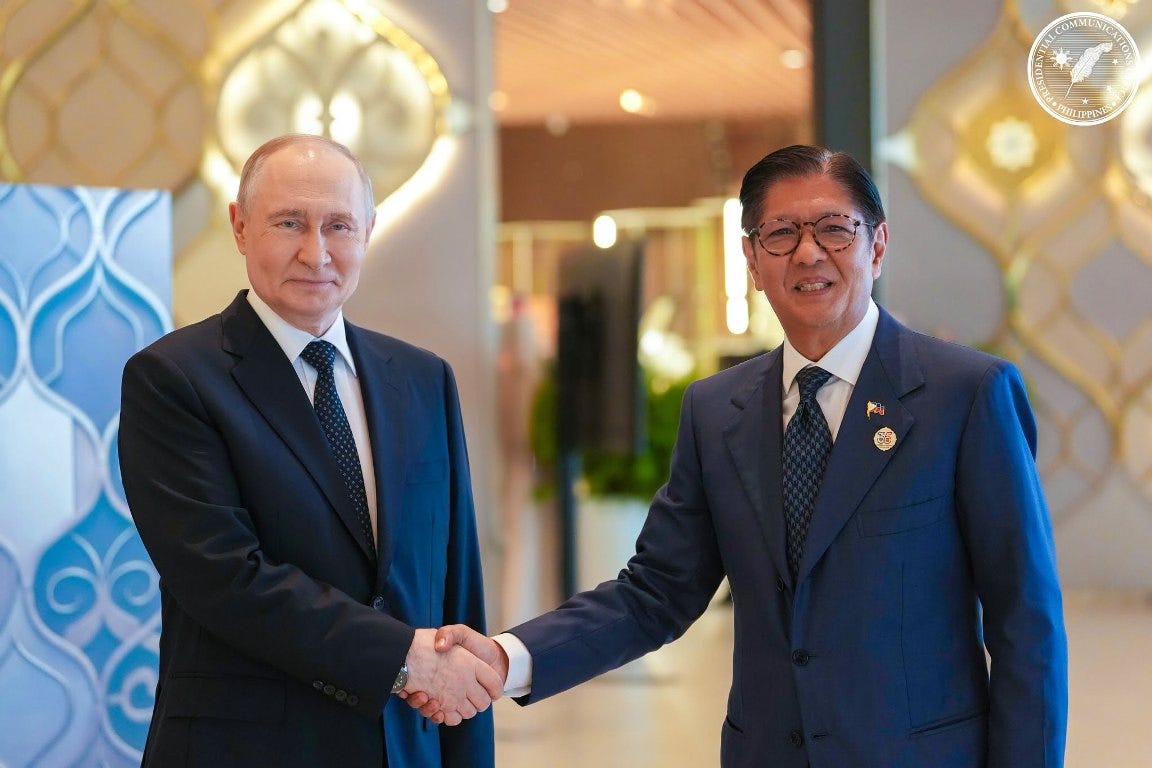
President Ferdinand Marcos Jr. and President Vladimir Putin meet for a bilateral at the Galiasgar Kamal Tatar State Academic Theatre in Kazan, Russia on Wednesday, June 18. Official handout
Manuel Mogato | June 18, 2026
MANILA — President Ferdinand Marcos Jr flew this week to Russia on a mission: to seek oil and fertilizer supplies as global prices soar after the United States and Israel bombed Iran in late February.
Marcos was in Kazan for a bilateral meeting with Russian leader Vladimir Putin and, as co-chair of the Russia-ASEAN Summit to commemorate the 35th anniversary of bilateral relations.
Marcos discussed with Putin food and energy security, trade, tourism, and other forms of cooperation, as Manila diversifies its foreign policy and reduces dependence on the United States and other Western allies.
“They provide a very important opportunity to explore further ways of cooperation,” Marcos said.
“There are many potential areas that I think we should still open to explore. The present level of trade, although it is steady, I think that there is a great deal more that we can do.”
Oil and fertilizer topped the agenda during the Marcos-Putin summit as rice production was projected to decline in the second half of 2026 due to fertilizer shortages and mineral fertilizers’ prices.
Manila is seeking to increase its oil reserve capacity to last more than 90 days, putting pressure on its only refinery in Bataan province. (Also read: Marcos places the country under an energy emergency)
Like other Southeast Asian states, the Philippines explored possible oil supply from the Russian Far East, which is much closer than the Middle East.
Petron, a private petroleum company, had imported 2.4 million barrels of crude oil when Washington issued a waiver in April to allow Moscow to sell oil to ease supply woes and lower global prices.
Manila is still negotiating with Washington to extend the waiver, allowing it to buy more oil supply from Russian tankers floating in the Far East and elsewhere.
Other ASEAN states, including Malaysia, Thailand, and Vietnam, are ready to defy US sanctions to secure a reliable and steady oil supply. (Also read: ASEAN: Finding relevance in a burning world)
Manila also wanted to buy more Russian fertilizer to sustain farm production to avert a shortage that may push prices higher and accelerate inflation.
It also explored a meat supply deal and a possible power supply agreement after Moscow offered to deploy a floating nuclear reactor in the country.
During bilateral discussions with Putin, Marcos asked Russia to send more tourists to the Philippines and personally invited the Russian leader to attend the ASEAN Summit and the East Asian Summit in Manila in November.
