


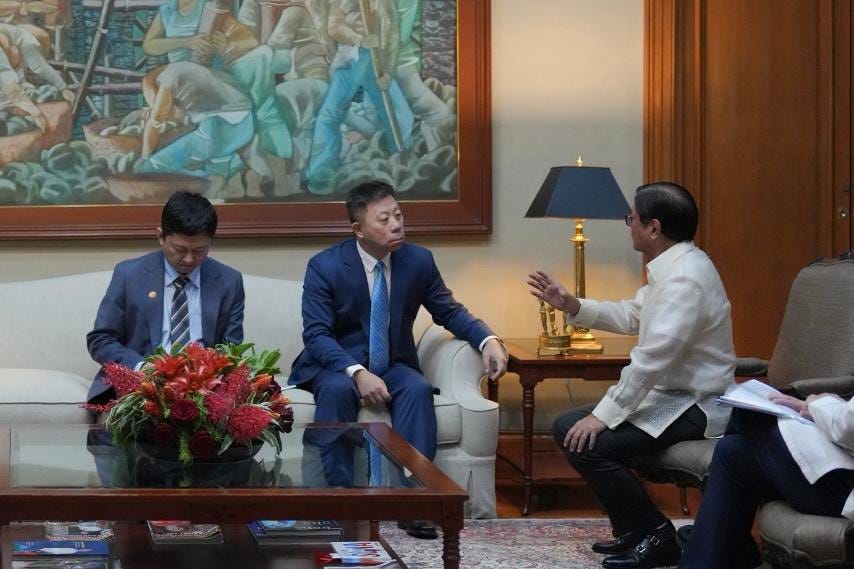
China’s Ambassador to the Philippines Jing Quan, summoned by Philippine President Ferdinand Marcos Jr. to discuss the recent incident in Ayungin Shoal. Photo from PCO.
Manuel Mogato, Anna Mogato | July 21, 2026
MANILA – Philippine President Ferdinand Marcos Jr. on Tuesday summoned China’s ambassador, Jing Quan, to discuss the recent violent incident on Ayungin Shoal in the contested West Philippine Sea and how to avoid future similar incidents.
A presidential spokesperson, lawyer Claire Castro, confirmed to journalists the meeting had taken place late in the afternoon but withheld further information.
However, China’s ambassador told journalists the meeting with the Philippine president was a “private discussion”.
He said the meeting “is very constructive.”
“This is not a diplomatic protest, demarche, pointing fingers at each other, exchange of strong words against each other,” he explained.
“I think it’s a very useful, constructive, and in-depth exchange of views, especially not on the incident, but kind of a whole range of issues that recently happened which create difficulty in bilateral relations.”
On Monday, two Philippine Navy servicemen were injured after attempting to drive away a Chinese Coast Guard (CCG) rubber boat that approached BRP Sierra Madre.
The CCG personnel had taken photos and videos of the grounded ship.
Jing defended the Chinese Coast Guard actions, saying that the CCG had sent two boats to check on BRP Sierra Madre after they noticed “some kind of construction work in the ship.”
The Philippines and China signed a provisional agreement in July 2024 to de-escalate tensions in Ayungin Shoal after a Philippine sailor lost a finger during another violent incident near Ayungin Shoal.
The agreement stipulated that the Philippines does not have to request permission to conduct rotation and resupply missions, and Chinese personnel are not allowed to board Philippine vessels.
“That’s the spirit of our provisional agreement, that is no new construction, keep the status quo; we agree to the resupply agreement,” Jing said.
“But we found they are doing something new. They sent boats and people, challenged us, to provoke or something. Then something happened. That’s the whole story.”
“I think the last 2 years we implemented the agreement very well, but I hope that both sides could abide by the agreement, especially the spirit of the agreement, no new construction, no change of the status quo.”
Meanwhile, Foreign Affairs Secretary Ma. Theresa Lazaro told reporters on the sidelines of the 59th Association of Southeast Asian Nations (ASEAN) Foreign Ministers Meeting that she has also raised the issue during their plenary session.
“Well, I was the one who presented it as part of the discussion. Everybody has read it; it’s all in the newspapers,” Lazaro said.
“But here, the foreign ministers did not respond to that position that I made because I think everything is still being discussed between the two parties.”
However, the Code of Conduct (COC) on the South China Sea had been discussed during the ministers’ retreat. The Philippines has been pushing for the COC to be signed within the year, while the country still has the chairmanship of ASEAN.
“There was a statement, of course, made at the South China Sea by the other various ministers and me, but I think what was really very emphatic about it is the Code of Conduct,” Lazaro said.
“I think all the foreign ministers, almost all, have really focused themselves on the development that is happening with the Code of Conduct between ASEAN and China on the South China.”
Lazaro is expected to hold a bilateral meeting with China’s Foreign Minister Wang Yi tomorrow.
Jing said that the bilateral relations between the Philippines and China are at a critical moment, but remained confident that the foreign ministers can set up a roadmap by the end of the year.
“[S]ometimes we debate, we don’t agree with each other but at least we should talk to each other. We should find a way to manage those difficult issues, and prevent those issues from becoming something explosive to our relations,” Jing said.
“And to keep the relations stable best serves the fundamental interest of our two countries. We are neighbors. And serve the best interests of our [people].”
