

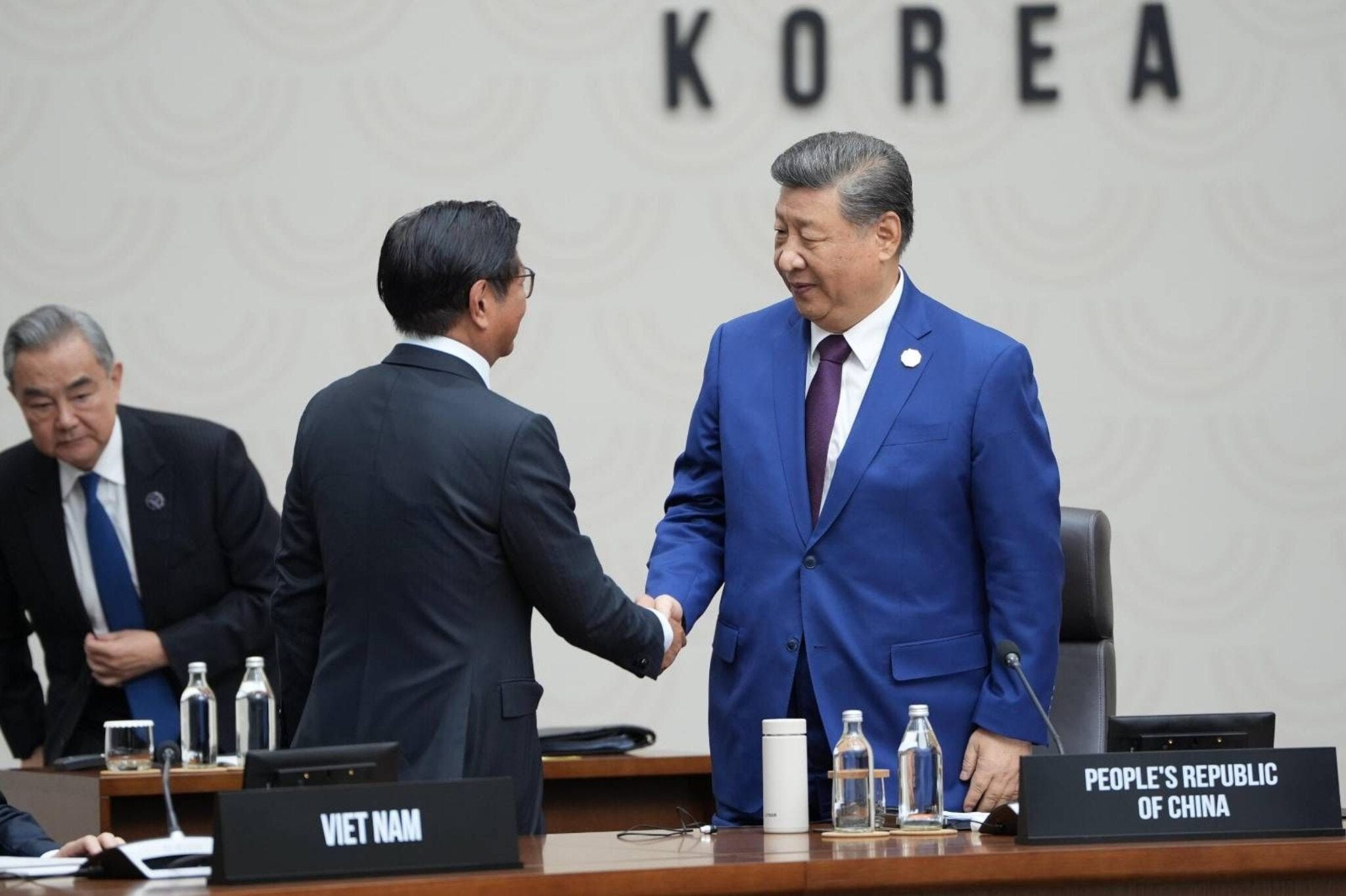
Philippine President Ferdinand Marcos Jr. and Chinese President Xi Jinping meeting during the handover of the Asia-Pacific Economic Cooperation (APEC) chairmanship from South Korea to China last November 2025. Official handout.
Rommel Banlaoi | July 17, 2026
MANILA — Amidst worsening ties arising from persistent disputes in the South China Sea, the release of a racist caricature by China Daily on the tenth anniversary of the arbitral award was not only offensive to Filipinos but also damaging to China’s own interests. Messaging that demeans, insults, and racializes undermines the very possibility of constructive dialogue between Manila and Beijing.
If propaganda of this nature dominates the discourse, hostility will be entrenched and the foundation for cooperation eroded. Responsible statecraft requires restraint in public messaging to avoid inflaming nationalist sentiment. Respectful communication is indispensable if both sides are to rebuild confidence and pursue reconciliation.
For the Philippines, the arbitral award is a matter of law, dignity, and sovereignty. It is upheld as a permanent feature of international jurisprudence, and no amount of ridicule can erase it from the Filipino consciousness. China may continue to reject the award, but disagreements must be addressed through respectful dialogue, not through offensive caricatures or racist propaganda.
Demeaning imagery cannot substitute for legal argument or diplomatic engagement. Constructive engagement is essential to prevent disputes from hardening into permanent estrangement.
Both countries share centuries of cultural ties, economic interdependence, and geographic proximity. These realities make permanent estrangement neither desirable nor sustainable. The Philippines and China must therefore commit to a higher standard of discourse, one that avoids insults, racist messaging, and offensive propaganda. Such restraint is not weakness but strength: it values dignity and aspires to peace. (Also read: Dialogue with China Is Imperative: Trump–Xi Summit Proved It)
Measured language and respectful engagement can deescalate tensions and foster mutual trust. By elevating the quality of dialogue, both nations can demonstrate maturity and a genuine commitment to regional stability.
The future of the South China Sea will be shaped by whether the Philippines and China can build a framework of cooperation rooted in mutual respect. Reconciliation requires courage to reject racism, rise above propaganda, and keep open the possibility of dialogue even in the face of deep disagreements. (Also read: Building Bridges Not Walls: The Philippines and the Future of Maritime Order in the Asia-Pacific)
Stabilizing Philippines–China relations demands mutual respect to pursue dialogue, not division. Offensive propaganda deepens distrust, but respectful engagement builds the trust necessary for peace. Sustainable peace requires consistent efforts to institutionalize dialogue mechanisms that prevent disputes from escalating. Constructive diplomacy based on mutual respect offers the best option to transform competition into cooperation.
In this period of heightened tension, both sides must choose words and actions that heal rather than harm. The way forward lies not in caricatures or insults, but in diplomacy, dialogue, and the shared responsibility to stabilize relations for the benefit of both peoples and the wider region.
The Philippines will continue to uphold the arbitral award while China will also continue to reject it. But both nations must rise above inflammatory rhetoric and embrace the discipline of diplomacy. Only then can they move from confrontation to cooperation, from distrust to trust, and from division to reconciliation. (Also read: Philippines remains confident that the Code of Conduct on the South China Sea will be finished this year)
Rommel C. Banlaoi, PhD, is the Director of Philippines–China Studies Center at Diliman College, President of Philippine Society for International Security Studies and Chairman of the Board of Advisers of China Studies Center at New Era University