


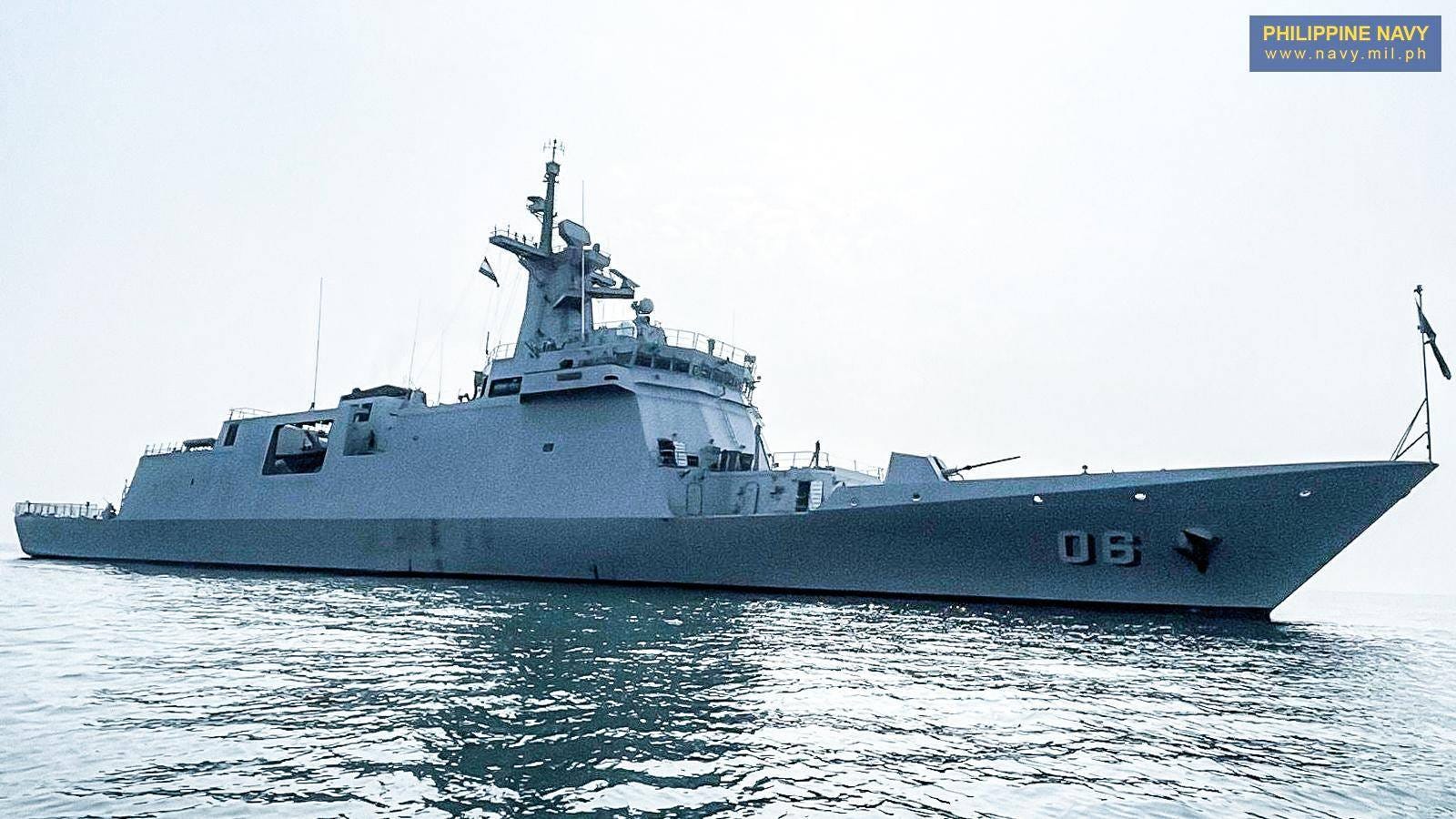
BRP Miguel Malvar (FFG6) on a sovereignty patrol near Sabina Shoal last March 7, 2026, when PLA-Navy corvette (bow no. 622) aimed its fire control radar toward the Philippine vessel. Photo from Philippine Navy.
Manuel Mogato | April 2, 2026
Manila — The Armed Forces of the Philippines has rejected proposals to hold “Navy-to-Navy” cooperation with China in the West Philippine Sea, a spokesman said.
In a press briefing at Camp Aguinaldo, Navy spokesman for the West Philippine Sea Rear Admiral Roy Vincent Trinidad described China as an unreliable partner.
Trinidad was responding to efforts by Philippine and Chinese diplomats to amend a memorandum of understanding to reestablish the 2016 Joint Coast Guard Committee on Maritime Cooperation. (Also read: Duterte’s Gentleman’s Agreement)
Trinidad said the military is leaving to the Department of Foreign Affairs any diplomatic efforts with China. (Also read: Philippines rejects China’s sovereignty claim on West Philippine Sea)
“History will tell us that the talk is different from the action,” Trinidad told journalists.
“Historically, we have observed a difference in the way they speak and their actions on the ground. These are facts which are recorded, Trust and confidence will always be based on transparency or truthfulness.”
He said the military “will continue performing its mandate of patrolling our seas and securing our sovereignty and sovereign rights, bearing in mind that the Chinese Communist Party is not a reliable partner on the negotiating table.” (Also read: Philippines wins more support against China as it celebrates the 9th anniversary of the tribunal victory)
China has said that it wants peace in the West Philippine Sea but continues to harass Philippine government vessels and aircraft and even fishing boats in the area.
Last March 7, a Chinese Navy corvette aimed its fire control radar on a Philippine Navy frigate near Sabina Shoal. The Philippine Navy called it as an “alarming and escalatory act.”
Last March 25, a Chinese Navy frigate conducted dangerous maneuver against a Philippine Navy transport, BRP Benguet, near Pag-asa Island. The Philippine Navy vessel avoided colliding with the Chinese warship.
On China’s statement that it recently conducted naval, air and coast guard exercises near Scarborough Shoal, also known as Bajo de Masinloc, Trinidad said the military has not monitored any Chinese exercise in the area.
“What we monitored was the dispersed presence of the Coast Guard, the PLA (People’s Liberation Army)-Navy and the PLA Air Force,” said Trinidad.
“There was no exercise conducted. This is part of their false narrative, the malign influence to project that they have control over Bajo de Masinloc,” said Trinidad.
Trinidad also reported that the military has monitored some 90 Chinese vessels at four key features in the West Philippine Sea, including at the vicinity of Scarborough Shoal. (Also read: Philippines challenges China in a “Go” game in the West Philippine Sea)
Fifty-eight of the vessels are from the Chinese Coast Guard while the 32 others are from PLA-N, said Trinidad.
He said 49 Chinese vessels - 17 PLA-N and 32 CCG - were monitored at Scarborough Shoal, also known as Bajo de Masinloc, which is under the de facto control of China.
Fifteen vessels were monitored at the Philippine-occupied Pag-asa Island, said Trinidad. Eleven of these are CCG vessels and four are PLA-N vessels, he said.
At another Philippine-occupied feature, Ayungin Shoal, Trinidad said 14 Chinese vessels were sighted -- 10 CCG and four PLA-N.
Trinidad said 12 vessels were sighted at the unoccupied Sabina Shoal or Escoda Shoal — seven PLA-N and five CCG.
“These figures highlight the continued use of ICAD (illegal, coercive, agressive and deceptive) actions which undermine the rules-based international order and is a blatant attempt to erode the territorial integrity, sovereignty, and sovereign rights of the Philippines,” said Trinidad.