

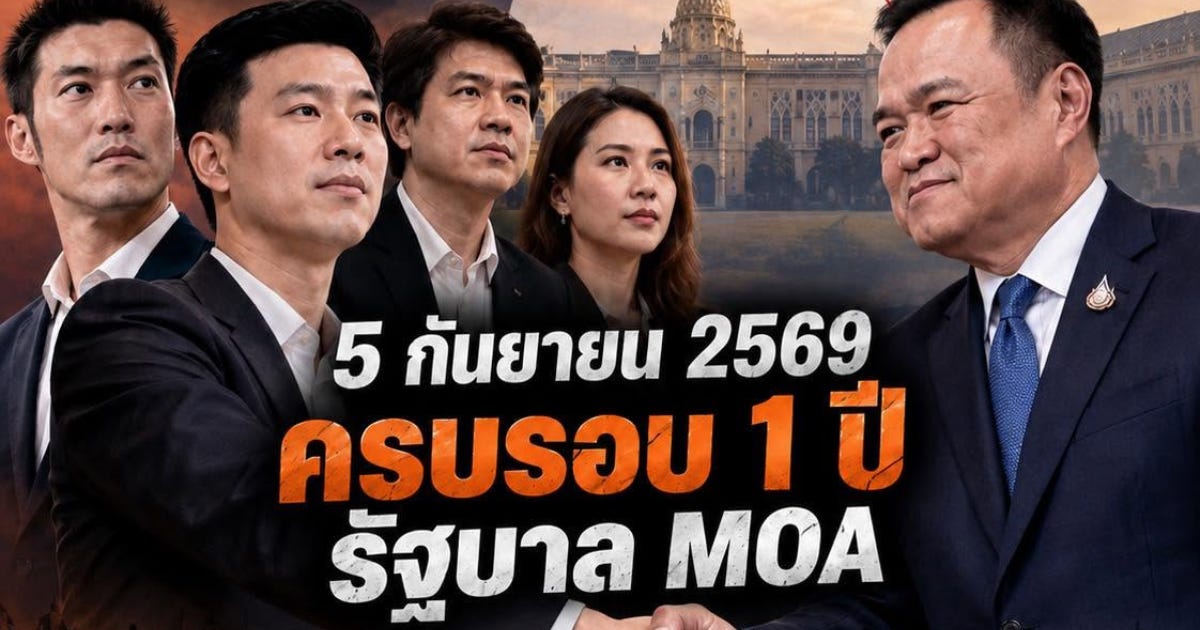
The deal between the People’s Party and Bhumjaithai to form a government marked its first anniversary on September 5, 2026. Photo courtesy from Nattawut Saikuea
Kunravee Sukhimoke | September 14, 2026
BANGKOK – “The Senate-rigging and Khao Kradong cases are becoming hot issues in society,” Nattawut Saikuea, a former adviser to the Pheu Thai family, wrote on his personal Facebook page, looking back at political developments before the People’s Party and Bhumjaithai reached a memorandum of agreement (MOA) to form a government. The Senate election-rigging case was one of the key issues at the center of political conflict at the time.
Before the MOA
The turning point came on August 31, 2025, when Pheu Thai negotiated with the People’s Party to form a government, proposing Chaikasem Nitisiri as prime minister and offering a condition to “cooperate in accelerating legal proceedings in the Senate-rigging case and the Khao Kradong land case.”
Just a few days later, on September 3, the People’s Party announced an MOA with Bhumjaithai. On September 5, all 143 People’s Party MPs voted to support Anutin Charnvirakul as prime minister, making Bhumjaithai the core of the government while the People’s Party chose to become the opposition.
As political power shifted, so did the case
During the government led by Paetongtarn Shinawatra, the Senate-rigging case was pursued more seriously. Evidence was collected and the case was sent to the Department of Special Investigation (DSI) for examination. Phumtham Wechayachai, who was then deputy prime minister and had previously served as chairman of the DSI board, and Pol. Col. Tawee Sodsong, the justice minister and vice chairman of the DSI board, played roles in overseeing the agencies responsible for the case. (Also Read: Thailand’s Allegations of Senate Election Collusion Raise concerns Over Democratic Legitimacy and Freedom of Expression)
After Anutin became prime minister in September 2025, senators petitioned the Constitutional Court against Phumtham and Tawee, accusing them of interfering with the DSI’s work.
As for the case itself, the 26th inquiry committee, jointly formed by the Election Commission (EC) and the Department of Special Investigation (DSI), had initially recommended legal action against 229 suspects. However, in December 2025, the number of suspects whose case files the DSI forwarded to prosecutors on money-laundering charges fell to just eight. Meanwhile, some witnesses retracted their statements.
These changes raised the question of whether the Senate-rigging case might have progressed further had the People’s Party not cleared the way for Bhumjaithai to form the government.
What about Pheu Thai?
After disappearing from the spotlight for almost a year, the Senate-rigging case returned to public attention after iLaw made public case files compiled by the EC and DSI.
Wiroj Lakkhanaadisorn, deputy leader and party-list MP of the People’s Party, called on Pheu Thai to “look forward” and work together to address the alleged rigging of the Senate election.
“The party that pushed the investigation into the Senate election-rigging and is likely to know more than the People’s Party is Pheu Thai, because the investigation into the rigging began with Phumtham, and there was also an investigator like Tawee Sodsong. Pheu Thai has the most information about the Senate-rigging case. It was the party that pushed for and initiated it.”
Chuwat Rerksirisuk, a news analyst and program host, said bringing Pheu Thai’s role back into the discussion was an attempt to “deflect” attention from the People’s Party’s decision, particularly on the first anniversary of the government.
Chuwas said the People’s Party was shifting responsibility for the formation of the Bhumjaithai-led government back to Pheu Thai, “gaslighting” the public into seeing the government as the result of Pheu Thai’s mistake, even though Pheu Thai’s role in the Senate-rigging case had already ended.
“Hoping to get Pheu Thai to help bring down Bhumjaithai is not going to happen, and is unlikely. Pheu Thai’s role has already ended. And I don’t think fighting the Senate-rigging issue again would be good for Pheu Thai, because when Pheu Thai had power, it did not hesitate to deal with the issue. But when it no longer had power... it did not obstruct anyone from pursuing it.”
Phumtham Wechayachai, a member of Pheu Thai’s executive committee and a party member, also posted on X, saying the People’s Party had no right to demand that Pheu Thai return to pursuing the Senate-rigging case after previously rejecting cooperation with Pheu Thai to form a government.
Phumtham said that if the People’s Party had chosen to support Chaikasem Nitisiri as prime minister at the time, Pheu Thai would have dissolved parliament immediately and proceeded with both the Khao Kradong and Senate-rigging cases.
“We did it, but you chose not to join us. Why are you asking us to do it again?”
Note: The EC is scheduled to vote on Monday, September 14, 2026. Civil society groups are calling for legal action against all 229 suspects without exception. iLaw said that if the EC decides not to pursue legal action against any individual, it will make information concerning that person public. It has also called for a final public gathering on Sunday, September 13, 2026, in front of the Bangkok Art and Culture Centre.