


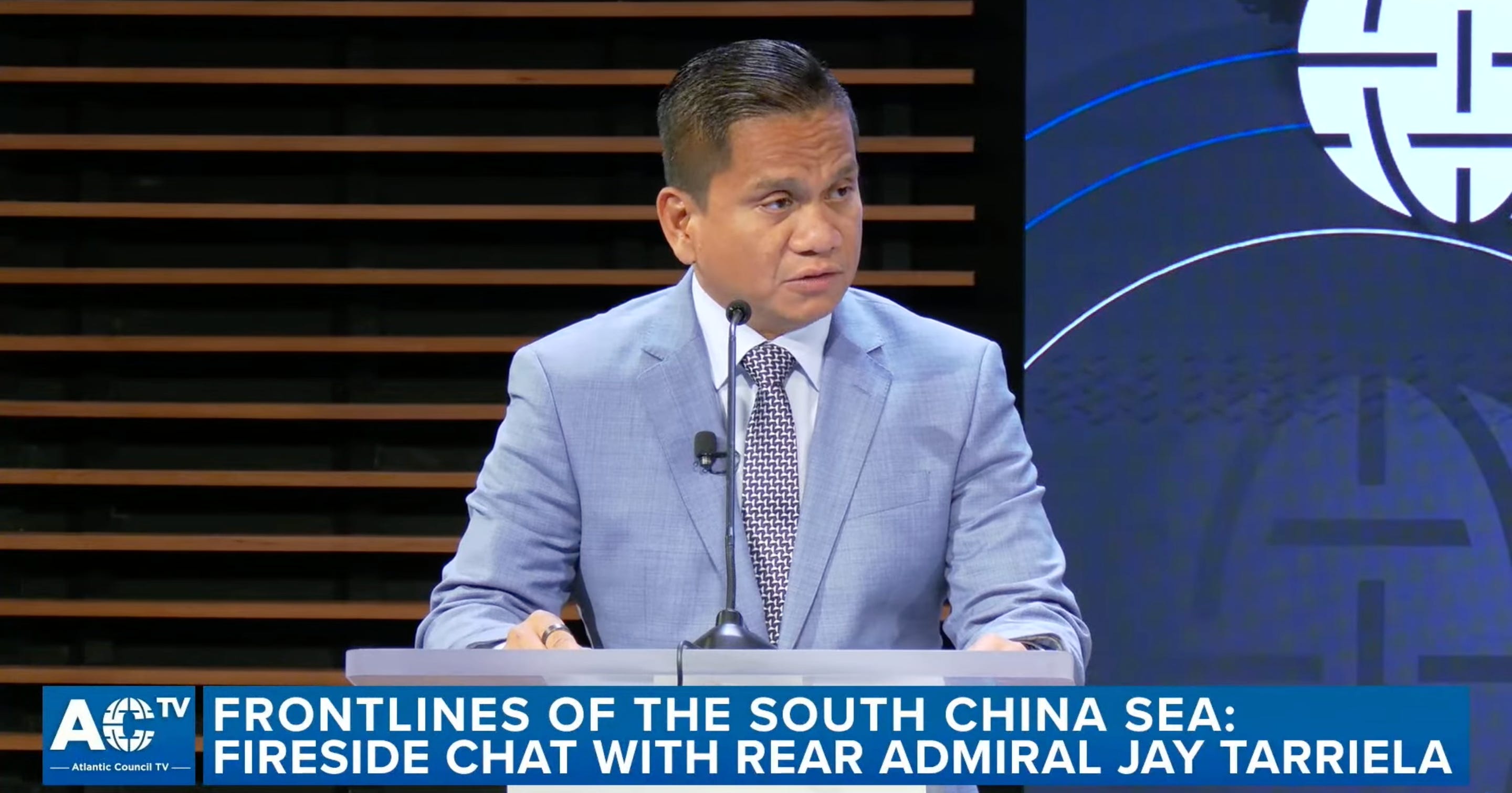
Screen grab from Atlantic Council’s fireside chat last Friday, June 26, 2026.
Rodney J. Jaleco | June 28, 2026
WASHINGTON D.C. — Philippine Rear Adm. Jay Tarriela said yesterday that while Chinese water-cannon attacks on Filipino ships and fishermen appears to have abated the last six months, it’s been replaced by China’s “wolf warrior diplomacy” that’s expanded confrontations to the arenas of diplomacy and international law.
Tarriela, who’s been the point of the spear in the Philippines’ transparency efforts in the West Philippine Sea, was guest speaker at the Atlantic Council “fireside chat” on the South China Sea yesterday.
He traced Chinese aggression to a laser-pointing incident in 2023 that quickly deteriorated to ramming Philippine vessels, using water cannons on government supply crafts as well as fishing boats, and a knife attack that wounded a Filipino serviceman. (Also read: Philippines rejects China’s sovereignty claim on West Philippine Sea)
He argued that the nature of the confrontation in the West Philippine Sea has evolved. Instead of the frequent physical incidents that dominated headlines in 2023–2025 the contest is increasingly being fought through information campaigns, public messaging, and diplomatic exchanges.
When Tarriela and other Philippine officials refer to “wolf warrior diplomacy,” they are using a term commonly applied to China’s more assertive and confrontational diplomatic style.
In recent months, exchanges between the Philippine Coast Guard and the Chinese Embassy in Manila have become highly public, with both sides accusing the other of spreading misinformation and escalating tensions.
China propaganda has zeroed in on the 2016 UN arbitral ruling that dismissed its sweeping claims over the South China Sea, especially in the Philippine Exclusive Economic Zone. It frames the ruling as “null and void” and “political manipulation” arguing the tribunal abused the United Nations Convention on the Law of the Sea (UNCLOS). (Also read: China Rewriting Maritime Rules)
Tarriela said China’s latest tack can be attributed more to the Philippines hosting this year’s ASEAN leaders’ summit and what he saw as China’s grudging acknowledgment of the effectiveness of the Philippine transparency campaign, rather than an actual policy change in Beijing. (Also read: The Philippines as ASEAN Chair Should Build Bridges of Cooperation Through a Code of Conduct in the South China Sea)
He noted that some ASEAN countries that had previously shied away from criticizing Chinese aggression in the South China Sea are starting to react, albeit more subdued and cautious.
Malaysian Prime Minister Anwar Ibrahim has empasized friendly bilateral relations with China, the country’s principal trading partner. But he has drawn “red lines” on energy projects off Sarawak after Chinese Coast Guard ships have been frequently spotted in the area.
Anwar has stated that Malaysia will not bow to Beijing’s demands to halt these oil and gas exploration projects. Kuala Lumpur maintains that the sites fall strictly within its recognized maritime territory and EEZ.
China’s nine-dash line territorial claims overlap not only parts of the Philippines but also Malaysia (Sabah and Sarawak), Indonesia (Natuna Islands), Vietnam, and Brunei. Beijing has since added a dash (ten-dash line) that covers all of Taiwan and extends further west to parts of India. (Also read: Thinking out of the box)
Tarriela said the Philippines has no choice but to be more assertive compared to its ASEAN neighbors. Its proximity to Taiwan and strategic location as a gateway to the Pacific — China’s ultimate goal — mean the country is directly in Beijing’s crosshair.
