


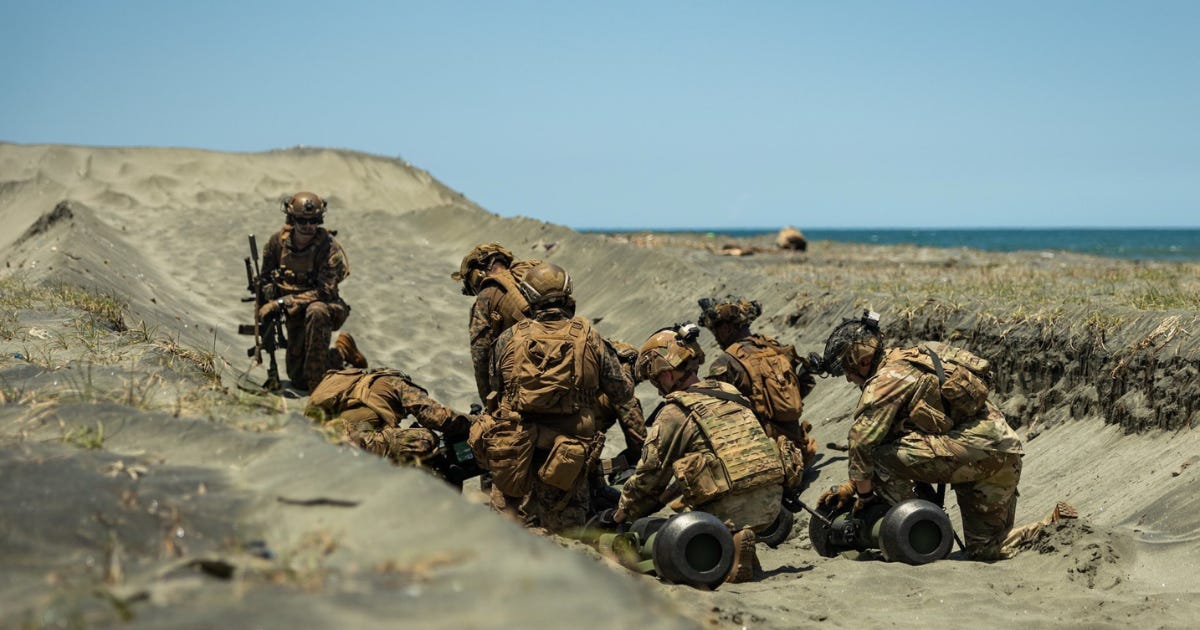
U.S. and Philippine forces conducting a live-fire exercise in Aparri, Cagayan, in northeastern Luzon during the Balikatan exercises last May 7, 2025. Photo by U.S. Marine Corps photos by Cpl. Malia Sparks.
By: Manuel Mogato | Published: July 15, 2025
When Ferdinand Marcos was elected president in May 2022, he immediately transitioned the Armed Forces from counterinsurgency to external defense, abandoning his predecessor’s military campaign to decimate the Maoist-led New People’s Army (NPA) guerrillas.
It was a step in the right direction.
The twin insurgencies were almost over, and the 220,000-strong National Police could take over the law and order functions with its regional mobile force and the elite Special Action Force (SAF), both trained in combat.
Rodrigo Duterte did not want to abandon the military’ anti-rebel mission, demonizing the already weakened Communist rebels because he was too afraid to confront China, which stepped up its presence and activities in the West Philippine Sea.
Duterte was a lackey of Beijing, distancing from Washington, which supported its former colony and oldest ally in the region with training, equipment, and exercises.
Marcos, on the other hand, was not afraid. He wanted to challenge China and prove to the world that a small state can stand up against a superpower, asserting rights over might.
In June 2023, Marcos appointed Gilberto Teodoro Jr, a lawyer who understood how to strengthen the country’s defenses against a bully.
In six months, Teodoro revised the military’s wish list of equipment and capabilities to build a minimum credible defense.
It is something a hostile state should think twice before launching an attack on a small state, like the Philippines. It could certainly hurt them if they try.
Together with the new vessels, aircraft, unmanned drones, missiles, and command-and-control equipment, Teodoro unveiled a concept – the Comprehensive Archipelagic Defense.
Teodoro asked military planners to develop it into a strategy and eventually operationalize the Comprehensive Archipelagic Defense into a campaign plan, similar to what it has been doing to defeat internal security threats under Campaign Plan “Kapanatagan” under Duterte.
Before Teodoro came in, the military had a campaign plan “Pagkakaisa”, borrowing from Marcos’ campaign slogan of unity.
But a more active campaign plan was needed to mirror the military’s shift to external defense operations, “Tatag Kapuluan.”
The three services – Army, Navy, and Air Force – immediately crafted implementing plans (Implan) to operationalize “Tatag Kapuluan.”
It reflects the military’s shift from internal to external defense operations, defending the entire archipelago and strengthening strategic chokepoints.
The Air Force unveiled an integrated air defense and missile plan, the Army is reinforcing its coastal defense mission, while the Navy borrowed a 2012 strategy to create a “one-theater” concept nationwide.
But a full transition to an external defense force is not complete without abandoning its counterinsurgency mindset.
The Armed Forces is still an anti-insurgency military with nearly a dozen territorial infantry divisions and a mobile Special Operations Command and smaller armored and artillery units.
It’s about time the Army cuts its territorial units and plow back resources to sustainment of equipment, like armored vehicles, artillery, and coastal missile defense.
It was also high time for the Armed Forces to create “joint operations” allowing Army soldiers to operate coastal and air defense systems, freeing the Navy and Air Force to do more on their distinct maritime security operations.
The Philippines must learn from the United States in creating “multi-domain” forces, removing the intra-service rivalry in procuring equipment, assigning officers to key positions, and jockeying for ranks.
The Philippines is a maritime country with a coastline longer than the United States, but, in its almost 100-year history, only one naval officer was installed as chief of staff.
General Rodolfo Biazon was not even a sea dog. He was an infantryman as a Marine.
The Air Force was luckier to have at least five generals appointed as chiefs of staff from Pelagio Cruz to Eduardo Oban.
The Philippines needed more aircraft and vessels to guard its maritime zones and deter an assertive China, which is attempting to change the status quo in the region by ignoring the 2016 landmark legal victory of the Philippines in an arbitration court in the Hague.
The tribunal’s decision nullified China’s nine-dash-claim claim and ordered Beijing to allow local fishermen access to a traditional rich fishing ground at Bajo de Masinloc.
The Philippines marked the 9th anniversary of the historic arbitration victory, which China chose to ignore, a clear violation of the international laws and the rule of law.
China’s insistence on controlling Bajo de Masinloc has escalated tensions with ship ramming, water cannon incidents, and dangerous maneuvers.
Bajo de Masinloc has become a regional flashpoint that disturbs and worries Japan, a security partner after it recently ratified a status or forces agreement, known as Reciprocal Access Agreement (RAA).
In March, Japanese Defense Minister Gen Nakatani proposed to visiting US Defense Secretary Pete Hegseth to consider declaring the South China Sea, East China Sea, Taiwan Straits, and the waters around the Korean Peninsula as one theater.
It means an incident in one the body of water could be seen as action in one area that needs response.
In a way, Japanese aircraft and vessels will have an expanded scope of operations together with the United States.
The Philippines can be dragged into action because of its treaty commitment and obligation under the 1951 Mutual Defense Treaty.
In case the Philippines agrees to the Japanese one-theater concept, the Navy’s one-theater operations would expand to include Taiwan Strait and Northeast Asian waters.
It was unclear if the one-theater proposal was taken up by the foreign ministers of Japan, the Philippines, and the United States when they held a trilateral meeting or at the sidelines of the annual ASEAN Foreign Ministers’ meeting in Kuala Lumpur last week.
The foreign affairs department is lukewarm to the proposal but the defense department and the armed forces wanted it.
Japan is offering to transfer six old destroyer escorts and the US promised four second-hand Coast Guard boats to boost the Philippines’ deterrence capability.
The Philippines must rethink its navy’s one-theater operations, if it wants to expand beyond the West Philippine Sea.
It might stretch its already limited capabilities. It is in the middle of transitioning to full external defense.
The Navy and Air Force must concentrate on developing their external defense capabilities, invest on modern platforms, including drones and missiles, rather than worrying about other flashpoints.
The Armed Forces must credibly defend the Philippines first.