

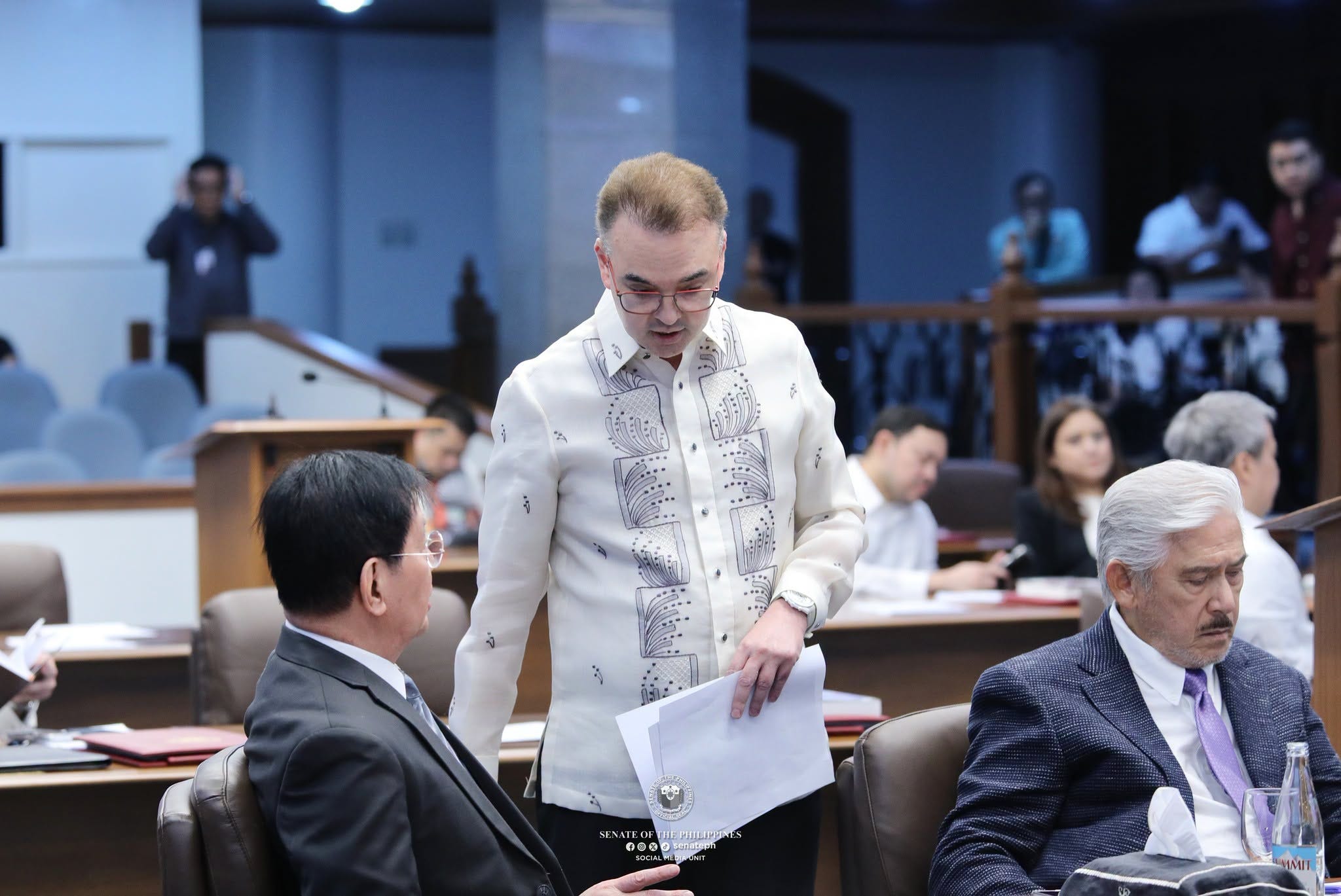
Ousted Senate President Alan Peter Cayetano approaches Minority Bloc members Senators Panfilo “Ping” Lacson and Vicente “Tito” Sotto III during the plenary session last May 26. Senator Sherwin “Win” Gatchalian became Senate president pro tempore last Wednesday, June 3. Photo by Senate Social Media Unit.
Rommel Banlaoi | June 8, 2026
MANILA — Crisis has once again engulfed the Philippine Senate. The declaration of vacancies in all leadership positions and the installation of Senator Sherwin Gatchalian as acting Senate president, despite Alan Peter Cayetano’s refusal to step down, has thrown the chamber into turmoil. This domestic dispute is a direct challenge to the stability of our democracy and the security of our nation, with implications that reverberate internationally.
The political turmoil deepened during the recent Blue Ribbon Committee hearing, where Cayetano’s bloc defied the suspension of Senate business and proceeded with an inquiry into flood control anomalies. Senator Pia Cayetano presided over the session, administering oaths to 18 former Marines who alleged the delivery of suitcases of cash linked to corrupt projects involving high officials in government. The hearing was conducted without a Senate secretary or stenographers, further underscoring the institutional breakdown and contested authority within the upper chamber. (Also read: Authorities arrest a senator for corruption)
At the core of this dispute lies a constitutional question: what constitutes a legitimate majority?
The Constitution requires thirteen votes to elect or remove a Senate president. Yet the new majority insists quorum can be defined differently, citing the 1949 Avelino v. Cuenco ruling. Such legal gymnastics may serve immediate political interests, but they erode the rule of law. When constitutional provisions are bent to suit factional convenience, institutions lose credibility. When institutions lose credibility, the state itself becomes fragile and allies abroad begin to question the Philippines’ reliability as a democratic partner.
The senate crisis comes at a critical juncture. The Senate is preparing to try the impeachment case against Vice President Sara Duterte. Leadership disputes cast doubt on whether the chamber can conduct the trial with fairness and impartiality. If the impeachment process is perceived as manipulated, public trust will erode further. In a country already weary of political theatrics, this erosion of trust risks fueling instability and delegitimizing the very mechanisms designed to resolve conflict peacefully. For the international community, this raises concerns about the Philippines’ ability to uphold democratic norms and remain a credible voice in regional security dialogues.
From a national security perspective, the implications are serious. The Philippines faces escalating tensions in the West Philippine Sea, persistent insurgencies, and the growing menace of transnational crime. (Also read: Philippines loses bid for a non-permanent seat in the powerful UN Security Council)
A Senate consumed by internal strife cannot provide the legislative oversight and policy direction needed to strengthen national resilience. Political elites must realize that their actions reverberate beyond the halls of Congress. A weakened Senate diminishes the state’s capacity to respond to threats, leaving the nation vulnerable and undermining collective defense arrangements with allies who depend on Manila’s stability.
Malacañang’s recognition of the new majority adds another layer of concern. While executive endorsement may stabilize one faction, it risks compromising the independence of the legislative branch. The separation of powers is the safeguard against authoritarian drift. When the executive openly validates contested leadership in the Senate, the balance of power envisioned by our framers is endangered. For international observers, this signals a dangerous erosion of checks and balances, raising alarms about democratic backsliding.
The implications for political stability are also alarming. If the Senate remains divided, legislative priorities will stall. Economic recovery measures, social welfare programs, and national defense initiatives will be sidelined. The public, already skeptical of political elites, will lose confidence in government’s ability to deliver. This erosion of trust creates fertile ground for populist backlash, further destabilizing the political landscape. International investors may withdraw, and regional allies may question the Philippines’ reliability in joint security efforts.
The Senate must, therefore, resolve its leadership dispute through constitutional means, securing the requisite thirteen votes to establish legitimacy. Senators must recommit to their legislative mandate, placing national interest above factional loyalty. Civil society, the media, and the international community must hold both the Senate and the executive accountable, ensuring that democratic norms are not sacrificed at the altar of expediency.
The Senate has survived crises before during martial law, post-EDSA transitions and various corruption scandals. Its resilience lies in its ability to rise above partisan conflict and serve as a forum for national deliberation.
Today, that resilience is being tested once again. The outcome will determine not only the fate of Vice President Duterte’s impeachment but also the credibility of Philippine democracy itself and its standing in the global community.
The Senate must choose as either to be an arena of partisan strife or a pillar of democratic stability.
If this crisis drags on unresolved, the risks extend far beyond politics. A paralyzed Senate will weaken our ability to respond decisively to pressing challenges in the West Philippine Sea, undermine ongoing counterinsurgency operations, and embolden criminal networks that thrive on institutional dysfunction. The inability to pass legislation, allocate resources, or provide unified oversight leaves critical national security concerns exposed. In short, political instability at the highest levels of government translates directly into national vulnerability, eroding both deterrence and resilience.
Beyond immediate security threats, prolonged paralysis corrodes public trust in democratic institutions. Citizens may grow disillusioned with governance, creating fertile ground for populist movements or extremist groups to exploit frustration. Economic confidence could falter as investors perceive instability, while regional allies may begin to question the Philippines’ reliability in collective defense arrangements. Such doubts can weaken security partnerships, complicate diplomatic negotiations, and diminish Manila’s credibility in multilateral forums.
In this way, the Senate crisis transcends domestic politics: it becomes a systemic challenge that reverberates across defense, diplomacy, and development, undermining the country’s standing in the international community. If the present crisis is not resolved immediately, it could eventually erode the very foundation of our national security, thereby driving our nation to unwanted collapse with consequences that extend far beyond our borders.
Rommel C. Banlaoi, PhD, is a political science practitioner, national security advocate and President of the Philippine Society for International Security Studies.