


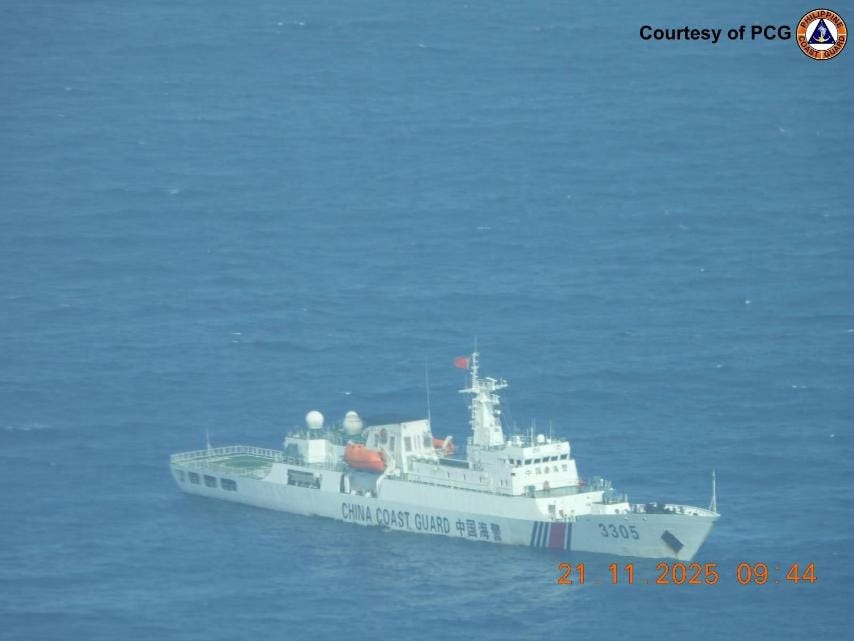
File photo of a Chinese Coast Guard vessel in Bajo de Masinloc. Photo from Philippine Coast Guard.
Manuel Mogato | June 2, 2026
MANILA — The Philippines has been looking into “raw” reports that China has built a structure on Bajo de Masinloc, a clear violation of an informal code of conduct signed in 2002 in Cambodia, Manila’s defense secretary said.
Gilberto Teodoro Jr. said the Armed Forces of the Philippines (AFP) and the Philippine Coast Guard have sent patrols to check on the latest developments after satellite images showed a structure near the mouth of the shoal. (Also read: China blocks Bajo de Masinloc with floating barriers)
“There is raw information and, as I have always said, Bajo de Masinloc is a dynamic area,” Teodoro told journalists at the Shangri-La Dialogue in Singapore.
“So even if the developments are still small, these are already being monitored.”
Under Article 5 of the 2002 Declaration of Conduct of Parties in the South China Sea, claimant states are prohibited from occupying uninhabited features and building structures on features. (Also read: Philippines rejects China’s protest on construction activities in South China Sea)
“These are raw information; we are still checking,” Teodoro said.
The military only reported that Chinese military and coast guard vessels continued to have a presence within the country’s maritime zones, with about 36 Chinese vessels operating in four key areas.
Of the total, 19 vessels, composed of 10 People’s Liberation Army Navy warships and nine China Coast Guard vessels, were monitored near Bajo de Masinloc.
The remaining vessels were spotted near Ayungin Shoal, Escoda Shoal and Pag-asa Island.
Retired Rear Admiral Roy Vincent Trinidad, a government spokesman, said the sustained presence of Chinese vessels is part of Beijing’s strategy. (Also read: Philippines rejects China’s sovereignty claim on West Philippine Sea)
“The presence in Bajo de Masinloc is there to normalize the situation as they have already declared a nature reserve,” Trinidad said.
“These are all illegal statements; these are false narratives which we have been pushing back against. Rest assured, the AFP will continue monitoring the situation and performing our actions of patrolling the seas and flying the skies,” he said.
Trinidad said China has maintained a constant presence in the disputed waters. “We do not speculate on their presence, or why they are there. What is important is that their presence is still illegal,” he said.