

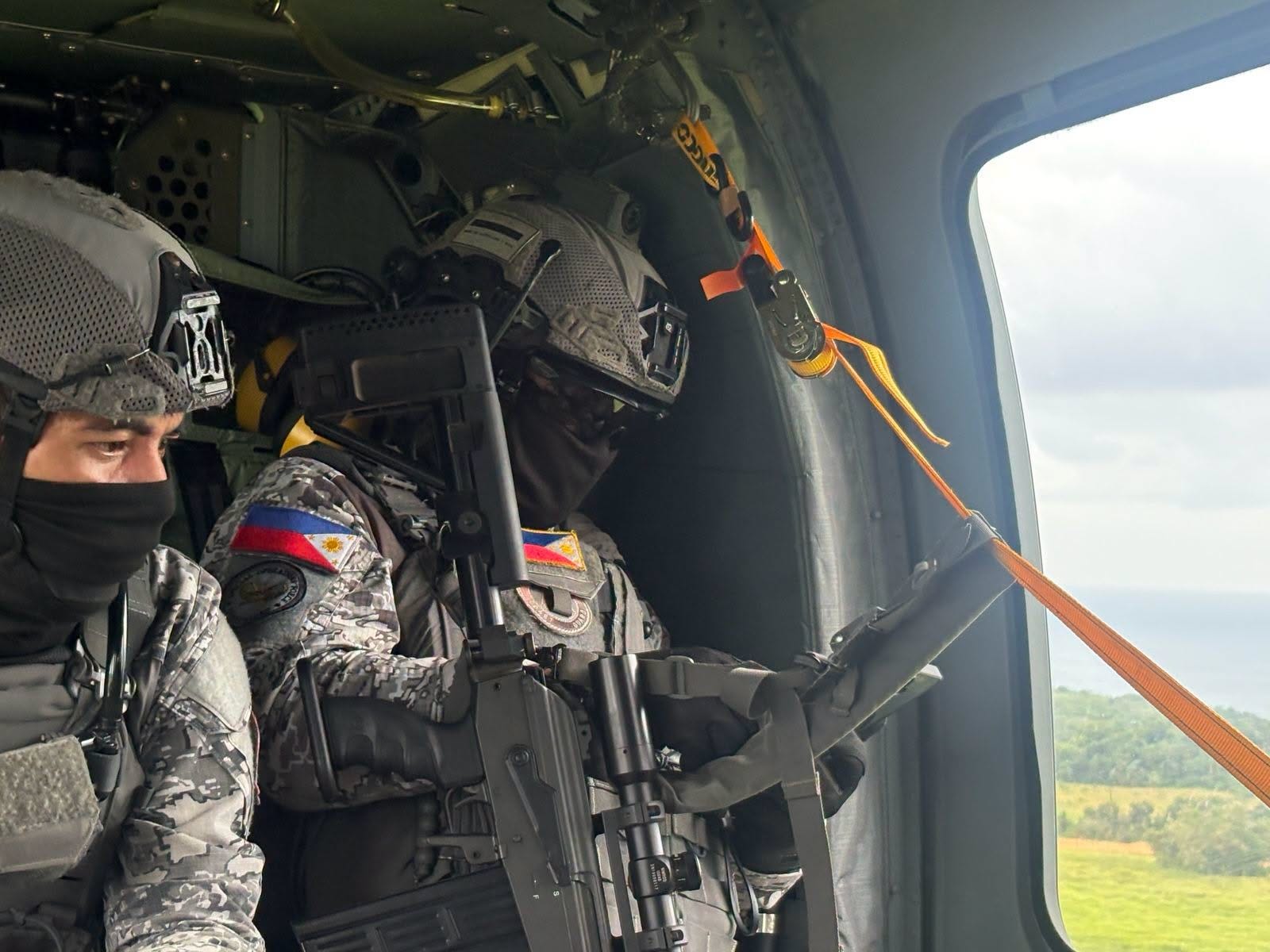
Joint Special Operations Forces preparing for an aerial insertion during the simulated Maritime Key Terrain Security Operations North at Fuga Island on November 21, 2026. Photo by Armed Forces of The Philippines
Joe M. Reyes | November 26, 2026
MANILA — The Armed Forces of the Philippines tested its ground, air, and maritime combat readiness by holding simultaneous military exercises in some parts of the archipelago, a spokesman said.
Army Colonel Xerxes Trinidad said hundreds of troops waded onto beaches on a northern island as paratroopers dropped from the skies to simulate retaking an island from imaginary hostile forces.
In a coordinated tactical and operational maneuver on Fuga Island in northern Luzon, Army, Marines, and Air Force personnel practiced a three-phased operation to seize and secure an island, Trinidad told journalists as the military held a wide-scale DAGITPA exercise in northern Luzon
“The exercise tested the military’s capability to secure key maritime terrain through coordinated joint operations,” Trinidad said, adding troops seized an airfield to enable the arrival of follow-on forces, then an amphibious assault came to establish a foothold on the island, and, an island defense was established to prevent hostile forces from gaining access.
Trinidad said the local armed forces deployed several naval vessels, amphibious assets, aircraft, and unmanned aerial systems to demonstrate their ability to insert troops.
The troops also rehearsed aerial and amphibious assaults as well as intelligence, surveillance and reconnaissance (ISR), and integrated defense operations, he added.
Trinidad said the combined Maritime Key Terrain Security Operations-North (MKTSO-N) exercise strengthened the local military’s ability to secure strategic maritime locations, establish a defensive position, and support follow-on joint forces in the defense of Northern Luzon.
In a nearby northern province, the air force demonstrated how to repel airborne threats using three-dimensional radars, detecting and tracking aircraft, drones, and missiles, and shooting them down with air defense missiles. (Also read: Teodoro pushes for technology-driven exercises.)
Trinidad said the air defense exercises were part of DAGITPA exercises, testing the Israeli-made Surface-to-Air Python and Derby (SPYDER) air defense system.
“The exercise tested the military’s ability to detect, track, and intercept simulated airborne threats through coordinated operations involving joint air and surface assets,” he added.
“The exercise was also meant to validate operational procedures, enhance interoperability among participating units, and further strengthen the integrated air and missile defense capabilities,” Trinidad said.
While testing air and missile defenses, Marines and Army units rehearsed counter-landing drills with live fire at the same area in Burgos, Ilocos Norte.
“The exercise tested the military’s ability to detect, stop, and defeat simulated enemy amphibious landing operations before hostile forces could establish a foothold on Philippine territory,” Trinidad said. (Also read: Philippines, allies practice how to repulse amphibious assault landing)
He said the drill involved “coordinated operations” among land, naval, and air forces, and was supported by surveillance, intelligence, artillery fires, armor direct fires, and infantry capabilities.
The exercise also included evacuation of civilians safe, and simulated mass-casualty response.
Down in Palawan, the military conducted a simulated Gas and Oil Platform (GOPLAT) Take-Down exercise in El Nido, Palawan, as part of the Defense of the West Phase of the ongoing AFP Joint Exercise DAGITPA.
The AFP’s Joint Special Operations Forces (JSOF) together with command and control personnel and participating members from Western Command took part in the drills.
It involved coordinated operations utilizing Multi-Purpose Attack Craft (MPAC), a Philippine Coast Guard vessel (MRRV 4411), a Rigid-Hull Inflatable Boat (RHIB), SOKOL and Blackhawk helicopters.
The simulated operation tested the participating forces’ ability to secure an offshore platform, neutralize hostile threats, rescue hostages, and conduct medical evacuation.